New To This...

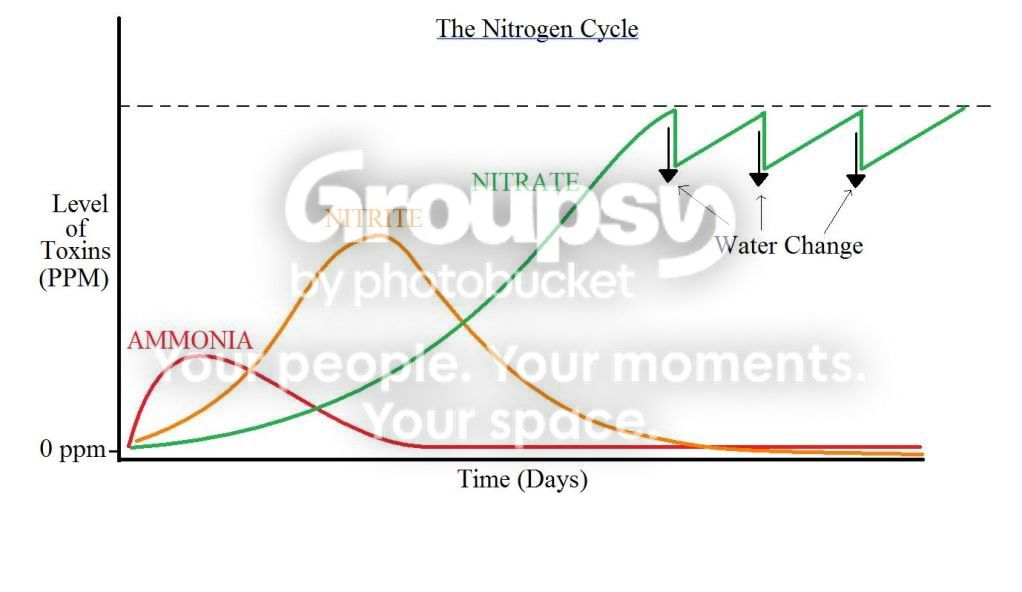
Here is a little graph I made of how the nitrogen cycle plays out.
Untitled-1.jpg


-FHM
 
The type of algae eater I have is this one here: [URL="http://myfishtanks.info/wp-content/uploads...algae_eater.jpg"]http://myfishtanks.info/wp-content/uploads...algae_eater.jpg[/URL] and even if it does outgrow, I should soon be getting a 20 gallon tank to replace my 10 gallon tank sometime soon. Before Winter is planned.
Your algae eater is a Gyrinocheilus aymonieri: they have the potential to grow to 30cm if very well looked after, but in a tank as small as yours, they will be stunted which is harmful to their health. Stongly advise that you find someone with a much larger tank to take them in for you.

A 20 gallon will be a great improvement with your current stocking, the sooner the better! When you do get the new tank, run your old and new filter *both* on it for about 4-6 weeks before you take the old one out and do not add any new fish until you have taken the old one out.

With tetras and other common fish that are classified as beginners, you said the PH should be 7.0? What's a decent range out of curiosity for safe-keeping?
Not all tetras are beginner fish! :P With tetras, 6.0-7.2ish is fine for most species, other "common community" species usually need about 6.8-7.5ish. I can't be very precise as it differs greatly for different species.

How can I prevent Nitrite and Nitrate?
Nitrite by having a cycled (or matured) filter, lots of good comments above regarding this.
Nitrate by having plants and/or doing water changes. Nitrates (basically) = plant food.

Also, about the peas. I've seen videos of people just feeding their fish peas. Just regularly cooked peas the way people would eat peas at dinner. Does this make a difference or should they get peeled? (Obviously size is notable for small fish, but it's the skin I'm asking about.)
Most common beginner community fish will not be able to cope with the skins, while larger fish obviously can.

Also, between the Danios and the Betta (Siamese Fighting), would they still be a safe tank for all these fish or should I immediately make this transaction? What concerns me is... A few things actually. First things first. I had a Molly earlier today. It was also pregnant. Though, it passed away. It was in a breeding tank, and it started freaking out on me last night. Rolling around on the bottom of the breeder, diving toward the gravel, etc. I wasn't sure if it was going to give birth finally, or if it was just signs of stress. So I decided to let it out not willing to take the risk. Though, it sank right to the bottom. The Betta ended up going down, and snapped at the Molly. After that I immediately put her back in the breeding tank for safe keeping. Though, this morning she wasn't doing to healthy and a few hours after I noticed that, she passed away. Telling that story got rid of two concerns of mine at once. The third concern of mine is that my guppy is missing a piece of his tail as well. The part of the tail that fans out and makes it look all shiny and pretty has a nice chunk/hole in it now. I'll try to get a picture of this if I can to describe what I mean. I'm not sure how that happened exactly, but I immediately suspected the Male Betta or the Zebra Danios.
You should remove the male betta immediately to a different heated tank. If you mean your molly was in a breading trap/box/floating thing then the male betta may be temporarily be put into there while you find somewhere better.
If you want to keep the male betta over the female, then a good solution would be if you were to take the female, the algae eater and the red eye tetra back to your fish shop and replace them with two danios (same as you already have) as that might probably solve the problem with the guppy being munched. (Of course, the best solution would be to take them and the guppies back and not replace with anything.)
To prevent the guppy from getting finrot, you should get a general tonic/anti-bacterial medication and follow the instructions.

[quote post='2544907' date='Sep 22 2009, 06:40 PM']Gilli, it says that page isn't available. But thanks. What do you mean is it cycled? I don't believe it is... What is cycling and what does cycling do?[/quote]
Plenty of information in the posts above, but my favourite way to describe it is "where do you think all the cow crap goes?"

I really have no idea how to cycle a fish tank though...
My favourite way: the fishless, shrimp as source of ammonia way

Miamisportsfan45 said:
I didn't cycle my fish tank, does this mean that my fish will die?
Not if you pay attention to what we say and do lots of water changes. Try to keep ammonia and nitrite readings below 0.25ppm if you can by doing water changes.. if you haven't got a test kit yet, you will probably be ok for the moment if you do 30% at 6 hour intervals, and feed every other day, just enough so that they do not start starving.

Miamisportsfan45 said:
I read that link that was sent, I still don't understand how to cycle a fish tank or what it is... Can anyone help?
See above, lots of good information there.. but it would really help if you could find someone with an established fish tank and borrow some filter media from them. Even asking your fish shop for some water which is left over from filter cleaning would be better then nothing. Even some gravel will do.

If you haven't bought water tests yet, I strongly recommend that you do.
 
Most of the water in my aquarium (before I replaced it - started cycling it) was from the water from Walmart and Petsmart. I trust Petsmart far more then Walmart however.
 
Most of the water in my aquarium (before I replaced it - started cycling it) was from the water from Walmart and Petsmart. I trust Petsmart far more then Walmart however.
When we cycle a tank, we are not necessarily cycling the water. Instead, we are trying to grow beneficial bacteria that process ammonia and nitrite. These beneficial bacteria colonize in our filters, NOT in the water.

So, the water you added to your tank that you got from walmart and petsmart, really did nothing, as water contains less then 0.1% of the bacteria that grow in your filter.

Also, it is not good to add water from fish shops directly into your tank.

Here is a link on how to properly acclimate you fish to your tank.

http://www.liveaquaria.com/general/general...eral_pagesid=19

-FHM
 
So basically...

Ammonia doesn't turn into Nitrite on its own? It only turns into Nitrite if the beneficial bacteria is being produced from the filter? Same goes for Nitrite to Nitrate, too?

Though, removing old water and putting in new water, gets rid of all three (Ammonia, Nitrite, AND Nitrate as well) of these?

Edit: Minnow, the link you sent me is sort of what I did. I sat the bag in the water for 10-15 minutes, then opened the bag, dipped the opened part into the aquarium water so that some water went in, then lifted it back out, and repeated. Repeated it multiple times, then just poured the whole thing into the aquarium.
 
So basically...

Ammonia doesn't turn into Nitrite on its own? It only turns into Nitrite if the beneficial bacteria is being produced from the filter? Same goes for Nitrite to Nitrate, too?

Though, removing old water and putting in new water, gets rid of all three (Ammonia, Nitrite, AND Nitrate as well) of these?

Edit: Minnow, the link you sent me is sort of what I did. I sat the bag in the water for 10-15 minutes, then opened the bag, dipped the opened part into the aquarium water so that some water went in, then lifted it back out, and repeated. Repeated it multiple times, then just poured the whole thing into the aquarium.
Use a net to scoop the fish out when you get to this stage.

As for cycling, you almost have it down! lol

When there is ammonia in a tank, which there always is when you have fish, a certain type of bacteria grow in our filters, because they live off of ammonia. Ammonia is their food source. When these bacteria eat the ammonia, the ammonia then turns into nitrite. This is the only way nitrite gets into your tank! Then a second type of bacteria will begin to grow in our filters when nitrite becomes available. This is because this second type of bacteria eat nitrite, nitrite is their food source. When they eat nitrite, the nitrite turns into nitrate. At this point, there is no bacteria that live to eat nitrate, so the only way to get nitrate out of the water is through a water change.

When you start up a new tank, this whole process does not take place right away, because there are not enough of the first type pf bacteria in your filter to eat all of the ammonia. But, over time, as long as there is an ammonia source in your, which there always will be if there are fish in your tank, these first type of bacteria will begin to grow more and more and more in your filter to eat all of the ammonia in your tank. When they do this, like I said above, ammonia then turns into nitrite. (This first step takes weeks). The second step is, now since nitrite is becoming more and more available in the tank, (Due to the first step/type of bacteria), the second type of bacteria begin to grow (along side the other type of bacteria already in your filter), and these guys eat the nitrite. When nitrite is being processed by these little guys, like i said above, nitrite becomes nitrate. (It takes weeks for the second part to fully take effect as well.)

Now, when there is enough of the first and second type of bacteria in your filter, they will process ammonia to nitrite, and nitrite to nitrate so fast that if you take a reading of ammonia or nitrite in your tank, the results would be 0 ppm.

At this point, if you take a reading of nitrate in your tank, you will see that the nitrate level is starting to slowly rise. The only way to get nitrate out is to do a water change. That is why, once you are cycled, you must do weekly water changes of like 10-20%.

Where are you right now?

You are at the point in the cycle where you are trying to grow enough of the first type of bacteria to eat the ammonia. Since you do not have enough of this type of bacteria in your tank, the current bacteria are not physically able to eat all of the ammonia. Lets say this. Say you have 5 of the firs type of bacteria, and you have 10 units of ammonia. Those 5 bacteria can only eat 5 units of ammonia at once, leaving you will 5 units of ammonia still in the tank. These 5 units of ammonia will stay there until more bacteria colonize in the filter. As long as there is an ammonia source, more than the current bacteria population can handle, your little bacteria friends will reproduce offspring to eat the current level of ammonia.

After you have enough bacteria to constantly (Because your fish are constantly producing ammonia) process all of the ammonia in your tank. Your ammonia reading, when you test your water, will read zero. At this point, you will be dealing with the second step of the cycling process, and that is growing enough of the second type of bacteria to eat the nitrite, and turn that into nitrate.

I hope this clears things up for you?

Remember, we are here to help! So ask all the questions you need!

-FHM
 
Let me respond little by little... lol. I'm a slow learner, sorry. =/ haha. But... Alright...

So... Ammonia is ONLY produced by fish breathing, waste being fish urine and... well... fish "waste", and old food, correct? Anything I missed? A certain type of bacteria grow in our filters, called beneficial bacteria. Ammonia is the food source of beneficial bacteria. Do I have to have ammonia in the tank to get the beneficial bacteria to grow into the filter? The only way you get nitrite is when beneficial bacteria eat the ammonia, right? Otherwise, Nitrite won't be in your tank, only ammonia would be and it'd be building up, correct? Bacteria eats the nitrite, which becomes Nitrate which isn't toxic to fish unless it's in high quantities, right? The only way to get rid of nitrate is with water cycling or changing the water, or with plants that feed off of the nitrate, right? Didn't think I saw that in your above post but I remember reading it somewhere...
 
Let me respond little by little... lol. I'm a slow learner, sorry. =/ haha. But... Alright...

So... Ammonia is ONLY produced by fish breathing, waste being fish urine and... well... fish "waste", and old food, correct? Anything I missed? A certain type of bacteria grow in our filters, called beneficial bacteria. Ammonia is the food source of beneficial bacteria. Do I have to have ammonia in the tank to get the beneficial bacteria to grow into the filter? The only way you get nitrite is when beneficial bacteria eat the ammonia, right? Otherwise, Nitrite won't be in your tank, only ammonia would be and it'd be building up, correct? Bacteria eats the nitrite, which becomes Nitrate which isn't toxic to fish unless it's in high quantities, right? The only way to get rid of nitrate is with water cycling or changing the water, or with plants that feed off of the nitrate, right? Didn't think I saw that in your above post but I remember reading it somewhere...

CORRECT :good: You sound like a fish keeping pro ;) (decaying plant matter (leaves, roots whatever) ALSO produces ammonia)

You would have had to manually add ammonia to your tank if you were doing a fish-less cycle, but it's too late for that. Your fish will be producing all the ammonia now.

If you have got a water testing kit, have a go at testing the water that comes right out of your tap. You'll find that it contains small amounts of ammonia, nitrite, nitrate etc.

The beneficial bacteria that are growing inside the foam in your filter are found in tap water and water pipes. You're just giving them a good home inside your filter.

Do a test of your tank water for us asap please. Ammonia is lethal to fish and will cause permanent damage to their gills.
 
I can do the test, but right now all I have are test strips which my parents bought when they were going to set up a 50 gallon aquarium and gave up due to not knowing all of this information and not being motivated to find time to squeeze learning in and research it. I can test the water using those test strips, however.

I'll soon be getting a 20 gallon fish tank instead of my 10 gallon that I have at the moment. When I get that tank up and running, could I cycle that tank using goldfish to produce the ammonia, that my brother would use as feeders anyway? Then as time goes on and the filter adjusts, change it to a tropical fish tank for other fish.

Also, sorry about your previous post asking about the bettas. Didn't really get to respond. Got to distracted by other topics, but they seem to be doing fine. The two bettas are usually on different ends of the tanks and anytime the female betta is near the male, she either flees from him quickly, or hides in/behind rocks and what not. The male betta usually steers clear of the other fish too from what I've noticed. The female however, is always around the other fish from what it seems, and when she's not she's in a rock with about three holes that I have sitting at the bottom. Not many fish can really fit into that rock, but she's just the right size to get in without any problems.
 
Let me respond little by little... lol. I'm a slow learner, sorry. =/ haha. But... Alright...

So... Ammonia is ONLY produced by fish breathing, waste being fish urine and... well... fish "waste", and old food, correct? Anything I missed? A certain type of bacteria grow in our filters, called beneficial bacteria. Ammonia is the food source of beneficial bacteria. Do I have to have ammonia in the tank to get the beneficial bacteria to grow into the filter? The only way you get nitrite is when beneficial bacteria eat the ammonia, right? Otherwise, Nitrite won't be in your tank, only ammonia would be and it'd be building up, correct? Bacteria eats the nitrite, which becomes Nitrate which isn't toxic to fish unless it's in high quantities, right? The only way to get rid of nitrate is with water cycling or changing the water, or with plants that feed off of the nitrate, right? Didn't think I saw that in your above post but I remember reading it somewhere...

Yes, you are getting it!

Do I have to have ammonia in the tank to get the beneficial bacteria to grow into the filter?

Yes, the beneficial bacteria's food source is ammonia. No ammonia = No bacteria = ammonia build up = extremely unhappy/died fish!

What you need to do now, like stated above and in the message I sent you, is to go out and buy a Liquid test kit. Since you live in the US, you should be able to pick up an API Fresh Water Master Test kit from Petsmart for around $30. This will last you for some time and it is a MUST for good fish keeping! In the test kit, you will be able to test for Ammonia, Nitrite, Nitrate and pH in your tank! When you test these levels, the results will show you how much of what ever you tested is in your tank.

Ammonia must be as close to zero as possible. Anything over .25 ppm will cause permanent gill damage.

Nitrite must be as close to zero as possible. Anything over .25 ppm will cause permanent nerve damage.

Nitrate is okay to about 40-50 ppm.

Your test kit will show you what level each are at when you test your water.

If any ammonia, nitrite or nitrate is over the level I said above, you must do an immediate water to bring that certain level down.

So, get a test kit, and then post the results up here. We will then guide you through the next steps!

-FHM

I can do the test, but right now all I have are test strips which my parents bought when they were going to set up a 50 gallon aquarium and gave up due to not knowing all of this information and not being motivated to find time to squeeze learning in and research it. I can test the water using those test strips, however.

I'll soon be getting a 20 gallon fish tank instead of my 10 gallon that I have at the moment. When I get that tank up and running, could I cycle that tank using goldfish to produce the ammonia, that my brother would use as feeders anyway? Then as time goes on and the filter adjusts, change it to a tropical fish tank for other fish.

Also, sorry about your previous post asking about the bettas. Didn't really get to respond. Got to distracted by other topics, but they seem to be doing fine. The two bettas are usually on different ends of the tanks and anytime the female betta is near the male, she either flees from him quickly, or hides in/behind rocks and what not. The male betta usually steers clear of the other fish too from what I've noticed. The female however, is always around the other fish from what it seems, and when she's not she's in a rock with about three holes that I have sitting at the bottom. Not many fish can really fit into that rock, but she's just the right size to get in without any problems.


Are you going to be getting a new filter as well? If so, you can do a fishless cycle on your 20 gallon. In a fishless cycle, you can go out and buy ammonia in a bottle at a local hardware store. The you can use that ammonia to mimic the ammonia produce by fish by pouring a certain amount of ammonia in your tank and waiting until the bacteria grow.

If you are going to use the same filter that is on your 10 gallon tank, then just simply swap the filter over to the 20 gallon tank form the 10 gallon tank.

-FHM
 
Thanks, I appreciate all the help. I think I got it now. I hope. haha. Would I be able to use goldfish that would be feeders anyway to produce ammonia for another tank setup?
 
Thanks, I appreciate all the help. I think I got it now. I hope. haha. Would I be able to use goldfish that would be feeders anyway to produce ammonia for another tank setup?


I can do the test, but right now all I have are test strips which my parents bought when they were going to set up a 50 gallon aquarium and gave up due to not knowing all of this information and not being motivated to find time to squeeze learning in and research it. I can test the water using those test strips, however.

I'll soon be getting a 20 gallon fish tank instead of my 10 gallon that I have at the moment. When I get that tank up and running, could I cycle that tank using goldfish to produce the ammonia, that my brother would use as feeders anyway? Then as time goes on and the filter adjusts, change it to a tropical fish tank for other fish.

Also, sorry about your previous post asking about the bettas. Didn't really get to respond. Got to distracted by other topics, but they seem to be doing fine. The two bettas are usually on different ends of the tanks and anytime the female betta is near the male, she either flees from him quickly, or hides in/behind rocks and what not. The male betta usually steers clear of the other fish too from what I've noticed. The female however, is always around the other fish from what it seems, and when she's not she's in a rock with about three holes that I have sitting at the bottom. Not many fish can really fit into that rock, but she's just the right size to get in without any problems.


Are you going to be getting a new filter as well? If so, you can do a fishless cycle on your 20 gallon. In a fishless cycle, you can go out and buy ammonia in a bottle at a local hardware store. The you can use that ammonia to mimic the ammonia produce by fish by pouring a certain amount of ammonia in your tank and waiting until the bacteria grow.

If you are going to use the same filter that is on your 10 gallon tank, then just simply swap the filter over to the 20 gallon tank form the 10 gallon tank.

-FHM
 
I'll probably be setting up two separate aquariums. Somebody I know told me that he can just give me a 20 gallon tank to use, as well as a bunch of other things he said he has, such as a filter, a heater, thermometer, whatever it may be, once he gets his house cleaned out. He used to have an angel fish for 2 months apparently. So I could just use two separate filters. But since my brother buys goldfish as food for his snake often anyway. I figured I could save on the ammonia by doing this. Especially since his fish will end up dying/being eaten anyway.
 
I'll probably be setting up two separate aquariums. Somebody I know told me that he can just give me a 20 gallon tank to use, as well as a bunch of other things he said he has, such as a filter, a heater, thermometer, whatever it may be, once he gets his house cleaned out. He used to have an angel fish for 2 months apparently. So I could just use two separate filters. But since my brother buys goldfish as food for his snake often anyway. I figured I could save on the ammonia by doing this. Especially since his fish will end up dying/being eaten anyway.

I guess it is up to you then.

I would highly recommend doing a fishless cycle, but if you really don't care about the life of a gold fish, then I guess you can use a gold fish to cycle you next tank.

I am not going to judge you differently if you use a gold fish to cycle a tank, and not worry about it dying. That is your choice. I am just here to guide you along the way! :good:

So yes, goldfish, or any fish for that matter, can be used to cycle a tank.

Here to help!
-FHM
 
I think doing the fish-in cycle is a lot of work (water changes, constant monitoring, etc). I wish I had found this website BEFORE I found the one suggesting using Danios to cycle a fish tank.
 

Most reactions

Back
Top