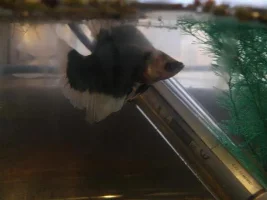
Hey, I'm new to this forum as well as everything about starting an aquarium. I just recently got my aquarium up and running, and I want my fish to be treated as best as possible, and be taken care of properly as best I can with my own effort and what's affordable to me. So I decided to join this website and create a topic here for discussion to get tips and advice from the experts instead of just trying to gather research from multiple sites that seem to have been contradicting one another.
Like I've said, I'm new to the entire setting of keeping and taking care of aquarium fish. With that being said, I basically have little to vague ideas as to what I'm doing. However, I'm willing and eager to learn and become better if not expert at this. I've really got no experience or background in this at all. So any help and tips given and provided would help greatly, and be honorably appreciated.
Hello and welcome! It's great that you've come here. We'll try to help out as much as possible!
As of right now, I have a 10 gallon tank with many fish in the aquarium. The fish that are currently in my aquarium are: 1 Betta (Siamese Fighting Fish), 1 Female Betta, 3 Flame Tetras, 1 Red Eye Tetra, 4 Zebra Danios, 2 Guppies (1 male, 1 female), 1 Algae Eater.
Personally, I think you are overstocked. That means you have too many fish - sometimes a tank will settle down and mature in such a way that you can keep all of them, and sometimes you'll need to rehome some or get a second/bigger tank.
Firstly - never keep two bettas together, male or female. They will fight. You could keep a group of 4+ girls or one male, but not fewer girls and not a mix of males and females. NEVER keep two males together unless you are happy to run the very real risk of one or both of them being torn to shreds.
Secondly - Danios actually get quite big - 2 inches each when adult. They don't stay teeny forever. I would have the danios or the tetras. To be entirely honest, I wouldn't put tetras in a tank as small as 10 US gallons. They move fast and need quite a bit of swimming space, despite being small fish. The danios also should idealy have at least one or two more members for the shoal.
Thirdly - the tetras should to be in shoals of 5+ fish of the same species. Different tetras may shoal together but they are much happier with their own kind.
The algae eater will probably get far too big for your aquarium, if it is the kind I think it is. I would consider rehoming. Having a bottom feeder or algae eating fish isn't necessary - some pet stores will tell you it is essential but as long as you keep your tank clean and don't leave the lights on too much, or overfeed your fish, you shouldn't get too many algae problems. Most algae eaters (except for ottos) get fairly big.
Finally - both tetras and danios are fin nippers, so expect both your guppys and your fighters to have bits missing from their fins at some point. I wouldn't keep guppys and fighters in with either kind of fish, having had to nurse my first fighter back to health after his nipped fins developed fin rot.
Since I'm a beginner at this, I tried to buy "beginner fish" so that I could learn as I go. As well as fish that would possibly breed so that as fish get older and pass on I don't have to invest even more into that particular fish species itself to repopulate and keep my tank looking beautiful.
A single fish may live for many years (bettas - 2-5 years, tetras - about 5 years, etc) and so they will have produced more babies than you'll know what to do with before they die - especially the guppys! They'll breed every few weeks and you'll be overrun. Honestly, it'd be cheaper to get new fish every few years than to buy all the equipment needed to keep and maintain the fry.
What do the things on the test strips mean and how do the differentiate when affecting fish?
The test strips will test for things like ammonia, nitrite, pH and nitrate. The box should tell you which the strips test for.
Ammonia is in fish pee and it is very toxic to them. This needs to be kept as low as possible - even a reading of 0.25 means there is a harmful level in the aquarium. You'll need to test for this everyday and change as much water as necessary to get it under 0.25 again. It will climb very fast with all those fish in your tank! Remember - don't do 100% water changes. It is better to do several smaller water changes (up to 70/80% each max) than to do a 100% water change, as the sudden change in water chemistry can shock your fish, potentially even kill them.
Nitrites are what you get when ammonia is broken down. This is a good thing, but nitrites themselves are still very toxic. You'll need to test for that as well and to keep doing the water changes.
pH should be about 7. It can be as low as 8.5 and as high a 6, but 7 is a good middle pH suitable for most fish. Many fish won't like high or low pHs, and extreme pHs can kill. pH shock is a big killer so when you introduce new fish or do big water changes, only add a little new water at a time and get them used to it before you put them in the tank/add the rest of the water. It's quite tricky to change water pH so your best bet is to check the pH and then make sure you buy fish that are suitable, rather than buying the fish and trying to change the pH.
Nitrites are the final stage of ammonia break down. It is much safer for fish. Try to keep it below 40, but fish can generally tolerate nitrates as high as 60, or 80. Sometimes higher. While you are still getting ammonia and nitrite readings, and thus while you are doing lots of water changes (don't worry, that won't go on forever), you won't need to worry about nitrates too much. However, once you stop getting ammonia and nitrite readings above 0 for over a week, you'll know your tank is (for the time being) biologically stable and so you should be doing at least a 25% water change every week to keep nitrates down. Before you change the water, do a full set of tests and if you see ammonia or nitrites creeping up, start doing more regular water changes until it calms down again.
What's a good temperature for keeping my fish alive and active in my aquarium?
For a mixed community like yours, I'd say about 77. The danios actually cope in cooler water, although they are fine in tropical tanks, and the fighters are happy with temperatures up to 82. Don't let it get colder than 74, and pick a temperature and stick to it. Temperature fluctuations can actually kill fish.
I've heard about people feeding peas to their fish... How and why?
I'm not sure about all fish, but peas act as a laxative for bettas. It makes them poop a lot and generally clears out their system. As bettas a prone to constipation, many betta keepers feed a pea once a week to keep everything hunky-dory. The pea needs to be cooked, soft and have the skin removed, then cut up and fed a piece at a time. Most bettas won't need more than about 1/4 or a pea at any one time.
Thanks, I appreciate everything. I bought the guppies of each gender, intending to breed them. They're really colorful looking fish, but I don't want an aquarium consisting of only guppies. I was hoping to be able to mix various fish together to make it look like an entertaining and interesting aquarium. Looking at the same species of fish after so long is too plain, and can get really boring. I do however have a breeding tank that I bought when I purchased a Molly that happened to be pregnant... Although she passed away today and this is one of three incidents that has me concerned.
As I said, they'll breed like rabbits. If you don't want too many babies, just leave the fry in the main tank and you might get a few survivors but nature will keep your population low. What do you mean by a breeding tank? A proper tank or a plastic/cloth tub you float in the main tank?
The Bettas I was intending to breed as well, though, I was primarily ONLY breeding to keep the females in that tank. Any males that resulted out of that, from what I was planning, were to be given to friends and family, or even sold to local pet shops if at all possible, due to the fact that males fight.
Betta breeding is pretty specialist. You'll need a spawning tank (this can also be used for the fry) and then as they get bigger, all the males will need seperate tanks as they will fight, even when too young to sell. Sometimes you can get 100+ males in a spawn - do you have the space for this? Just letting them breed as and when and leaving the fry in the main tank isn't really an option, either. The bettas won't breed like the guppys do - it's a much more stressful process for them and if you don't want dead parents, for you. The male and female must be split up until they are ready to spawn. To be honest, it's not simple. You'd do better to focus on your main tank and think about betta breeding in a year or so when you are more experienced and know that you have the time and money to dedicate to it.
A good thing to buy in general is a smaller tank (only needs to be about 2.5 US gallons given the fish you have) for a hospital tank. Diseases can devastate entire aquariums if sick fish are not isolated and treated. Just to check - you do have a filter and heater, right?
GOOD LUCK!
Please ask if you would like something explained and you're welcome to PM me with some questions =)



 /myfishtanks.info/wp-content/uploads...algae_eater.jpg

 /www.fishforums.net/index.php?showtopic=277264
 to TFF!!!!