Ask Questions About Cycling

Had a question, I am creating a mini pond in my backyard 30gal~ and was wondering how I would go with cycling it. Here in Rocklin it is still very hot at around 94 f today and steady the whole week. Should I still go with the regular routine of putting fish food etc?
Thanks, Deniz
 
This is from Dr. Hovanec's site:

Using shrimp or fish food​


One of the more popular fishless cycling methods is to buy a few dead shrimp at the grocery store, cut them up into chunks and add them to the aquarium. The shrimp decay, which produces ammonia to feed the nitrifying bacteria. There are a few drawbacks with this method, one being that the hobbyist really has no way to know how much ammonia is being produced by the decaying shrimp, and the aquarium does not look very good with dead shrimp laying on the bottom. Also, the organic material of the shrimp can cause bacteria blooms which turn the aquarium water cloudy. This method works but it takes time and patience and you will probably see a spike in ammonia and nitrite if you add a medium to heavy load of fish after the initial cycling. Note that some people use flake fish food instead of shrimp but this is not recommended because flake food does not have much organic material compared to shrimp and so does not add a lot of ammonia to the water, but you can use cut fish instead of shrimp. Hint: to speed up the decay of the shrimp/fish and produce more ammonia, add some DrTim’s Aquatics Waste-Away sludge busting bacteria to the tank.


Using ammonium chloride​


This is the other most popular way to cycle a fishless aquarium. Simply add chemical ammonia to the aquarium water and let the process cycle. The benefits of this method are that the tank does not cloud up with a bacteria bloom and you don’t have to look at an aquarium with dead cut up shrimp or fish on the bottom. Plus you can somewhat accurately determine the amount of ammonia being added to the tank.


There are two ammonium chloride products on the marker
y that allow one to add "drops per gallon" to produce a known level of ppm in a tank:
Dr. Tims Ammonium Chloride and Fritz's Fishless Fuel. Both use the same dosing. There is one consideration when using either product.

There are two different scales used to measure the nitrogen complex. You can read about this here https://www.hamzasreef.com/Contents/Calculators/NitrogenIonConversion.php

Basically, the scientific community uses the Nitrogen scale but, most of the hobby test kits use the Total Ion scale. The lonk above gives the conversion formulas. This is not a real big deal is is much like converting miles to kilometers or vice versa. The two products above use the Nitrogen scale.

The products will tell you that 4 drops/gallon produce 2 ppm pf ammonia. However, this is one the nitrogen scale. To convert this to the Total Ion scale I use a conversion factor of 1.28. So 2 ppm x 1.28 means on an API type test kit the reading would be 2.56 ppm. I worked out that conversion number because it takes into account that when ammonia (NH3) is added to tank, it turns mostly into ammonium (NH4).

If you are not sure about any of the above, shoot me a site PM and I will be happy to help you. O get an email from here when I am sent a PM. Bear in mind that, if you use live plants, they use NH4 but they do not create either nitrite or nitrate as a result.

 
The nitrite in my tank is still the same. Hasn't budged in a week and a half. Last night I took the prefilter sponge from my cycled tank and put it in the uncycled tank's filter basket. Still no change this morning.

I set up the 10g tank one day after the 20g, and that one cycled in a week. I don't understand the difference. I did all the same things as far as ammonia and the Micro-Lift. Both are planted with driftwood. I have gravel and sand in the uncycled tank and Eco-Complete in the cycled tank. That is the only difference.

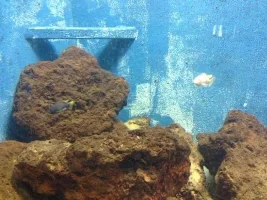
The driftwood and rocks in the uncycled tank appear to have a ghostly-looking film around them. Should I be concerned or hopeful?
 
I do not know Micro-Lift when I tried searching for it I learned here is something called Microbe-Lift. They make several products. If this is what you meant can you tell us which product of their's you used.

Using fish food as indicated above is not the best thing to do since you cannot control ammonia with it. So you can set up two tanks and add fish food and get different results.

Next, plants use ammonium. But all plants are not equal. The best indication of how much ammonium a plants might use has to do with how fast it normally grows. Faster growing pants use nutrients faster than slower growers. A second consideration is the mass of plants in a tank. What this means is, all things being equal, more plants mean faster use of ammonium.

Then there is the need for new plants to settle in. Depending on a number of factors this can take more or less time. I normally suggest to people trying to "cycle" a tank with plants involved are best served by planting and then giving the plants about 2 weeks to settle in before adding anything for the microorganisms. Most commercially grown plants or plants in a healthy established tank store nutrients. So, these normally do not need ferts during this settling in period. They will use what they have stored.

My point here is that one cannot assume that your two tanks which appear to be getting the same things may not be equal. This becomes more true the smaller the tanks involved is.

When I am cycling and want to seed bacteria etc. by getting it from the media I have in established tanks I do this by removing the foam media from filters and rinsing them out in the new tank. The media goes back into the filter from which I took it.

Finally, ther are all sorts of bacteria microorganisms which might be in what is called a solution which helps establish a cycle. many do not have in them what will end up in our tanks after the cycle. I usually only suggest one use Dr. Tim's One and Only or Tetra's Safe start as they contain the nitrite bacteria that end up in a cycled tank. This is because those bacteria have been patented and cannot be used in other products. So such products use a different bacteria which mostly not be there when the cycle is complete. They die off and get replaced by the proper ones.

Plants use nitrate when they cannot get ammonium. However, they do not use nitrite. Plants also host the microrganisms that do that. But, they are not in big amounts. So, what you have is a situation where the amouns of ammonia bacteria present are making nitrite but it takes time of nitrite oxidizers to appear. the fewer plants there are using ammonia means the more bacteria is at work and that means more nitrite. However, whatever amount of the nitrite bacteria you do have is able to make nitrate. But the plants may be using it.

So, ammonia/ammonium is being used by plants and microorganisms which are producing nitrite. But uintil you develop enough nitrite converting bacteria, nitrite hangs around. However, any of them you do have will be making nitrate which the plants will use. So, it is may be hard to test for nitrate as the plants may be using it as fast as it is being created.

In order to know why one has the reading they do for ammonia etc. it helps to have a basic knowledge of how it all works. It took me some time to figure it all out. My very first cycle was happening with fish in the tank. After that every tank was done fishless. Over time since I had to set up and take down tanks every summer and then I began selling fish born in my tanks or purchased at events so I started to cycle filters in a bio-farm instead of individual tanks. This allowed me to get filters ready in 10-14 days and then I could move them into a new tank and fully stock it the same day.
 

Most reactions

Back
Top