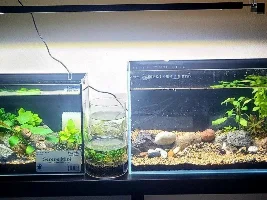
Water testing.

Swampman1

Fish Fanatic
Joined
Feb 13, 2020
Messages
70
Reaction score
39
Points
18
Location
Chicago Suburbs
Hi Is there a real way to test for nutrients in the water? I'm dosing my tanks when I change water every week. 20% every other week and 60% every other week. I have co2 in two tanks. One has a high output light. I'm getting a bit of BBA. I do test the water for the usual problems. My Phosphates are 30% Which I am using Clearmax in the filter to get rid of it. I would like to find out how fellow aquarist dose their tanks. Thanks
 
Is the 30 in ppm? Most hobby phosphate kits stop at 10, so I wouldn't trust a reading that high much.

I'd take the ClearMax out of the CO2 tanks either way. Plants under strong light and CO2 go through a lot of phosphate, and stripping it out tends to leave them weak, which is when BBA gets a hold. In CO2 tanks BBA follows the CO2 more often than the fertiliser: levels that swing through the day, or dead spots with poor flow.
Yeah it's 10ppm. So Phosphate is alright for the tank. CO2 creates BBA? I thought it was the opposite. I do have a sponge filter in the corner. Just to keep water flowing. I'll take out the Clearmax. See what happens in a couple three weeks. What about fertilizer dosing? Thanks so much for the info.
Is the 30 in ppm? Most hobby phosphate kits stop at 10, so I wouldn't trust a reading that high much.

I'd take the ClearMax out of the CO2 tanks either way. Plants under strong light and CO2 go through a lot of phosphate, and stripping it out tends to leave them weak, which is when BBA gets a hold. In CO2 tanks BBA follows the CO2 more often than the fertiliser: levels that swing through the day, or dead spots with poor flow.
 
Other way round, steady CO2 keeps BBA down. What it takes advantage of is CO2 that runs low or swings up and down through the day. If that sponge filter is air driven and sits in one of the CO2 tanks, the bubbling gasses CO2 off while the lights are on, so I'd put it on a timer to run only at night. When does your CO2 switch on compared to the lights?
 
Other way round, steady CO2 keeps BBA down. What it takes advantage of is CO2 that runs low or swings up and down through the day. If that sponge filter is air driven and sits in one of the CO2 tanks, the bubbling gasses CO2 off while the lights are on, so I'd put it on a timer to run only at night. When does your CO2 switch on compared to the lights?
Very interesting. I have the co2 on one hour before lights and one hour off before lights off. I have bubbler on all the time. Thanks I'll fix it up now.
 

Most reactions

Back
Top