Suspected fish Tb in my tanks

Fishlover1N

New Member
Joined
Aug 28, 2022
Messages
38
Reaction score
42
Points
18
Location
Saturn
Over the course of nearly 2 years my fish have been slowly dying, one by one. I tried every medication and tested my water constantly. They had a wide range of symptoms such as wasting, rapid breathing, red sores, white lumps, loss of colour, inflamed gills, fry with very stunted growth and one instance of a curved spine. I was trying to ignore it since I really didn't want it to be fish tb. The main effected tank now has 4 alive fish who are seemingly healthy, but I'm not sure how long they will live.

The problem is that at least 5 of my other tanks have been 'infected'. Since I moved a plant or even a fish between tanks before I realized what was happening. Should I just get rid of all the tanks? I put a betta in one of the potentially exposed tanks and it lived about 9 months before dying suddenly of dropsy. I don't know wether to add new fish to this tank since I'm not sure if it's tb...
 
TB is trouble, but chronic with some fish. So the first question is what fish do you have?

The second question is what's your water chemistry?

These elements may sound unconnected, but they matter if anyone is going to be able to help.
 
TB is trouble, but chronic with some fish. So the first question is what fish do you have?

The second question is what's your water chemistry?

These elements may sound unconnected, but they matter if anyone is going to be able to help.
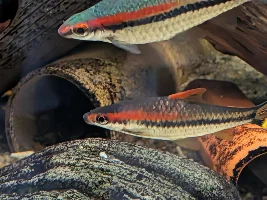
The remaining fish are 2 ember tetras, 1 panda garra (hitchhiker) and 1 daisy's ricefish.

Gh: 8 kh: 4
Temp: 24 Celsius
Ammonia: 0 nitrite: 0 nitrate: 0-5

I've heard how persistent the bacteria can be and I'm considering quitting fishkeeping. Aparently they can even survive out of water and so new tanks can easily become contaminated just through touching a surface.
 
Mycobacter in fish from farms is probably there a lot of the time. It's a contagious disease that thrives in crowding and poor conditions. I get the impression that many farms have taken measures to mitigate it, and I see healthier looking fish coming from southeast Asia recently. It had gotten really bad for a while.
The disease interests me because I caught it 20 years ago - it can transfer across the species barrier as a minor problem. It's cured. You have to be immune compromised as I was when I got it. Under normal life circumstances, like now, I would have fought it off. So it is a consideration beyond what it does to fish.
Let's assume you do regular maintenance, changing 30% of the water every week. If you don't overstock, you can mitigate the effects of tb. The fish will produce cysts to isolate the pathogen internally, and they can hold for years. The disease will always break out, and will shorten their lives considerably. You shouldn't see the outbreak type results you're describing unless you get fish dying in the tank. TB bacteria will flood out of a dying or dead fish, or out of a fish that shows sores. Those fish must be immediately euthanized.
The fish can hold off the disease unless it's hit with a wave of new bacteria after a death.

Obviously, if I caught it, it is in my set up. I still have those tanks, and plants descended from the ones I had then. I no longer keep rainbowfish or hybrid livebearers, both of which can be rotten with it. I avoid buying farmed fish and try to find wild caughts and local hobbyist bred fish. I am religious about maintenance. I haven't observed tb symptoms in any of my tanks for over 15 years now, and fish lifespans have been excellent. I don't doubt it's present - you can't eradicate it. But it's invisible here.

One trick that can help in a single tank is a small UV unit, It kills bacteria that gets into the water column and slows the spread.

It has made people leave the hobby, as it's discouraging. If it's present in your tanks, the problem is real. But it can be managed. It's a plague, and it can go quiet. Flare ups come with new fish from dodgy sources and with slips in basic aquarium care.
Thanks for the reply. If a fish has died in a tank with suspected tb and it's now empty, should I empty the tank and sanitize everything? It all seems very confusing to me since people say most tanks have mycobacterium yet a lot of fish keepers never deal with this issue. Does it shorten the lifespan of most ornamental fish since they are bred in fish farms?
 
It spreads easily on farms, and for a long time, rumoured intense pressure from the large corporate chains to reduce prices led to pressure to reduce standards. I see better fish from the big farms hitting my lfs, with lower disease rates, so something seems, maybe, possibly to have changed. But the major vectors for human tb seem to be places like prisons - it's a disease that thrives in crowding.

It's no use sanitizing for tb. It can survive bleach. But also bear in mind that's hard to diagnose because its symptoms are so varied, and overlap with other fish diseases. Short of learning to do autopsies and spot the cluster of bacteria, you can't ever really be sure of your diagnosis. I take a squared/rectangular lesion on the fish as certain - that's what I got on the back of my hand. Beyond that, as a disease with many faces it can be misdiagnosed easily.

Maybe I'm a bit cowboy here, but I just restart after a 100% water change and assume if I'm getting strong and healthy fish, they may have already fought it off.

A fish that can live 10 years healthy will usually die in 3 to 5 with Mycobacteriosis. It has a serious life shortening effect. For a lot of aquarists who think a 3 year old tetra is ancient, it never shows. The fish dies of overcrowding, lack of water changes, etc, long before it "blossoms". The twisted spines come from an immune response - the fish encysts the bacteria to isolate them internally, but as the cyst grows, in the wrong place it acts like a tumour and presses on the spine. But beyond that, a lot of aquarists don't keep their fish alive long enough to see this chronic disease appear.
 

Most reactions

Back
Top