I have a very well planted 55 gallon with a sunfish in it, granted i did forget to do a water change last week but i tested my water today before doing one and it read 160 ppm on nitrates but 0 on ammonia and nitrites?? im trying to figure out how to take these down but also how it happened? the tank is very well planted as i said and the fish has been looking fine, i also do not over feed as i only feed one worm about every 2-3 days. anyone know how to take it down and prevent it from happened again?

You are using an out of date browser. It may not display this or other websites correctly.
You should upgrade or use an alternative browser.
You should upgrade or use an alternative browser.
nitrate spike
- Thread starter Peatear
- Start date
-
- Tags
- nitrate nitrate removal

How much are you dosing fertilizers?I have a very well planted 55 gallon with a sunfish in it, granted i did forget to do a water change last week but i tested my water today before doing one and it read 160 ppm on nitrates but 0 on ammonia and nitrites?? im trying to figure out how to take these down but also how it happened? the tank is very well planted as i said and the fish has been looking fine, i also do not over feed as i only feed one worm about every 2-3 days. anyone know how to take it down and prevent it from happened again?

Uberhoust
Fish Herder
Nitrates are most effectively removed with water changes. When you do a water change how much are you changing. 160 pp for nitrates suggests that your water change amount is insufficient for the number of nitrates produced by the fish and or added through fertilization, or... something is decomposing in the tank.
I would start with a water change of at least 50% which would drop the nitrates to 80ppm, followed by a second 50% change in a couple days to drop the nitrates to 40 ppm. I have heard of old tank syndrome and fish adapting to higher nitrates, but in my experience, I haven't seen an issue with my fish, but I also haven't had nitrates to 160. Are you sure your water from the tap is low in nitrates.
I always wanted to raise sunfish. My father kept them many years ago in a very large tank and they were very fun to feed, almost like oscars. Do you have any photos?
I would start with a water change of at least 50% which would drop the nitrates to 80ppm, followed by a second 50% change in a couple days to drop the nitrates to 40 ppm. I have heard of old tank syndrome and fish adapting to higher nitrates, but in my experience, I haven't seen an issue with my fish, but I also haven't had nitrates to 160. Are you sure your water from the tap is low in nitrates.
I always wanted to raise sunfish. My father kept them many years ago in a very large tank and they were very fun to feed, almost like oscars. Do you have any photos?
haven’t used them in about 6 monthsHow much are you dosing fertilizers?
i normally do 50% and last night immediately did a 50%, tested the tap water and 0 nitrates or anything. no idea what the issue is but hoping to figure it out. and sunfish are very very fun fish, he’s only about a year old but has a lot of personality. love hand feeding him and seeing how aggressive he is. personally my favorite fish i’ve ever keptNitrates are most effectively removed with water changes. When you do a water change how much are you changing. 160 pp for nitrates suggests that your water change amount is insufficient for the number of nitrates produced by the fish and or added through fertilization, or... something is decomposing in the tank.
I would start with a water change of at least 50% which would drop the nitrates to 80ppm, followed by a second 50% change in a couple days to drop the nitrates to 40 ppm. I have heard of old tank syndrome and fish adapting to higher nitrates, but in my experience, I haven't seen an issue with my fish, but I also haven't had nitrates to 160. Are you sure your water from the tap is low in nitrates.
I always wanted to raise sunfish. My father kept them many years ago in a very large tank and they were very fun to feed, almost like oscars. Do you have any photos?
Attachments
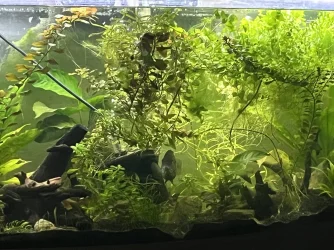
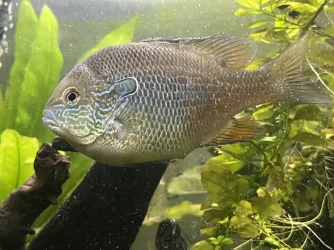
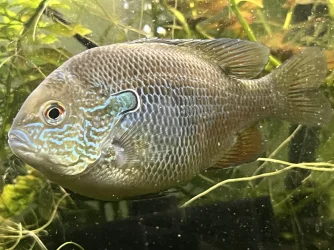
update!! did a 50% water change last night and today it read somewhere between 40-80 ppm, looked closer to 40 but couldn’t tell. planning to do a 25% wednesday or tuesday and hoping that will fix it completelyI have a very well planted 55 gallon with a sunfish in it, granted i did forget to do a water change last week but i tested my water today before doing one and it read 160 ppm on nitrates but 0 on ammonia and nitrites?? im trying to figure out how to take these down but also how it happened? the tank is very well planted as i said and the fish has been looking fine, i also do not over feed as i only feed one worm about every 2-3 days. anyone know how to take it down and prevent it from happened again?
Could it be the testing of the nitrate? I always ask this just in case, are you using a liquid kit or strip kit?update!! did a 50% water change last night and today it read somewhere between 40-80 ppm, looked closer to 40 but couldn’t tell. planning to do a 25% wednesday or tuesday and hoping that will fix it completely
strip kit, is one better than the other?Could it be the testing of the nitrate? I always ask this just in case, are you using a liquid kit or strip kit?
Uberhoust
Fish Herder
My experience is the liquid kit is more accurate but you absolutely have to follow the instructions on shaking one of the reactants aggressively. If you don't treat the reactants correctly the kits will give you a much lower reading than expected. API liquid tests have been the easiest for me to use for Nitrate, I found the Fluval Nitrate test to always read lower than expected. I tested both against a nitrate solution of known concentration.
I am now curious about your nitrate level, if you are doing 50% changes weekly there is no way your nitrates should be climbing to 160 ppm. How large is the fish? Doesn't sound like you are overfeeding, you have some plants to help with the nitrogen cycle, I would be looking for some other source of contamination, substrate, decomposing material...
I am now curious about your nitrate level, if you are doing 50% changes weekly there is no way your nitrates should be climbing to 160 ppm. How large is the fish? Doesn't sound like you are overfeeding, you have some plants to help with the nitrogen cycle, I would be looking for some other source of contamination, substrate, decomposing material...
i’d say he’s about 10 inches, he definitely produces a lot of waste but i don’t see how that would singlehandedly get it THAT high, and i haven’t seen any decomposing material so it may have just been inaccurate i guess? i’ll test it with a liquid kit tomorrow and see what the results sayMy experience is the liquid kit is more accurate but you absolutely have to follow the instructions on shaking one of the reactants aggressively. If you don't treat the reactants correctly the kits will give you a much lower reading than expected. API liquid tests have been the easiest for me to use for Nitrate, I found the Fluval Nitrate test to always read lower than expected. I tested both against a nitrate solution of known concentration.
I am now curious about your nitrate level, if you are doing 50% changes weekly there is no way your nitrates should be climbing to 160 ppm. How large is the fish? Doesn't sound like you are overfeeding, you have some plants to help with the nitrogen cycle, I would be looking for some other source of contamination, substrate, decomposing material...

Just to emphasise Uberhoust's comment
Liquid nitrate testers have 2 or sometimes 3 bottles. One of them contains a reagent which settles out onto the bottom of the bottle. The instructions will say to shake this bottle before use, this is to make sure all the reagent is back in the liquid. Many advise to tap the bottle on the worktop before shaking to break up any lumps.My experience is the liquid kit is more accurate but you absolutely have to follow the instructions on shaking one of the reactants aggressively. If you don't treat the reactants correctly the kits will give you a much lower reading than expected.
Yeah, I use the API liquid test kit. The coloring can be hard to differ from say 30ppm to 40ppm but is a lot easier then a strip. The API strip kit is not very easy to identify, except for the GH and KH tests, which are pretty accurate. Nitrate test can be diffuclt to get right in the liquid test. I memorized all the tests, but the nitrate test sometimes slips my mind, so I then read the instructions to help me remember.Just to emphasise Uberhoust's comment
Liquid nitrate testers have 2 or sometimes 3 bottles. One of them contains a reagent which settles out onto the bottom of the bottle. The instructions will say to shake this bottle before use, this is to make sure all the reagent is back in the liquid. Many advise to tap the bottle on the worktop before shaking to break up any lumps.
Also, how long has your tank be established/cycled?
Uberhoust
Fish Herder
I currently only have one tank running it has been running for 5 years now, its cycle is well established. It is 75 gallons and has 8 angels. I would expect your one 10 inch fish produces more waste than my angels do, the biggest of my angels is only about 6". When I kept multiple tanks I would always start them with a fish in cycle with a lot of plants, and filter media from established tanks.
That said if you have 0 nitrites and 0 ammonia then your cycle is working, nitrate is the final form from the ammonia waste, there are bacteria that can break it down but they are anerobic and trying to encourage their growth can cause other issues. I am not entirely sure how plants help with the nitrates, I have read different points of view on this, but they do seem to lower it.
Sunfish are active fish, they might be able to produce a lot of waste, they are not a typical aquarium fish, you might not be feeding it much but maybe he is eating some of the vegetation, snails. He doesn't look hungry and in total mass of food 3 worms, depending on the size, could actually be quite a bit of food for a 55 gallon tank.
For my tank when I do a water change I actually do 70 to 80% change, usually weekly, I used try to target a nitrate concentration of less than 10ppm but honestly I really don't know because I haven't tested my tank for a couple of years.
What are you using for substrate, I was using aquarium soil at one time and it initially worked quite well but as the tank aged it seemed to elevate my nitrates, I have since moved back to either sand or fine gravel. Large gravel can also be an issue if the food drops into the voids where the fish cannot get it.
Just some thoughts, good luck, you might have to increase your water change routine to keep your fish.
That said if you have 0 nitrites and 0 ammonia then your cycle is working, nitrate is the final form from the ammonia waste, there are bacteria that can break it down but they are anerobic and trying to encourage their growth can cause other issues. I am not entirely sure how plants help with the nitrates, I have read different points of view on this, but they do seem to lower it.
Sunfish are active fish, they might be able to produce a lot of waste, they are not a typical aquarium fish, you might not be feeding it much but maybe he is eating some of the vegetation, snails. He doesn't look hungry and in total mass of food 3 worms, depending on the size, could actually be quite a bit of food for a 55 gallon tank.
For my tank when I do a water change I actually do 70 to 80% change, usually weekly, I used try to target a nitrate concentration of less than 10ppm but honestly I really don't know because I haven't tested my tank for a couple of years.
What are you using for substrate, I was using aquarium soil at one time and it initially worked quite well but as the tank aged it seemed to elevate my nitrates, I have since moved back to either sand or fine gravel. Large gravel can also be an issue if the food drops into the voids where the fish cannot get it.
Just some thoughts, good luck, you might have to increase your water change routine to keep your fish.
would you recommend reducing it to 1.5-2 worms a week? i do see him snacking on snails and plants pretty often. and i use sand for a substrate, black diamond sand specifically, has worked good in both of my tanksI currently only have one tank running it has been running for 5 years now, its cycle is well established. It is 75 gallons and has 8 angels. I would expect your one 10 inch fish produces more waste than my angels do, the biggest of my angels is only about 6". When I kept multiple tanks I would always start them with a fish in cycle with a lot of plants, and filter media from established tanks.
That said if you have 0 nitrites and 0 ammonia then your cycle is working, nitrate is the final form from the ammonia waste, there are bacteria that can break it down but they are anerobic and trying to encourage their growth can cause other issues. I am not entirely sure how plants help with the nitrates, I have read different points of view on this, but they do seem to lower it.
Sunfish are active fish, they might be able to produce a lot of waste, they are not a typical aquarium fish, you might not be feeding it much but maybe he is eating some of the vegetation, snails. He doesn't look hungry and in total mass of food 3 worms, depending on the size, could actually be quite a bit of food for a 55 gallon tank.
For my tank when I do a water change I actually do 70 to 80% change, usually weekly, I used try to target a nitrate concentration of less than 10ppm but honestly I really don't know because I haven't tested my tank for a couple of years.
What are you using for substrate, I was using aquarium soil at one time and it initially worked quite well but as the tank aged it seemed to elevate my nitrates, I have since moved back to either sand or fine gravel. Large gravel can also be an issue if the food drops into the voids where the fish cannot get it.
Just some thoughts, good luck, you might have to increase your water change routine to keep your fish.
Uberhoust
Fish Herder
Always wanted to try black diamond sand but it is not available, at reasonable cost, here, it is highly unlikely that it is the source of the issue. Your fish looks well fed and I expect his? feed could be reduced, but I really don't know about sunfish other than my father kept them in the 60s but in a much larger tank, I did a quick look at their requirements and your tank would be at the minimum for a sunfish of the size we are talking about. I suspect he produces more waste than expected and the nitrates built up over time. I would likely start tracking the nitrates more and do more frequent and or larger water changes. Before each water change check the nitrate concentration, if it increases over time then you have to increase the amount of water you change each time.
Similar threads

- Replies
- 24
- Views
- 1K


- Replies
- 2
- Views
- 603

- Replies
- 1
- Views
- 118




Fish and Aquarium Photos
Fish and Aquarium Photos
Most reactions
-
 406
406 -
 277
277 -
 221
221 -
171
-
 168
168 -
 153
153 -
 149
149 -
146
-
 145
145 -
 135
135 -
 132
132 -
 129
129 -
 85
85 -
 67
67 -
65