
You are using an out of date browser. It may not display this or other websites correctly.
You should upgrade or use an alternative browser.
You should upgrade or use an alternative browser.
Fish ID
- Thread starter chrisrm
- Start date


MattW
Supporting Member
Staff member
5x Tank of the Month 🏆
Global Moderator ⚒️
Fish of the Month 🌟
Supporting Member ⭐
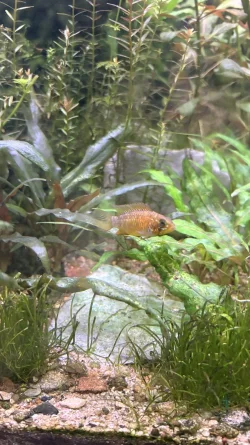
My guess is an Apisto sp. Can't say what specifically, I've never kept cichlids before 

SammyTargo
Fish Fanatic
That's a nice fish and has solid colours. @MattW is right, it is a species of Apistogramma. This genus ironically has a broad range of species depending on where you are from that are sold for Aquariums. There are over 8 species that are accessible in most areas of the world to own, and more popular areas and certain countries can have up to 20 common aquarium species.
My initial thoughts were A. Macmasteri, but it doesn't look like an exact match; the problem with Apistogrammae are that I sex based on side by side comparison, and you only have 1. I cannot tell if yours is a less-colourful variant or if it is just female. I should probably learn how to sex them based on fins, but I am an ignorant guy . To further complicating the ID of an apisto, each more common species has multiple different variations with separate patterns, colours, sizes, and more. The wild variants of each apisto that is colourful is almost always much more bland, which makes matters worse as there are vibrancy spectrums as well.
There are "complexes" that group different apistos within the genus. I am almost sure it is in the A. Regani lineage, since that is the one that A. Macmasteri is from.
Since I only have 1 photo to reference from, you should look into my prime suspects yourself to see if there are any matches. Do you know if it is male or female? If not, figure that out by looking at male and female images of each species. Here are my biggest suspicions:
I understand why it is important to properly evaluate the ID of an unidentified fish, because apistos specifically like pairs so it is important to get your fish a pair; the wrong species could result in a war in your tank. Same would apply with wrongly IDing the sex, as that could cause a civil war. Also, it's good as each Apistogramma Spp. have their own personalities and behaviour. You can find out exactly how to give your fish the most suited home and life based on their specific species' traits.
Good luck, hope you find a match, and please get back to us!
Regards,
Samuel
My initial thoughts were A. Macmasteri, but it doesn't look like an exact match; the problem with Apistogrammae are that I sex based on side by side comparison, and you only have 1. I cannot tell if yours is a less-colourful variant or if it is just female. I should probably learn how to sex them based on fins, but I am an ignorant guy
. To further complicating the ID of an apisto, each more common species has multiple different variations with separate patterns, colours, sizes, and more. The wild variants of each apisto that is colourful is almost always much more bland, which makes matters worse as there are vibrancy spectrums as well.There are "complexes" that group different apistos within the genus. I am almost sure it is in the A. Regani lineage, since that is the one that A. Macmasteri is from.
Since I only have 1 photo to reference from, you should look into my prime suspects yourself to see if there are any matches. Do you know if it is male or female? If not, figure that out by looking at male and female images of each species. Here are my biggest suspicions:
- A. Macmasteri
- A. Hongsloi
- A. Agassizii (Probably the one with the most variants so could very well be this guy even if some photos look nothing like it)
- A. Guttata
- A. Pedunculata
- A. Viejita (similar to A. Macmasteri)
- A. Cacatoides (Specifially the wild variant, domestic ones are a definitive no)
- Apistogramma cf. ortegai 'Pebas'
I understand why it is important to properly evaluate the ID of an unidentified fish, because apistos specifically like pairs so it is important to get your fish a pair; the wrong species could result in a war in your tank. Same would apply with wrongly IDing the sex, as that could cause a civil war. Also, it's good as each Apistogramma Spp. have their own personalities and behaviour. You can find out exactly how to give your fish the most suited home and life based on their specific species' traits.
Good luck, hope you find a match, and please get back to us!
Regards,
Samuel

Rusty_Shackleford
Fishaholic
- Joined
- Jan 6, 2019
- Messages
- 661
- Reaction score
- 1,389
- Points
- 93
I would agree it looks like an Apistogramma. 94 described species as of today, likely you'll never know what species it is so don't breed it.

gwand
Fish Aficionado
Fish of the Month 🌟
2x Tank of the Month!
Supporting Member ⭐
2x Pet of the Month!
Go to Apistogramma.com. Frank andTom on that site helped “write the book” on Apistogramma. They will be able to ID this fish.

I'm 99% sure it is not agassizii, viejita (which iis almost never seen despite the overuse of the name for marketing); cockatoo, cf ortegai (pebas is again over used for marketing), guttata ;
- A. Macmasteri
- A. Hongsloi
- A. Agassizii (Probably the one with the most variants so could very well be this guy even if some photos look nothing like it)
- A. Guttata
- A. Pedunculata
- A. Viejita (similar to A. Macmasteri)
- A. Cacatoides (Specifially the wild variant, domestic ones are a definitive no)
- Apistogramma cf. ortegai 'Pebas'
Also there are more than 30 species relatively availalbe most times of the year though some of the ones you mentioned are more common than others and others you mentioned less common.
Doesn't help much but i'm lousy at fish id 'cept for the 10 species i own none of which were mentioned. You can ask on apistogramma.com and get a better answer. I was leaning towards hongsloi of the ones listed but i don' tthink it is the markings aren't right and there are 20 or so similar looking species.
SammyTargo
Fish Fanatic
Like I said, I know how apistos have been bred for domestic fishkeeping within the last century. People have turned their colours inside out for some variants. Because there are so many species, it is hard to know so I based my answers based on not only colours but also body shapes. Markings vary between lineages.I'm 99% sure it is not agassizii, viejita (which iis almost never seen despite the overuse of the name for marketing); cockatoo, cf ortegai (pebas is again over used for marketing), guttata ;
Here is the variants I was talking about:
F = Figure; F1 A. Viejita, F2 A. Agassizii, F3 A. Cacatoides (Cockatoo), F4 A. cf. ortegai 'Pebas', F5 A. Guttata
I focused on the most probable specimens I could come up with, not how common they are. I know some of them may not look like what you see upon google search or memory, which is why I noted:Also there are more than 30 species relatively availalbe most times of the year though some of the ones you mentioned are more common than others and others you mentioned less common.
Please remember that while your first photo upon looking up a species may not look nearly the same colouration of your cichlid, it may be because that is a different variation. Try to see what official strains there are of the species, and seach up photos of each one to match.
OP hasn't responded on whether it is a male or female.Doesn't help much but i'm lousy at fish id 'cept for the 10 species i own none of which were mentioned. You can ask on apistogramma.com and get a better answer. I was leaning towards hongsloi of the ones listed but i don' tthink it is the markings aren't right and there are 20 or so similar looking species.
Actually, I agree. OP probably shouldn't breed it unless they have a definitive answer. Some species can be crossbred though, and actually may produce fertile offspring.I would agree it looks like an Apistogramma. 94 described species as of today, likely you'll never know what species it is so don't breed it.
Guys, I don't know if I was right about any of the species I listed, I just plainly threw down my thoughts. I thought of the Apistos I had seen in my time before, in exotic aquariums and tried to link it back. Some of the ones I listed like A. Agassizii were 100% long-shots, but I threw them in there on the possible fact that they shared some certain features.
Regards,
Samuel
Rusty_Shackleford
Fishaholic
- Joined
- Jan 6, 2019
- Messages
- 661
- Reaction score
- 1,389
- Points
- 93
What mentally competent person would knowingly create a hybrid?Actually, I agree. OP probably shouldn't breed it unless they have a definitive answer. Some species can be crossbred though, and actually may produce fertile offspring.
Many people do sometime intentionally (blue-steel which is frequently sold under a number of names is believe to be a cross bred with borelli (possibly with one of the arcina species)) and sometime accidently (ortega cf pebas we mixed with another species of ortega in the wild and now they are cross breeding in the 'wild' producing hybrid).What mentally competent person would knowingly create a hybrid?
It happens both deliberate and intentionally - there was a thread on another forum where a guy announced he thought it would be 'neat' to cross breed a bunch of closely related species - and then of course there is the 'famous' parrot fish sold at petco and similar which is a cross breed (though there is a true parrot fish but it looks different).
btw electric blue acara is believed to be a cross bred fish.
Hum. Trying to think of other examples - oh well they well drift in after i hit reply.

I see a high bodied 'generalist' Apistogramma. It's either eunotus group, or mcmasteri group, which leaves dozens of fish as possible. More pictures closer up as it grows would help. There's a store west of me that has been bringing in Peruvian and Colombian Apistos, and they don't fit any of the colouration of the fish they expected to receive. They're very upset, where I'd be excited at the possible new species if I were still keeping Apistos.
In the glory days of Apistogramma importing in the later 1990s, I would say that in every ten shipments I unpacked, there were 2 or 3 unidentified species. And I helped unpack 20 or so shipments a year back then. The exporters became predictable after and stuck to a small circle of species, and the farms reduced that even more. Wild Apistos became unfashionable, as no one bought them. It appears like they may be back on the menu.
Many would. For one thing, they are worth money. If learning about nature isn't of interest to you, but making money is, hybrids are cheap to produce novelties that sell for very high prices. A human produced colour variety of an easy to get species is controllable. You know about the traits of the original fish and if you can breed them, you have nothing to learn. If a more beautiful fish comes from nature, it may be harder to mass produce. Blood parrots outsell real Parrot Cichlids by incredible percentages. Their intentionally chosen handicaps make them easy to manipulate in comparison.
I'll wager a lot of the people here don't care to learn about the evolution of fish, or may not even believe evolution is a process. If fish are "just fish", and aren't great stories to figure out, then species don't matter much, and you can do whatever strikes your fancy with them. I've had people tell me we should stop finding new species and just stick with what we know now (or knew in the 1970s). I've been told if we want new fish, we can cross what we have...
In the glory days of Apistogramma importing in the later 1990s, I would say that in every ten shipments I unpacked, there were 2 or 3 unidentified species. And I helped unpack 20 or so shipments a year back then. The exporters became predictable after and stuck to a small circle of species, and the farms reduced that even more. Wild Apistos became unfashionable, as no one bought them. It appears like they may be back on the menu.
What mentally competent person would knowingly create a hybrid?
Many would. For one thing, they are worth money. If learning about nature isn't of interest to you, but making money is, hybrids are cheap to produce novelties that sell for very high prices. A human produced colour variety of an easy to get species is controllable. You know about the traits of the original fish and if you can breed them, you have nothing to learn. If a more beautiful fish comes from nature, it may be harder to mass produce. Blood parrots outsell real Parrot Cichlids by incredible percentages. Their intentionally chosen handicaps make them easy to manipulate in comparison.
I'll wager a lot of the people here don't care to learn about the evolution of fish, or may not even believe evolution is a process. If fish are "just fish", and aren't great stories to figure out, then species don't matter much, and you can do whatever strikes your fancy with them. I've had people tell me we should stop finding new species and just stick with what we know now (or knew in the 1970s). I've been told if we want new fish, we can cross what we have...
Rusty_Shackleford
Fishaholic
- Joined
- Jan 6, 2019
- Messages
- 661
- Reaction score
- 1,389
- Points
- 93
I appreciate your points of view.
In my opinion there are only three reasons someone would create a hybrid.
1. Ignorance
2. Greed
3. God complex.
In my opinion there are only three reasons someone would create a hybrid.
1. Ignorance
2. Greed
3. God complex.
Rusty_Shackleford
Fishaholic
- Joined
- Jan 6, 2019
- Messages
- 661
- Reaction score
- 1,389
- Points
- 93
Google AI says there are 30,000 species of fish described of which 3000+ are available in the aquarium trade. None of us could keep 3000 species in a lifetime. Why do need to create more man made monstrosities?
We don't, but there's money in it. There will always be people who take out the monster masher and make new dishes, as long as there are people who want to buy them. You may have a love of nature, and I may have a love of nature, but that guy over there will take a bulldozer through an old growth forest to make a data centre for a company he doesn't even have shares in. If he keeps fish and breeds them, then his first idea will be how to best short term monetize that.Google AI says there are 30,000 species of fish described of which 3000+ are available in the aquarium trade. None of us could keep 3000 species in a lifetime. Why do need to create more man made monstrosities?
There was a guy in the hobby who set a line of killies from a mutation, and then tried to pass it off as a new species named after himself. There's that too - that wish to be recognized for your ability to (*(&* things up.
A few years ago, a gentleman who truly adored a very large finned version of the swordtail told me my dislike of it had to be rooted in my simply having no taste and being ignorant, possibly from bad genetics. He meant it. Wild fish were the marble that a Michelangelo carved a statue of David out of in his view, and marble uncarved was useless... interesting old man, that one. He'd been a leading name in the hobby when I was a kid, and probably represented a common point of view.
gwand
Fish Aficionado
Fish of the Month 🌟
2x Tank of the Month!
Supporting Member ⭐
2x Pet of the Month!
Modern day Homo sp sapiens are a hybrid of Homo neanderthalensis and Homo sapien. The apex hybrid.
Rusty_Shackleford
Fishaholic
- Joined
- Jan 6, 2019
- Messages
- 661
- Reaction score
- 1,389
- Points
- 93
They interbred yes. Did that occur in a lab or in the wild?Modern day Homo sp sapiens are a hybrid of Homo neanderthalensis and Homo sapien. The apex hybrid.
Species interbreed in the wild. That's not a forced, man made creation.
Similar threads


Fish and Aquarium Photos
Fish and Aquarium Photos
Most reactions
-
 736
736 -
 337
337 -
 331
331 -
 202
202 -
 193
193 -
 177
177 -
 173
173 -
 172
172 -
 169
169 -
 145
145 -
 145
145 -
 131
131 -
 99
99 -
 90
90 -
 83
83