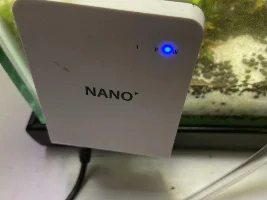
There is one big difference between the American Aquarium unit and the Aquatop unit, the power rating- 5 v.s. 7 watts.
I have a number of Aquatop heaters. when kensfish first had them I bougth a number of them in a variety of wattades as they were pretty cheap. I consider heaters, any model, to be the least reliable piece of equipmet used in the hobby. So I tend to buy the cheaper ones.
I would never even consider using an in tank UV unit. But when I bought my 5 watt external from AAP I already had extra small pumps and powerheads. All of my parts were brand new and I also bought a replacement bulb. If you think light bulb specs can be confusing, UV Bulbs are even moreso.
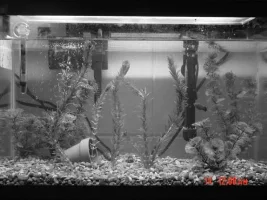
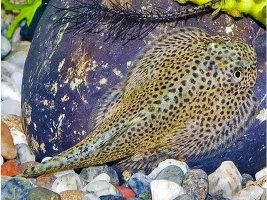
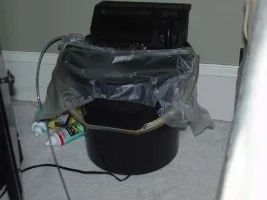
Here is my jury rigged unit on the 55 for the Altums. They came in wild and needed a pathogen free tank on arrival. I ran the UV for a bit more than a week before the fish arrived and a week+ afterwards.
The pump is a small adjustable flow Eheim Hobby pump. The punp had a jury rigged ATI prefilter. The tube to the left of the opump intak set-up it the return. I jury rigger it all.
But the most important part of the AAP U stuff is not the equipment, it is the education on UV provided. It enabled you to calculated exactly what us needed for any given application. I bought from Carl because I felt the education I got was worth paying a bit more.
I can also tell you I corresponded with Carl re his info on the nitryifying bacteria because he had some wrong information in his section in the cycle. He stated the bacteria were gram positive when the fact is almost all the nitrifying autotrophs are gram negative. One of the very few exception are not the ones in tanks One exception is Nitrolancea hollandica:
Nitrolancea hollandica
is a nitrite-oxidizing bacterium primarily found in specialized, high-ammonium/nitrite environments like wastewater treatment bioreactors (e.g., SHARON systems) and compost, thriving at warm temperatures (around 37-40°C) with high nitrite levels, but its genes also appear in natural hot environments like geothermal areas in Argentina, suggesting it's a "hidden" microbe adapted to these niche conditions.