DO NOT ADD FISH........THEY WILL DIE!
I prepared this for a friend and it will help you
Please read and follow
Cycling your Fish Tank Set-up
Hi and welcome to the world of fish keeping!
The first lesson you will learn is that you are actually keeping water, not fish. The fish will keep themselves providing you keep the water as near perfect that you can.
There are three main enemies you will encounter and they are AMMONIA, NITRITE and NITRATE. (Note that the only difference between the last two are an I and an A)
AMMONIA.
Ammonia is produced mainly from fish waste and decaying plant/food. Ammonia is deadly to fish even in minute quantities. Zero level required before adding fish and thereafter.
NITRITE
Nitrite is a waste product of the friendly bacteria that breaks down ammonia. Nitrite is also deadly to fish even in minute quantities. Zero level required before adding fish and thereafter.
NITRATE
Nitrate is a waste product of the friendly bacteria that breaks down nitrite. Nitrate is harmful to fish but only in high levels. Some fish can tolerate levels of nitrate as high as over 100 ppm (parts per million) A level of 40 ppm is considered expectable but the lower the better. Nitrates are controlled buy partial water changes.
Cycling your set-up.
Cycling refers to a process that is known as the Nitrogen Cycle. You are in fact cycling the filter as that is where nitrifying (friendly) bacteria will colonize. Little friendly bacteria will be present on the walls of the tank, gravel and decorations but none in the water.
There are two ways to cycle your filter, ‘Fishless’ and ‘With Fish’. The latter you use fish to produce the ammonia and Fishless Cycle you add ammonia solution.
As cycling with fish very often involve fish death or suffering I will only instruct on Fishless Cycling.
The Fishless Cycle
You will need:
A bottle of pure ammonia solution with no detergent. Homebase own brand costing £1.99 is a good choice. To check it is the right stuff, give the bottle a shake then without breathing the vapours check that it doesn’t foam up. No suds mean it’s the right stuff.
Water dechlorinator.
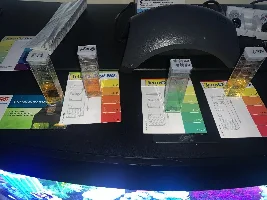
Water testing kit (API Freshwater Master Kit is a good choice)
Thermometer
Ok, so here we go….
Well rinse your substrate (sand or gravel) and place in the tank. Fix your heater to the tank side. Half fill the tank with fresh water. Add decorations (ie. Ornaments and plants). Fill with water to the maximum water level. Add the right amount of dechlorinator (check bottle for amount)
Set the gauge on the heater at 80* and switch on. The gauge on these heaters are not too accurate so only use as an indication. Later (after at least 6-12 hours) you need to check the thermometer and adjust the heater accordingly. (80* is a good temperature for cycling but will need to be turned down when cycling completes to around 76* depending on the fish you get). The temperature is set a bit higher during cycling as it speeds up the process.
Fit your filter and filter media in place
The average time for a fishless cycle is 6-8 weeks to complete but with ‘matured filter media’ (as it is known as, ie. foam with a colony of friendly bacteria already in it) this time can be greatly reduced. Still be prepared for 2-3 weeks before expecting to get fish.
Ok, so to recap…..water in and dechlorinated, heater in, switched on and set at 80*, Filter in place and running correctly.
Now the ammonia. The addition of ammonia is to simulate the amount of waste produced by the maximum amount of fish that will be allowed in your tank. Therefore it is a % level of 5 ppm.
For a 90 litres set up you should need to add up to but no more than 5ml of ammonia to your tank to bring the level up to 5ppm. So I would add under a teaspoon of ammonia, leaving it to mix for an hour or so then test the level using the ammonia test kit and adjust the level if required.
NOTE: follow the instructions in the testing kit closely as it is very important to be exact.
Once you have established the ammonia level is at around 5 ppm it is just a case of sitting back and waiting. Normally there is no drop in ammonia level for at least a week but in your case it should happen in a few days so in 3 days check your ammonia level again.
If the ammonia level has dropped but still present then it is a good sign that the cycle has started. When the ammonia level drops to 1 ppm (check daily now) add a little drop of ammonia to bring it back up to 5 ppm. At this stage also test for nitrite. When nitrite is present it means you are well on the way but expect the nitrite level to rise very high eventually before dropping (called the nitrite spike).
*******************************
I will explain the system now so you will have a better understanding of what’s expected.
The aim is to cultivate enough friendly bacteria to deal with the level of waste from the maximum amount of fish you will be able to have in your tank.
The science….you add the ammonia and after about a week bacteria starts to forms that ‘eats’ the ammonia. Trouble is, as this bacterium eats the ammonia it in turn produces nitrite which is also harmful to fish. In time another type of friendly bacteria forms that eats this nitrite. (It takes a lot longer for this type of bacteria to form than the first type) The nitrite eating bacteria also produces a toxic waste and this is nitrate. Unfortunately there is no bacteria that can deal with this nitrate but as it is not fatal to fish in lower doses so this is why we do weekly partial water changes of around 25-30% to dilute it. (Note: no water changes are required during the cycling period
*****************************
So
Add ammonia…..bacteria forms….ammonia drops…..add more ammonia…..ammonia drops….add more ammonia etc……..Check nitrite level…..nitrite level rises……keep adding ammonia…..nitrite level raises
Basically you add ammonia, ammonia bacteria forms, keep adding ammonia until nitrite bacteria forms, and keep adding ammonia and eventually you will get to the stage where the ammonia will be processed in 12 hours but because so much nitrite has been produced the level will go through the roof but don’t worry. Suddenly, one day after ‘spiking’ the nitrite level will drop to zero.
When you are at the stage where, after adding ammonia to a level of 5ppm, it drops to zero in less than 12 hours and the nitrite level (after spiking) remains at zero then you’re done! You must keep adding ammonia to 5ppm every 12 hours as the bacteria will start to die off if it has nothing to feed from and all your hard work will be wasted! Do this right up to the day before you add fish.
Now you are ready for fish. Before you add any fish you need to get rid of the end product of the cycle…The Nitrates. You will need to do a complete water change (or as much as you can get out) NOT FORGETTING TO TURN OFF THE HEATER FIRST!. Don’t forget to dechlorinate the water and in this way. Add a couple of inches of fresh water then add enough dechlorinator for the whole tank then add the rest of the fresh water. Turn heater (setting at around 76*) and filter back on.
You must now add fish as soon as you can (within 12 hours) once the water temperature has reached the desired level for the fish you are getting. At this point only you can add most of the fish you intend to keep all at once as you have a full load of bacteria. (Maximum at once though I would limit at 10)
However, if you only add a couple or so at this stage with a view to adding more later then this is ok too but you will only then to be able to add a few at any one time to allow the bacteria level to ‘catch up’ as some of your bacteria will have died.
***************************************************
If you have found this all a bit too rambling to follow then here is an excerpt from the fish forum on the subject.
"Add and Wait" Method
This is the method I have used to cycle 5 tanks (from 2.5 to 75 gallon) and it has worked perfectly. I think it is the simplest and requires the least amount of work. First add your ammonia to raise the level to 4 to 5 ppm Now you simply wait on the ammonia to drop back to around 1 ppm. Spend the time researching the fish you like and see if they are compatible with each other, with your tap pH, tank size, etc.
Test daily to see what the ammonia reading is. There is no use to test for anything else. Nitrite and nitrate won't be present until some ammonia has processed. Ammonia will raise your pH so no use to test it either. Once you see a drop in the ammonia, test for nitrite. There should be some present. When the ammonia drops back to about near zero (usually takes about a week), add enough to raise it back to about 3 to 4 ppm and begin testing the nitrite daily.
Every time the ammonia drops back to zero, raise it back up to 3 to 4 ppm and continue to check nitrites. The nitrite reading will go off the chart. NOTE FOR API TEST KIT USERS: When you add the drops, if they immediately turn purple in the bottom of the tube, your nitrites are off the chart high. You do not need to shake the tube and wait 5 minutes. If you do, the colour will turn green as the nitrites are so high that there isn't a colour to measure them with. Once the ammonia is dropping from around 4 ppm back to zero in 12 hours or less you have sufficient bacteria to handle the ammonia your fish load produces. Continue to add ammonia daily as you must feed the bacteria that have formed or they will begin to die off.
The nitrite spike will generally take about twice as long to drop to zero as did the ammonia spike. The reason for this is two-fold. First, the nitrite processing bacteria just develop slower than those that process ammonia. Second, you are adding more nitrite daily (every time you add ammonia, it is transformed into nitrite raising the level a little more) as opposed to the ammonia, which you only add once at the start and then waited on it to drop to zero. During this time, you should occasionally test for nitrate too. The presence of nitrate means that nitrite is being processed, completing the nitrogen cycle. The nitrate level will also go off the chart but you will take care of that with a large water change later. It will seem like forever before the nitrite finally falls back to zero but eventually, almost overnight, it will drop and you can celebrate. You are almost there. Once the bacteria are able to process 4 or 5 ppm of ammonia back to zero ammonia and nitrite in about 10 to 12 hours. You are officially cycled.
At this point, your tank will probably look terrible with brown algae everywhere and probably cloudy water. As I mentioned, the nitrate reading will also be off the chart. Nitrates can only be removed with water changes. Do a large water change, 75 to 90 percent, turn the heat down to the level the fish you have decided on will need, and you are ready to add your fish. You can safely add your full fish load as your tank will have enough bacteria built up to handle any waste they can produce.