Shelf life of a master test kit?

Chickadee26 47

Fish Fanatic
Supporting Member ⭐
Joined
Aug 30, 2026
Messages
98
Reaction score
106
Points
33
Location
Michigan US
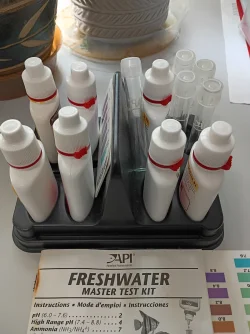
As mentioned in my intro, I'm getting back into the hobby after 10+ years off. I'm going through my stuff and determining what's still good, what to buy new. Hoping to reuse as much as possible. How long is a freshwater master test kit good for? Is there a way to test it before setting up the aquarium? Maybe test some stagnant water or something?

ETA: Just tested some bird bath water with the ammonia tester. The water turned green and reads 4.0 ppm. Can I assume the kit is still good then?
Nitrite was a light lavender 0.25 ppm. I think the kit still works, but will wait for knowledgeable input.
Surprised to get these readings from the bird bath that I flush out daily. Then again, the birds do poop in it a lot.
 

Attachments
  • testkit.webp
    testkit.webp
    171.3 KB · Views: 48
Last edited:
Welcome to TFF.
If it were a matter of a year or two past the 2018, then perhaps using it would be ok. Imho, test kits 8 years past the Exp. date should be tossed. Think of it like this……don’t you want accurate results to help make your fish husbandry successful? I decided to keep my 8 fish tanks and, in so doing, I am obliged to do my absolute best…..just like I do with my dog. If there is even a chance that my fish or dog meds/foods/etc are not going to do the task, away they go.
 
AI Overview

API aquarium test reagents last between 3 to 5 years from their date of manufacture. However, once a bottle is opened, exposure to air, light, and temperature fluctuations can cause the chemicals to degrade faster. Many hobbyists report inconsistent or "dodgy" readings after 6 to 12 months of active use.

🗓️ Shelf Life by Specific Test Type
Different tests use different chemical formulas, meaning they expire at different rates. According to user documentation on Facebook groups and Chewy product support, the standard manufacture shelf lives include: [1, 2]
  • 3 Years: Nitrite Test, High Range pH Test
  • 5 Years: Ammonia Test, Nitrate Test (Reagent #1), Freshwater pH Test, GH/KH Test [1, 2]

I have the FW Master kit + the GH/KH kit. but in the end I went to digital testing for the most part. I used to replace the master kit stiff unused after a few years to be safe. I did use the ammonia kit for mt bio-farm to cycle filters.

I would suggest you replace the kit rather than risk getting bad results. I have learned over the years that it is better to have things which you might need and them in good working condition and not need them than it is to need them an not have them. Early on we all needed them and then many of us got hooked and the number of tanks suddenly increased. Things like test kits and some meds are better to have on hand than not.

If you have more tests than you need, the way to deal with this is to get more tanks. ;)
 
I used the ammonia test just today. Expiration date 2021. It showed no ammonia.
A week ago, my filter stopped running, I did the ammonia test and it show .25 ppm. So I do believe it still works.
For the nitrate test, I only use salifert. It is easier to use than the one in the API test kit.
It requires no heavy shaking and gives results in 3 minutes. It is accurate down to 2 ppm. I find it fairly easy to read.
 
Hmm, I'll be a devil's advocate and say my kit sat on a shelf very effectively for a number of years before I got rid of it. They are quite useful if you are starting a tank cold and cycling, but once you're cycled, they are severely limited. If you do weekly water changes, regularly and methodically, the time spent shaking tubes could be better spent on those partial changes.
If your source water source is good, and unpolluted by agricultural run off, past the initial cycle it won't give you much once you learn to feed properly and maintain water. I occasionally like to check my water hardness, but I don't believe that's even in the API kit. It may be with better products. I know I had to use a secondary kit for that.
Once the cycle's established, if you suspect ammonia may be rising, pull out the equipment for a partial water change and get it done, quickly. Why waste time? I change 30% in every tank every 7-10 days, and all has been fine here since I got rid of the test kit in the 90s.
 
Once your tank is mature and has been stable for a long time and if you do regular 40% to 50% weekly, unless your fish seem unwell, testing for most conditions are not needed. However, I do a nitrate test every few months just to be sure it is not gradually building up above say 30%. If it does build up above that level, I will do one extra large water change. I only use the Salifert nitrate test as it is so easy to use and is easier to read and more accurate than the API test for nitrate.
 
You know, I love the information on here, but it is costing me ££££ Just looked on Amazon UK to find out about Salifert test as easier, and also as I was having problems reading the API one. Found this review on Amazon, so bought one :

I was having trouble measuring nitrate in my fish tank. The widely recommended API Master test was useless. Our tap water is 30ppm NO3 already. In the API test, 40 & 80ppm are indistinguishable. The machine-readable JBL strips also don’t work in this nitrate range. The Salifert test works perfectly. Most Importantly, it’s much better designed that the API. Firstly, the sample vial is square with flat sides, so that you always look through a consistent amount of solution. Then the reference card has space with a white background to place the sample vial to compare to each reference concentration in a controlled way. The test is a simple single colour, not some complicated arbitrary range of colours. You just judge the depth of colour. As a professional chemist, this system makes much more sense to me. In a single chromosphere system, the Beer-Lambert law tells you that the concentration is directly proportional to the absorbance divided by the path length (the amount of solution you look through). Now for the satisfying bit, the test is neatly designed so you can look down through a small path length, or sideways through a long path length. So, if you have a low nitrate concentration, you can use the long path length for accuracy, or conversely, if you have a high nitrate concentration, you can use the short path length. Nice! I will be buying more Salifert tests in future - and no more API.
 
One recommendation is to view any test vial/container in as bright a light a possible. I recommend putting a plastic laminate on the salifert card to waterproof it so it wont deteriorate if you get it wet.
 
I always suggested that every test be done the same way in the same spot with the same lights on or off every time.
At least then if inaccurate you have a consistent baseline for comparison.
 
It's a real wild card for people who have nitrate in their drinking water. There (as I was packing up to move), I'd test my water religiously. I've noticed a lot of hobbyists in the agricultural midwest of the US have polluted tap, and now, it seems a lot of people in regions of England have the same issue. I just looked at where Stourbridge is but I don't know how it fits geographically with the other regions people here mention. I was shocked to realize Birmingham to London is half the distance that I am from my local quality aquarium store.

That aside, when we're discussing the cycle and such, our tap water sources are really important to note because they can differ radically.
 
It's a real wild card for people who have nitrate in their drinking water. There (as I was packing up to move), I'd test my water religiously. I've noticed a lot of hobbyists in the agricultural midwest of the US have polluted tap, and now, it seems a lot of people in regions of England have the same issue. I just looked at where Stourbridge is but I don't know how it fits geographically with the other regions people here mention. I was shocked to realize Birmingham to London is half the distance that I am from my local quality aquarium store.

That aside, when we're discussing the cycle and such, our tap water sources are really important to note because they can differ radically.
That is why I am considering when I am having a very good day health wise, driving to Peterborough to pick up some plants and possible driftwood and other things for my aquarium. A journey of a mere 200 miles there and back. 🥂🥳
 
That is why I am considering when I am having a very good day health wise, driving to Peterborough to pick up some plants and possible driftwood and other things for my aquarium. A journey of a mere 200 miles there and back. 🥂🥳
That seems a very un British thing to do, based on my British immigrant friends here. They have a very different attitude towards distance. I'm 404km from the nearest good store. There's a nice guy across ton with a shop, but he has at most 20 tanks of common Singapore fish in there.

I only do that drive when I visit my kids though. For a REALLY top of the line store, I have to drive for 9 hours and fifteen minutes. This is an out of the way town to live in, though it's pretty.
 
I have two family owned huge fish stores located within 30 minutes of my home. And there are numerous chain fish stores (you know the names) within 15 minutes of my home but why go there when there are better options except for maybe picking up plants or emergency fish equipment or possibly to get a tank from them when on sale.
 
Last edited:

Most reactions

Back
Top