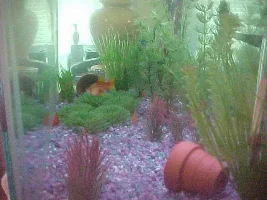
My aquarium is now cycled

Jennet26 84

Fish Crazy
Supporting Member ⭐
Joined
Jul 20, 2026
Messages
328
Reaction score
450
Points
63
Location
Stourbridge, UK
I will be going out to get more plants in the next week as I had to bin my other ones due to a snail infestation. I think I have got most of them out, but will still carry on with adding zucchini over the next few nights to be sure.

On testing yesterday my nitrites and amonia were 0, pH 7.6, GH 7, KH 5 but my Nitrate is still at between 40 and 80. I find it hard to make out the difference of these two colours.

Is that high for nitrate, and if it is, what can I do that will help bring it down please. I have no air stone running, nor have had in last 3 weeks, and my flow from my filter is running at about medium power I think.
 
Water changes is how most lower the nitrAtes.
The % you change is the % you will reduce it.
So if you are 40 and do a 25% change you should and up being around 30. Likewise if you changed 50% you would settle near 20.
That is why I like 50% changes. Easy math and I like thinking that I have removed 50% of all the stuff that builds up in our tanks.
 
It depends on how high tap water nitrate is. Water changes cannot get nitrate below that level. Your water quality report should give the min, max and mean nitrate for your address.

The legal limit for nitrate in drinking water in the UK is 50 ppm. Some areas are close to that.
 
It depends on how high tap water nitrate is. Water changes cannot get nitrate below that level. Your water quality report should give the min, max and mean nitrate for your address.
I agree.

I also claim that the frequency and the amount of the water change each time depends on what type of fish you're keeping. There are also fish that need less clean water to thrive in well. I've got certain species that will not thrive well in water without a certain level of nitrite and nitrates.
 
Plants will help and some use 'algae scrubbers' to use up nitrAtes.
IMO a scrubber is great DIY project and I really don't know why I don't have one myself.
 
I think thew reason your nitrates are so high is due to your changing out the plants. Most of the plants we put into our tanks want to use ammonium NH4). Once in water most of the ammonia (NH3) turns to ammonium and the plants use this faster than the bacteria, which prefer ammonia, can use that. So in a well planted tank most, but not all, of the cycling work is done bu the plants.

When the pants use ammonium, they do not create either nitrite or nitrate. However, the bacteria still do both which means there will be some amount of nitrate, However, as the quantity of pants increases there is often not enough ammonium for them. So, they will start to use the nitrate if there is any. With enough plants there can be 0 nitrate in a tank as the plants use it all.

If you looks at the ingredients for most aquarium plant fertilizers you will see some form of nitrate.

I think the above explains why you are seeing the nitrate levels you are. When a tank is newly planted it takes some time for the plants to settles in. Moreover, most of the new plants we buy which were commercially raised come with a full load of nutrients in them which means they need less initially. So they need to feed less from the substrate or water.

New tanks take more time than just what it takes to establish the cycle in order for them to build up all the microorganisms they will have when a tank is more mature and balanced.

Your nitrate level is not a problem here as long as there are no fish involved. If there are not do not keep adding ammonia daily, the bacteria will be fine getting only a bit every couple of days. As the new plants settle in your should see nitrate levels start to drop. However, if there are fish then do big enough water changes to get the nitrate levels to no higher than 20 ppm. If there are no fish I would still not want to have nitrate above 100 ppm. Lower than this will not be a problem either.

One last note about cycling and live plants. These can be sensitive to elevated levels of ammonia. Different species are more or less tolerant. I generally advice that people trying to cycle a planted tank use a lower dose of ammonia than the 3 ppm in the cycling article here.I suggest between 1 and 2 ppm will be fine The more plants one has and the faster growing they are then the 2 ppm is likely the better option. With fewer plants and/or when most of the plants are slower growers I would suggest close to 1 ppm would be sufficient. Remember, once established, the plants will be using ammonium way faster than the bacteria can use ammonia but the total ammonia will get used up faster by the all the things that use it. This is when we need to be adding ferts for the plants. But they usually let use know they need more "food" by how they look and how they grow.
 
Thanks all. I will not put anything else in there until I am certain everything is healthy. Except for plants, which I will put in once I am certain no snails left. I had been using fish food in there for probably at least 6 weeks before I started cycling
 
Get some ammonium ammonium chloride for cycling. The below is from the site of Dr. Timothy Hovanec one of the researchers who discovered the specific strains of cycling bacteria in out tanks.

Using shrimp or fish food​


One of the more popular fishless cycling methods is to buy a few dead shrimp at the grocery store, cut them up into chunks and add them to the aquarium. The shrimp decay, which produces ammonia to feed the nitrifying bacteria. There are a few drawbacks with this method, one being that the hobbyist really has no way to know how much ammonia is being produced by the decaying shrimp, and the aquarium does not look very good with dead shrimp laying on the bottom. Also, the organic material of the shrimp can cause bacteria blooms which turn the aquarium water cloudy. This method works but it takes time and patience and you will probably see a spike in ammonia and nitrite if you add a medium to heavy load of fish after the initial cycling. Note that some people use flake fish food instead of shrimp but this is not recommended because flake food does not have much organic material compared to shrimp and so does not add a lot of ammonia to the water, but you can use cut fish instead of shrimp.

from https://www.drtimsaquatics.com/resources/fishless-cycling/
 
Get some ammonium ammonium chloride for cycling. The below is from the site of Dr. Timothy Hovanec one of the researchers who discovered the specific strains of cycling bacteria in out tanks.

Using shrimp or fish food​


One of the more popular fishless cycling methods is to buy a few dead shrimp at the grocery store, cut them up into chunks and add them to the aquarium. The shrimp decay, which produces ammonia to feed the nitrifying bacteria. There are a few drawbacks with this method, one being that the hobbyist really has no way to know how much ammonia is being produced by the decaying shrimp, and the aquarium does not look very good with dead shrimp laying on the bottom. Also, the organic material of the shrimp can cause bacteria blooms which turn the aquarium water cloudy. This method works but it takes time and patience and you will probably see a spike in ammonia and nitrite if you add a medium to heavy load of fish after the initial cycling. Note that some people use flake fish food instead of shrimp but this is not recommended because flake food does not have much organic material compared to shrimp and so does not add a lot of ammonia to the water, but you can use cut fish instead of shrimp.

from https://www.drtimsaquatics.com/resources/fishless-cycling/
I used this when I was cycling. It does seem that the cycling went far quicker than it says on your cycling guidance. Unfortunately, my grandson got peanut butter all over the notebook I used whilst cycling, and I came downstairs this morning to find that my dog had destroyed (mostly eaten) my blasted notebook.

I have to put a high latch towards the top of my lounge (and kitchen) door overnight, as I worry that my grandson will go downstairs in the night and I not hear him. I love my dog, and she's mostly fine with him, but when he becomes overbearing with her, she will growl at him to let him know this is not acceptable. He does back off from her for a while, but not always long enough, so I tend to intervene the second time she warns him, and let her out into the garden. Hence my notes are at best my memory of them, which the older I get, the less I retain. (My great granny had altzheimers - I do sometimes wonder if I am heading towards this.

I am now wondering if using fish food may have started off the possible natural cycling before I use Dr. Timms ammonia??
 

Most reactions

Back
Top