
What's new

KH and pH relationship

gjohnson050

New Member
Joined
Jul 22, 2026
Messages
4
Reaction score
0
Points
1
Location
Orange County
Hello all.

I have a new tank, just finished cycling, I plan to get some cardinal tetras today or tomorrow as first animal life!

If I can figure this issue out first......I have a question on KH and pH relationships

my tank is:
40 gallons
planted with some swords and java fern
driftwood, that is still leaching, i expect it will be dark like iced tea in about a month but I am ok with that for now. I won't rush a water change just for that reason.
sand substrate
Fluval canister with only foam, floss, and bioFX

When I filled the tank, I used RO water, as there is no life in the tank yet (other than plants), I filled directly and let it run 24 hours before testing parameter
All other parameters looked good, GH was around 1, KH at 0 and pH at 6.8. TDS was 107
I added Brightwell Aquatics Neo KH+/GH+ until the GH came up to 4. However, what is interesting is KH didn't come up at all. pH came up to 7.0. TDS up to 150
I plan to have fish that like lower pH softer water, so I don't want to add more and bring GH higher

Having a KH of 0 is dangerous for pH swings I get that. higher KH will prevent swings. however, if I add simply baking soda to the water, KH goes up, but so does pH (went up to 7.7!)...the opposite of keeping it stable. It seems it only keeps high pH water stable. How do I raise KH to at least 2, while keeping pH 7.0-7.2 and stable? I am going to let it run to see if perhaps the system hasn't' yet stabilized. But why would the pH go up from adding STABILIZER? It directly caused a pH swing, didn't prevent it at all. I feel I am going crazy not understanding something.

Edit: to be clear, I only added baking soda when the water was 7.0, so there isn't anything for it to "work" on.

All I want is 7.2 pH water that is stable and soft (GH 4 max). I can only seem to get that pH with a KH under 1, which by definition, isn't stable.

Please help me get this. I dont want to put my cardinal tetras in 7.7 water! And I want them to be safe.
 
Question for you, where are you planning to get your fish from? If its a LFS then I would ask them what the parameters are that they are keeping their fish in. Tank raised fish are more flexible with the water parameters.

Unfortunately I am unsure how to raise the KH without affecting the pH, I'm sure someone will be able to help with that.
 
What is the water out if the tap like? Some people mix this with RO in consistent ratios to achieve the GH/ pH/ KH they desire.

Using treatments is very tricky, as you have seen the parameters bounce around. The best way to keep water stabilised is to do large frequent water changes always using the same water source. 50-75% weekly prevents the parameters drifting and if you ever have a problem (contamination, over heating, parthogens etc.) you can easily do a large water change without shocking the fish.

With low KH, old water will become more acidic as the nitrogen cycle releases hydrogen ions and pH can drop suddenly without KH to buffer it. With frequent large water changes the acidification will not occur and the problem is negated. Very soft water fish like cardinals will do just fine with RO water. Just be organised and commit to the water changes.

BTW, which cycling method did you use?
 
In our tanks what contributes to KH is mostly carbonates and bicarbonates. The best way to raise these things without raising the GH is by adding some crushed coral.

What in our tanks besides KH can use carbonates and bicarbonates? To answer this we need to understand that these things are inorganic forms of CO2. So pretty much anything that needs inorganic carbon is likely to be able to utilize carbonates and bicarbonates. This would include the nitrifying bacteria and plants which also includes some varieties of algae.

In a tank like yours this can be a problem since the KH is what keeps pH stable. So starting with low KH in such a tank can easily deplete the carbonates and bicarbonates.

So the next question becomes how can we increase the levels of the carbonates and bicarbonates without risking a rise in GH. The answer is crushed coral. The Google AI gets it right when it says:

Crushed coral is composed almost entirely of calcium carbonate (CaCO₃), which is the natural mineral structure built by marine polyps to form their skeletons. It also contains trace amounts of magnesium and other marine elements.
Because of its chemical makeup, crushed coral dissolves naturally when it comes into contact with acidic water. This breakdown process serves several key functions, particularly in aquarium keeping.....

Now the logical question here is what effect does the calcium component have? AGain the AI gets this right as well when asked, "what is the solubility of calcium in water" as the answer is:

Pure elemental calcium does not dissolve in water; instead, it reacts violently with it to form calcium hydroxide and hydrogen gas. However, the term "solubility of calcium" usually refers to how specific calcium compounds (salts) dissolve. Solubility varies drastically depending on the compound: [1, 2, 3, 4, 5]
  • Calcium Carbonate (\(CaCO_{3}\)): Effectively insoluble, at just \(0.013 \text{ g/L}\) at \(25^{\circ }\text{C}\).

What this means is by adding some amount of crushed coral, we can get the pH to go up with minimal effect on the GH.

When I was working with the B&W Hypancistrus plecos from the Rio Xingu It was sometime necessary to simulate a dry/rainy season. I could do this in one of two ways. I could use my tap, which is basically neutral pH and on the soft side KH 3-4 dg (53-71 ppm) and GH 4-5 dg (71-89 ppm), as either the rainy or the dry season water.

I had two options. If I wanted my tap to be the dry season parameters, I needed to use RO or RO/DI water as the dry season. However, I did not want to have to buy and RO or RP/DI units and have to make rany season water. The other option was to make my tap be the rainy season water which meant I needed to make the dry season water.

I could make my tap become dry season friendly by mixing a few things into it. So here is how I did it. I set up big can of my tap rater and then added Epsom salt which is basically Magnesium and then I filled the carbon basket on one of my Marineland H.O.T, Magnums with crushed coral and ran it on the can for about 24 hours. My finally add was a pretty small amount of baking soda. I kept this small as I wanted it to contribute so KH but not to GH.

What I discovered via trial and error was that if I only put the Magnum with the coral on the can an ran it for 24 hours it barely change the parameters. if moved the KH up a bit and did nothing to the GH. Most of the hardness increase I could generate came from the Magnesium and the tiny amount of baking soda.

Prior to all of the above I ran a high tech planted tanks which utilized pressurized CO2. I when I began this tank I was worried about the potential for a pH crash if the KH dropped too much. So, I put a bag of crushed coral into the canister filter for the tank. it did raise the KH a bit. What I learned was I really did not need the bag of coral as it is not so easy to cause pH crash.

I should say that a ran a leaner CO2 level than most folks do because I ran the CO2 24/7. I wanted to avoid a build up of CO2 overnight when the plants somewhat slow their use of it. However, they do not stop using it even when there is no light to power photosynthesis. I eventually stopped using the bag of coral in the filter and all was OK.

So, you may want to try adding a small bag of coral to your filter or else in a bag in the tank placed in the outflow of the filter. It is acid water which dissolves the coral, it needs to be replenished over time. As the pH starts to rise from this, less of the coral dissolves. So using a smaller amount in a bag has minimal risk of being able to crash the pH.

Since your are not adding CO2 which normally acts to make water more acidic, you are not needing to worry much abiut too much coral or cashing the pH. My tanks was a 50 gal., but it was a terraced tank and my best guesstimate was it really only held about 30 gal. of water. I used about 1/2 cup of coral in a bag in the filter. Then I monitored the pH for a while to determine the effect. it turned out the 1/2 cup was about the right amount.

I would suggest you start with 1/2 cup and test for a bit. If the pH is not stable you can reduce or increase the amount of coral accordingly. This will let you determine how much you need. You will aslo learn how fas tit disolves and therefore when to add more.

The real problem here is it is not so easy to buy crushed coral in smaller amounts. it is mostly used as a substrate for salt water or African rift lake cichlid tanks. When used this way it had a much more dramatic effect, used in a small mesh bag in a filter is is pretty mild in its effects. What we have to do is to fine tune the amount to match what wen need it to do in our tank.

This means by starting with about 1/2 a cup of coral initially you should learn fairly fast if this is either a bit too much, too little or just about right. Once you are learn what is the basic amount of coral to use, the only thing you need to do is to monitor how fast the coral is being dissolved and, thus, how often you need to add more to the bag.

Because calcium is difficult to dissolve in water it takes a lot to raise GH. The 1/2 cup in a bag for a 40 gal. should not have any real effect on the GH. And if the pH starts to rise towars 7.0. the less dissolved of the coral happens. So this is almost a self correcting mechanism.

One last thing to know here if you decide to add the bag of coral, it takes a bit of time to go to work, it is not instant by any means. This especially true in this case as your water is not severly acid and the amount of coral involved is actually minmal.

You can find crished coral on Amazon among other places. I bought a 15 pound bag and in10 years of the planted tanks and then for use when I ran my bio-farm for cycling filters is where I also used it. I would cycle filters for 6-8 tanks at a time and that used up KH fast. Over the years I used more of the coral in the bio-farm than the planted tank. I no longer need to cycle tanks and I still have over 5 pounds left from the 15 pound bag I bought many years ago. So you should be fine with a 5 or, at most, 10 pound bag. I prefer the crushed smaller size particles to the noodle-like pieces in a lot of the Amazon offerings.

If you have any Qs about all of this you can shoot me a site PM as I may not check back in this thread every time I visit the forum. But, I usually am here most days, even when I do not post.
 
I will buy from a LFS. Our tap water is very very hard and best not used (18DH). My RO system brings this down to 12 TDS out of the RO tap.
 
I don't get this ph swing thing is dangerous - i have 15 aquariums with 0kh and only a few deaths a year out several hundred fishes.

As for your question - ph is not a stable quantity kh makes it more stable but can still change through the day for various reasons. Just pump a few million ppm of co2 into it and see what that does to your ph regardless of kh.
-
Ph is mostly a useless number overly express in the literature. GH and KH are much more important but it is much better to have kh start at 0 and stay 0 then it is to have kh start at 1 or 2 and drop to 0.

As for tds - one decay leaf in a 10 gallon aquarium can raise the tds by 50 or 80 points It is a useful number for checking stability over time or to detect leaching but it is not a number with a definitive meaning by itself. So if it your tds is 50 or 80 you don't know a lot about the difference but if your tds is 600 today and 900 tomorrow then you know you probably have a problem.
 
I have around 60 cardinals in the tank in my signature. These are all over 6 years old (yes I know the internet says they live 2-3 years). My tank gets RO water and absolutely nothing else (except food :whistle: ). I have never seen a pH swing but do perform a substantial water change most weeks.
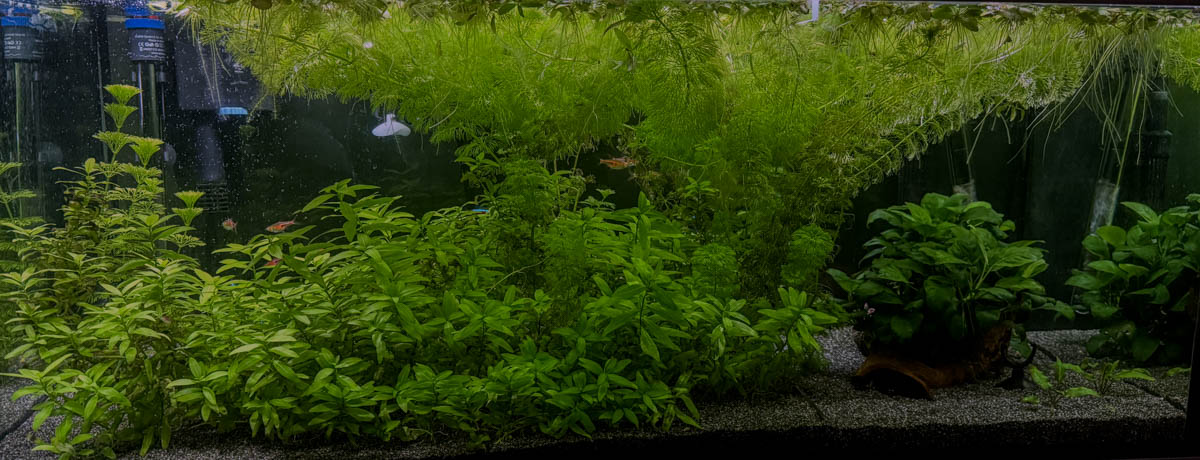
Draw you own conclusions.
 
I have around 60 cardinals in the tank in my signature. These are all over 6 years old (yes I know the internet says they live 2-3 years). My tank gets RO water and absolutely nothing else (except food :whistle: ). I have never seen a pH swing but do perform a substantial water change most weeks.
Draw you own conclusions.
Sigh. I only have 30 cardinals in my 180. I'm always behind the times.

Still there is hope for me as i plan to put 300 or 400 ruby tetra in my 700.
 
Last edited:
I have around 60 cardinals in the tank in my signature. These are all over 6 years old (yes I know the internet says they live 2-3 years). My tank gets RO water and absolutely nothing else (except food :whistle: ). I have never seen a pH swing but do perform a substantial water change most weeks.
Draw you own conclusions.
to clarify, you do substantial water changes most weeks and only put RO water into the tank? so your pH must be below 7, which cardinals love, but do you have plants? How do they do? I was considering this as an option.
 
to clarify, you do substantial water changes most weeks and only put RO water into the tank? so your pH must be below 7, which cardinals love, but do you have plants? How do they do? I was considering this as an option.
Are you joking? You must not read anything i post anywhere - this is one of my aquariums with ph below 6:

t5.webp


And this is another:

td.webp


And another:
t1.webp

Well i don't feel like posting all 15 or so aquariums with pure ro water so you will just have to trust me plants do lousy in such water.
 
i'm sorry - i should have added one additional piece of information - to grow plants in soft water you need plants that like soft water - avoid hard water plants in soft water and they will do ok i guess.
 
I just spent time on the Brightwell site reading about their NeoTigewr KH+/GH+.

I saw nothing the their ingredients which would raise the KH. The write a bunch about raising the GH but almost.nothing about the KH except for this:

Advanced Instructions: Each ml of NeoTiger KH+/GH+ will increase the GH and KH in 10 liters or 2.5 US-gallons of water by 1 dGH and .57 dKH.
https://brightwelldirect.com/products/neotiger-kh-gh

So, basically one's KH should go up by 1/2 as much as the GH.

Also, I am having a hard time finding out useful specifics about what it in the NeoTiger. Here is why, They mention the product contains Silicone as silica. This can have an alkaline effect but it will not act as a buffer. If I knew the actual ingredients in the NeoTiger I could figure out what it should be doing in your tank.

However, plants use silica to strengthen their stems and some plants need higher amounts of silica.

So, what it looks like to me is that you are not seeing a rise in the KH because the average test kit is likely looking at the carbonates and bicarbonates not silica or pH. But your pH test is picking up the alkaine effects of the silica.

If you want to raise the KH and not the GH if you want to allow the TDS to be lower than 107, do not use the NeoTiger and do use a small amount of crushed coral.

I also reread your post an I do not understand how you filled your tank with RO water which should have a TDS of about 10 ppm. If should have virtually no KH or GH. Yet you said it had TDS of 107. I am wondering why. That concerns me more than the 0 KH. I am thinking there is something that is causing that which I am not seeing from your post.

Here is what I would suggest you do. Go here and read: https://faq.thekrib.com/begin-chem.html#reference it will help you get a better idea about the more basic parts of water chemistry in your tank. It was my introduction to this stuff many years ago.

"First, a little history: The Krib has been in existence since January of 1994, which puts it officially as the first fish-oriented pages on the web." It has been updated a bunch since then. For some time it ran on a modernized site. This is gone but the infor is still available. It is all here: https://faq.thekrib.com/

One thing your will see there is this table for hardness:

General Hardness
0 - 4 dH, 0 - 70 ppm : very soft
4 - 8 dH, 70 - 140 ppm : soft
8 - 12 dH, 140 - 210 ppm : medium hard
12 - 18 dH, 210 - 320 ppm : fairly hard
18 - 30 dH, 320 - 530 ppm : hard
higher : liquid rock (Lake Malawi and Los Angeles, CA)

So event at 107 it is likely soft enough for cards unless they are wild caught. This is what Seriouslyfish.com says:
Temperature: 23 – 29 °C
pH: 3.5 – 7.5 although wild specimens do best in more acidic conditions.
Hardness: 18 – 215 ppm; towards the lower end of this range for wild fish or breeding.

So you parameters as you list them untouched should be OK for the fish.
 
So event at 107 it is likely soft enough for cards unless they are wild caught. This is what Seriouslyfish.com says:
Temperature: 23 – 29 °C
pH: 3.5 – 7.5 although wild specimens do best in more acidic conditions.
Hardness: 18 – 215 ppm; towards the lower end of this range for wild fish or breeding.

So you parameters as you list them untouched should be OK for the fish.
I've kept wc cardinals in tap water (gh 6 kh 3 tds 220) without any issues. They have been there for around 2 years. I have a 2nd group in ec 20 water (tds 10) and they have also been fine.
-
The ones in tap water almost certainly can't breed (ignoring that the tank itself is not acceptable for such even if they did) the ones in ec 20 should be able to breed but i have my doubt they would have much success given the tank mates.
 
to clarify, you do substantial water changes most weeks and only put RO water into the tank? so your pH must be below 7, which cardinals love, but do you have plants? How do they do? I was considering this as an option.
full

I do indeed have one or two plants. I just choose easy plants that like my water. In the early days I used TNC Lite (or Seachem Flourish Comprehensive) at half the recommended dosage. Once established I stopped the ferts. I stopped testing pH years ago but when I did this one was always between 6.5 and 7.
OTOH this one used to hover at around 5 with exactly the same treatment. Possibly because it had a lot more wood
20210216_192746502_ios-webp.129245
 
full

I do indeed have one or two plants. I just choose easy plants that like my water. In the early days I used TNC Lite (or Seachem Flourish Comprehensive) at half the recommended dosage. Once established I stopped the ferts. I stopped testing pH years ago but when I did this one was always between 6.5 and 7.
OTOH this one used to hover at around 5 with exactly the same treatment. Possibly because it had a lot more wood
20210216_192746502_ios-webp.129245
Why do you use fertilizers ? In the ones i posted none of those get any fertilizer. The only one i put fertilizer in is my 20 where i have a the entire top covered by frog-bit:

20_1.webp
 

Most reactions

Back
Top