Water Change

Box

Fishaholic
Joined
Apr 17, 2011
Messages
417
Reaction score
0
Points
0
Location
Kent
Got to say

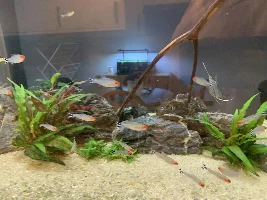
Just love the way my aquarium looks after a 50% water change
Everything looks so clean and clear
Livens up the whole tank 

Box
 
Got to say

Just love the way my aquarium looks after a 50% water change
Everything looks so clean and clear
Livens up the whole tank 

Box

i feel the same but only after i realised the joy of the watering can with rain like head to put the new water in. no disruption to the sand! but more trips to the sink to fill up!
 
150 litres with a watering can? :blink:

I just siphon mine back in with no proplems at all!
 
yep hose it straight in. i do 50% on my 500 litre and can do other things while its filling. 150 litres with a watering can is madness lol
 
You need to add the appropriate amount of dechlorinator such as tapsafe etc. Use warm water also.
 
Do u guys add ur water straight from the taps?
Yes. As long as you add enough dechlorinator for the whole tank before you start re-filling and you use a mixer tap so the water is warm, or trickle the new water back in slowly so the fish aren't shocked, there's no problem doing it that way.

Those of us with multiple large tanks just wouldn't be able to do the required amount using buckets; we'd all be bent double, lol!
 
I hose directly from my electric shower so I can lump in the same temp as my tank. I add seachem prime before I start filling up.
 
i allways have about 3 bukets full of water in my cupboard, it saves me having to go to the shop every couple of weeks, the chlorine evaporates out of the water
 
aged water is fine for chlorine but it does nothing for any metals in the water. Also as more water companies are using chloramines now because of its stability compared to chlorine I think its advisable still to use a good decblorinater.
 
That's fine if you only have a few small tanks; I used to do exactly the same when my kids were small and I had only the one tank.

Now I've got six tanks, four of which are 200l or over; the amount of buckets I'd need, bearing in mind I do 50-60% changes on all my tanks wekly, would be insane!

You should check with your local water authority that they are using chlorine only though, as many nowadays also use chloramine which will not gas off, AFAIK. If they are using chloramine you should start using a dechlorinator that also gets rid of that too.
 
Yes, water companies no longer use chlorine only. They also use chloramine which will not be dispersed by leaving it to stand. You need to be buying a dechlorinator that removes both. I have used Tapsafe, Aquasafe and now trying one from Nutrafin. All seem to do a good job so it's down to expense and personal preference imo. I like to use one that also adds Aloe Vera etc. Unsure as to whether it does any good but i like to think it does. :lol:
 
All dechlorinators will bind both free Chlorine and residual Chlorine as part of the Chloramine molecule, it depend on which type of Chloramine your company uses as to what you will be left with, most use a combination of all three Chloramines (Monochloramine, Dichloramine and Nitrogen Trichloride) after the chlorine from these three has been bound you're left with three Amines (primary, secondary and tertiary) these all have lone pairs which will bond to Hydrogen ions to form Ammonia/Ammonium, some dechlorinators deal with the Ammonia created as a result of the breaking of Chloramine molecule, some don't, your filter should be able to cope with any excess Ammonia within a few hours though.

 
All dechlorinators will bind both free Chlorine and residual Chlorine as part of the Chloramine molecule, it depend on which type of Chloramine your company uses as to what you will be left with, most use a combination of all three Chloramines (Monochloramine, Dichloramine and Nitrogen Trichloride) after the chlorine from these three has been bound you're left with three Amines (primary, secondary and tertiary) these all have lone pairs which will bond to Hydrogen ions to form Ammonia/Ammonium, some dechlorinators deal with the Ammonia created as a result of the breaking of Chloramine molecule, some don't, your filter should be able to cope with any excess Ammonia within a few hours though.
I love it when you talk technical ;)
 
All dechlorinators will bind both free Chlorine and residual Chlorine as part of the Chloramine molecule, it depend on which type of Chloramine your company uses as to what you will be left with, most use a combination of all three Chloramines (Monochloramine, Dichloramine and Nitrogen Trichloride) after the chlorine from these three has been bound you're left with three Amines (primary, secondary and tertiary) these all have lone pairs which will bond to Hydrogen ions to form Ammonia/Ammonium, some dechlorinators deal with the Ammonia created as a result of the breaking of Chloramine molecule, some don't, your filter should be able to cope with any excess Ammonia within a few hours though.
I love it when you talk technical ;)

I hate it when he talks technical as i don't particularly understand him. I struggle when he doesn't talk technical lol :lol:
 

Most reactions

Back
Top