This is wonderful! I'm very new to aquarium plants, and have had some difficulty identifying some of them. Would you be able to point me to resources that are good for helping laypeople identify a plant please? Or where you get information like this? It's really interesting stuff

I do wish I could go back and tell 12 year old me to sign up for those latin classes in school. I didn't see the point in learning a dead language at the time, but subsequent interests in plants and animals taught me how useful it would have been to learn!
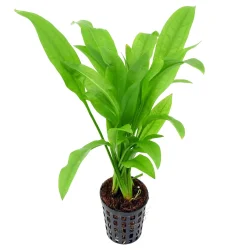
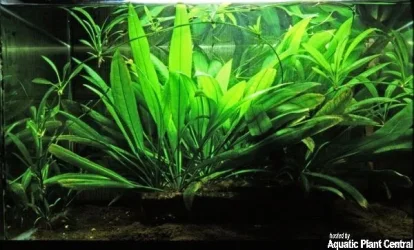
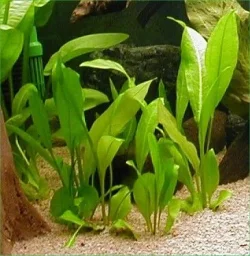
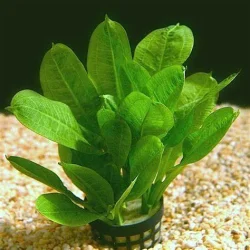
Thank you. Identification of aquatic (aquarium) plant species is not usually easy. The one example of the variety in appearance, leaf shape, even leaf colour, of the four "species" that are now known to actually be just one species with varieties illustrates this difficulty. If one looks at two plants with differing leaf shapes one would not usually assume they are in fact one distinct species. With other plants, like the
Cryptocoryne species, it is the flower that is used to determine the species, but these plants rarely flower in an aquarium.
Vallisneria species have a similar problem, but one made even more involved by the fact that there are quite different male and female flowers within the individual species, and rarely will we see them together.
I acquired what I thought were Amazon Frogbit plants some years ago, and they flowered shortly after I acquired them. I posted photos on another forum, and the forum owner sent me an email he had received from someone in the US Department of Agriculture informing him that the plant was an invasive species illegal in many states, and we should not be promoting it. Turns out there are three "Frogbit" species, one tropical but two temperate, and it was one of the latter that I had been sold to me and the flowers identified the species. Leaves are identical on both, so without the flowers or DNA analysis one might never know which we have.
Another issue we now have to contend with are the many hybrids the hobby has generated over the last couple of decades. All of the variegated leaf plants in the
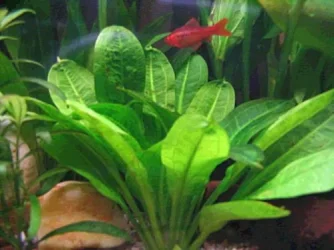
Echinodorus (sword) plant group are artificial hybrid plants that do not occur in nature.
I have researched the literature and scientific studies on some aquarium plants over the past 15 or so years, and written profiles for another forum. I am not a trained botanist, far from it, but I do have a strong interest in research and science and these days with the internet resources we can with some effort find a lot of good information. One excellent book is Peter Hiscock's
Encyclopedia of Aquarium Plants. Another more detailed and scientific is Christel Kasselmann's
Aquarium Plants (English edition as well as the original German). These are rather good as identification tools, and Dr. Kasselmann's does include a lot of scientific and taxonomy data. But some of this is being changed as we discuss, with the advancements now possible through phylogenetic analysis.



 I guess I was lucking moving my sword plants the other day. They did not have a big root system and were easy to transplant.