New Set Up! Noobie Water Question

baron von bubba

Fish Crazy
Joined
Feb 24, 2009
Messages
308
Reaction score
0
Points
0
Location
near stroud, glos
hi,
setting my tank up, its gonna be a quite a heavily planted tank
checked my tap water which i will be using at water changes and the initial fill up
nitrates around 12ppm
Phospates 3-4ppm

phosphates seem high and will give me problems, right??

what are my options?

any input welcome!
thanks.
 
3-4 is fine. After the tank is planted they should be reduced by the plants. Ideally you want to keep it at about 2.
 
3-4 is fine. After the tank is planted they should be reduced by the plants. Ideally you want to keep it at about 2.


thats contrary to almost all i've read!
phosphates of above 1ppm are not good due to the masively increased chance of algae growth?! (or so i believe) :0)
my way of thinking is if i keep the phosphate low and the nitrate to phos ratio in balance i'm halfway there to keeping my tank realtivly algae free?!

so i'm thinking 250ml of rowaphos at £12 or so, a quarter of this in my filter would take the phos in my tank down to less than 1ppm and the rest would be roughly enough to take the most phos out of my tap water (for changes) (in a butt with old canaster filter) for 2 months, that dosent seem too expensive if it helps keep algae at bay!!

anymore thoughts from ppl would be much appreiciated?
 
well I dont know much about phosphates but I do know there are other things that can cause algae. You do plan to use a substance that has nutirants for plants, Co2 (provided you have 2wpg) and a nutrient substance to help keep he plants healthy too right?
 
well I dont know much about phosphates but I do know there are other things that can cause algae. You do plan to use a substance that has nutirants for plants, Co2 (provided you have 2wpg) and a nutrient substance to help keep he plants healthy too right?


ya, using eco complete substrate topped off with plain black gravel and co2 with a dennerle ph controller, under gravel heater and currently have 2x 54w T5 plantgrow tubes over a 250 litre 4 foot tank.
 
3-4 is fine. After the tank is planted they should be reduced by the plants. Ideally you want to keep it at about 2.


thats contrary to almost all i've read!
phosphates of above 1ppm are not good due to the masively increased chance of algae growth?! (or so i believe) :0)
my way of thinking is if i keep the phosphate low and the nitrate to phos ratio in balance i'm halfway there to keeping my tank realtivly algae free?!

so i'm thinking 250ml of rowaphos at £12 or so, a quarter of this in my filter would take the phos in my tank down to less than 1ppm and the rest would be roughly enough to take the most phos out of my tap water (for changes) (in a butt with old canaster filter) for 2 months, that dosent seem too expensive if it helps keep algae at bay!!

anymore thoughts from ppl would be much appreiciated?

Any chance you have been reading about the "redfield Ratio" (RR)?
 
Any chance you have been reading about the "redfield Ratio" (RR)?

i've been reading various sites and books for about 4 hours a day over a 6 wk period!
so yeah the redfield ratio is something i have read about!

the contradictory info to trawl thro is just obscene!! :0/

i'm just trying to give myself the best chance of "success" and while the phos levels in some cases may be ok, i believe they are my biggest source for problems?? correct?
 
Any chance you have been reading about the "redfield Ratio" (RR)?

i've been reading various sites and books for about 4 hours a day over a 6 wk period!
so yeah the redfield ratio is something i have read about!

the contradictory info to trawl thro is just obscene!! :0/

i'm just trying to give myself the best chance of "success" and while the phos levels in some cases may be ok, i believe they are my biggest source for problems?? correct?

thought you might of lol. I would ignore the RR, it doesnt work out. Quote from Tom Barr:
Well, the issue here is the RR is entirely miscalculated and then everyone runs around linking an republishing the error.

RR is an atomic ratio based on the no# of ATOMS, not mass.

So the mass conversion must include the moles/gram.
P is 30.97 g/mol
N is 14 g/mol.

This means the mass ratio is 7.2 N : 1P

A factor over 2.2 times higher for P than what is stated above by Charles. I poiunted this out to him some years ago, references etc, no change, no response. This is common knowledge about the RR. Folks sometimes mix this issue up.

For NO3 and PO4, then you would use about 10:1.

Lean on PO4 is fine in most cases and providing some attention to nutrients will help, provided that you use use calibrated test kits for relyng on NO3 and PO4 tank measures, and you dose routinely etc.

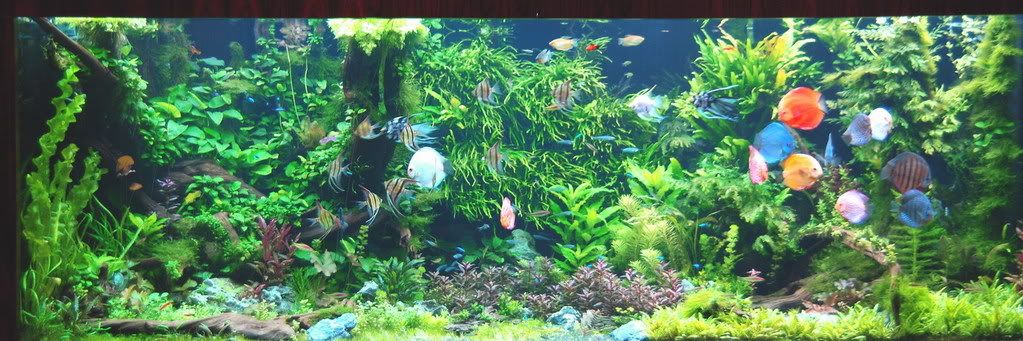
As you can hopefully see it does not meet the requirments of RR. Also, if high phosphate is a bad thing, then why do we see lots of excellent plant growth? Pictures clearly do speak a thousand words... The first few are mine, the 3ppm PO4 are Tom's and the latter are from various sources whom i have acknowleged,

1.5ppm PO4


3ppm PO4 - Tom Barr (plantbrain)
resizedsideview20.jpg

resizedcubapantanal1.jpg


Andy (supercoley1)
cabinetcomplete.jpg


Mark's (saintly)
b02c767e.jpg


Dave (dave spencer)
Sunsetpb.jpg


All are algae free tanks which are doing perfectly well - or was, because most if not all have been ripped down :lol: Perhaps some of them were in the RR ratio, but even still PO4 above 1ppm will do no harm. It is when you start to limit PO4 you get problems! When PO4 limited plants do not grow aswell, or even worse sometimes die. When they rot they produce ammonia and it is the NH3 spike that triggers algae.
Something else worth noting is that doing larger, or more frequent water changes helps to remove organic matter, algae spores and dilute NH3 - all which causes algae.

Hope that answers your question on high PO4 ;)

Thanks


EDIT: I can PM few links on RR where Tom goes more in depth if anyone is still not convinced.

Thanks
 
I am always dubious of people that post pictures of their tanks and then assume that is proof that their advice is not only the right way but also the only way. Even algae infested tanks have clean new leaves that can be photographed and tanks recently setup look lovely before the algae takes over, tanks that are constantly cleaned can look great for long periods of time but your not solving any algae problem, your just hiding it. That and the fact that most of these people tear down their tanks on a regular basis and start again.

High NO3 and PO4 by itsself doesn't induce algae. But PO4 above 1ppm will result in noticeable addition of algae unless you take the Tom Barr approach which means tons of light, tons of CO2, tons of nutrients, lots of water changes requiring alot of energy and enthusiasm. Tons of NO3 and PO4 are not only suited to this type of aquarium but they are actually required.

These "experts" seem to miss the point. To most people a tank is an addition to their living space and not something they are obsessed with. They want an easy maintenance schedule to go hand in hand with their busy lifestyle. They aren't going to be mixing up nutrients, changing 50%+ water every week and sticking their hands in the tank every 5 minutes to clean up algae and prune the plants.

They also care about their fish more than their plants so for example swimming space might be more important to them than huge plant biomass.

Reducing NO3 and PO4 will slow down algae growth and slow down plant growth so you need to decide what you want from your tank and how much effort you are willing to put in before determining if a certain level of PO4 is good or bad. Generally something like NO3 5ppm-10ppm and PO4 0.05-0.25 will enable most plants to grow at an acceptable level whilst limiting algae to the level that just one fortnightly cleanup will be sufficient to stop the algae taking over, and this is all that most of us want.

As for RR it has it's uses but it's not workable for stopping algae growing. It can tell you which type of algae you will get when either NO3 or PO4 is limiting but you should never have either of them limiting anyway. Running out of NO3 will result in BGA, running out of PO4 will result in green algae. A 10:1 ratio in your tank means you will run out of both at the same time, generally speaking of course. Higher NO3 means you will run out of PO4 first and higher PO4 runs you out of NO3 first. This is all assuming youv'e got sufficient levels of nutrients all of the time.

There are many ways to running a tank, showing a nice picture and saying it's got 3ppm PO4 by itsself is meaningless and misleading. Ask yourself what you want and then go from there :)
 
he's got a very valid point surely?

if i only am aiming for 30% water changes every two weeks and want a long term tank. with the fast growers i have more of now getting replaced over time with more slow growing plants.

i dont really like the idea of 50% water changes every week so the EI method isnt for me.
so the higher phosphate levels are fine if i'm gonna be dosing loads and doing large weekly water changes?

but, if i intend a slightly lower maintainence healthy planted tank the phos levels "could potentially" cause me problems?
if that's the case and there is an easy way to pre-emp this, then i should surely try it?

also it is true a tank in the early stages, as it "grows in" is fairly likely to get algae problems is it not?
 
I am always dubious of people that post pictures of their tanks and then assume that is proof that their advice is not only the right way but also the only way.

I never said that the pictures were the only way to go, i was merely stating not to worry if your PO4 is above 1ppm.
Even algae infested tanks have clean new leaves that can be photographed and tanks recently setup look lovely before the algae takes over, tanks that are constantly cleaned can look great for long periods of time but your not solving any algae problem, your just hiding it. That and the fact that most of these people tear down their tanks on a regular basis and start again.

ok then here are some full tank shots to prove i am hiding no algae :rolleyes: , point out the algae to me if you find some

My tank again
DSCF0003-3.jpg

tank-3.jpg


Toms tanks:
resizedfull180week4.jpg

resized16000Oct3.jpg


Marks tanks
test.jpg

cf32ee18.jpg


Theres proof of all the algae i was hiding ;)


High NO3 and PO4 by itsself doesn't induce algae. But PO4 above 1ppm will result in noticeable addition of algae unless you take the Tom Barr approach which means tons of light, tons of CO2, tons of nutrients, lots of water changes requiring alot of energy and enthusiasm. Tons of NO3 and PO4 are not only suited to this type of aquarium but they are actually required.

hang on a minute... tons of nutrients ... so are you saying that tons of nutrients (ie above 1ppm PO4) will actually limit growth in a high light, high tech environment? Interesting!

These "experts" seem to miss the point. To most people a tank is an addition to their living space and not something they are obsessed with.
True

They want an easy maintenance schedule to go hand in hand with their busy lifestyle.
Go for a low tech tank then

They aren't going to be mixing up nutrients, changing 50%+ water every week
buy an all in one fert then and change 10% weekly

and sticking their hands in the tank every 5 minutes to clean up algae and prune the plants.
correct because there will be no algae as the plants will not be PO4 limited.
They also care about their fish more than their plants so for example swimming space might be more important to them than huge plant biomass.
not sure what this has to do with high PO4 but still go for an iwagumi if you like open spaces.

Reducing NO3 and PO4 will slow down algae growth and slow down plant growth so you need to decide what you want from your tank and how much effort you are willing to put in before determining if a certain level of PO4 is good or bad. Generally something like NO3 5ppm-10ppm and PO4 0.05-0.25 will enable most plants to grow at an acceptable level whilst limiting algae to the level that just one fortnightly cleanup will be sufficient to stop the algae taking over, and this is all that most of us want.
So now we are getting somewhere, limiting nutrients does slow plant growth. Slower plant growth means algae will have a larger chance to grow, hence why i said in my 2nd post "When PO4 limited, plants do not grow aswell, or even worse sometimes die. When they rot they produce ammonia and it is the NH3 spike that triggers algae."

As for RR it has it's uses but it's not workable for stopping algae growing. It can tell you which type of algae you will get when either NO3 or PO4 is limiting but you should never have either of them limiting anyway. Running out of NO3 will result in BGA, running out of PO4 will result in green algae. A 10:1 ratio in your tank means you will run out of both at the same time, generally speaking of course. Higher NO3 means you will run out of PO4 first and higher PO4 runs you out of NO3 first. This is all assuming youv'e got sufficient levels of nutrients all of the time.
And again you are agreeing with me that PO4 should not be limited. You even state yourself that low PO4 causes GSA! Higher NO3 does not mean that plants will run out of PO4 first, PO4 uptake depends on the availability of CO2. So if you inject CO2, Phosphate will be more demanded.

There are many ways to running a tank, showing a nice picture and saying it's got 3ppm PO4 by itsself is meaningless and misleading. Ask yourself what you want and then go from there
True, but the "nice" pictures also show no algae, even though the PO4 is above 1ppm, surely that has to be telling you something. It is by no means meaningless, it proves my point very well that high PO4 does not lead to excessive algae growth.

Thanks.

 
i dont really like the idea of 50% water changes every week so the EI method isnt for me.
first of you are not EI dosing are you? so therfore you no need to worry.

so the higher phosphate levels are fine if i'm gonna be dosing loads and doing large weekly water changes?

because your PO4 is already high, you wont need to dose any more, there is plenty there for the plants to utilise. Personally i would do 30% weekly water changes, along with a basic fertiliser such as tropica plant nutrition (potassium and trace elements).
but, if i intend a slightly lower maintainence healthy planted tank the phos levels "could potentially" cause me problems?
if that's the case and there is an easy way to pre-emp this, then i should surely try it?
if you are convinced that you will get problems then by all means try something like Rowaphos, personally if i was desperate to lower the levels then i would just do larger, more frequent water changes.

also it is true a tank in the early stages, as it "grows in" is fairly likely to get algae problems is it not?
you are most vulnerable at the first few months of a tanks life, as there could be ammonia spikes, the plant biomass is low (why we always say plant 75% substrate coverage) and the whole tank is generally unstable. To help you could shorten the photperiod to 6hours a day, and performm 50% water changes per week for the first month to help minimize any early issues may come to face. Some people also use zeolite or purigen in the filter to remove ammonia.

Thanks
 
Wow there's some good inaccurate information being handed out. LoL
 
....the Tom Barr approach which means tons of light, tons of CO2, tons of nutrients, lots of water changes requiring alot of energy and enthusiasm.

Since when has this been the Tom Barr approach?

MT2009, are you saying 2ppm Phosphtes is ideal? How come? Instead of calling this thread full of misinformation, back it up.

Dave.
 

Most reactions

Back
Top