Mulling over the suckers

MattW31 147

Supporting Member
Staff member
5x Tank of the Month 🏆
Global Moderator ⚒️
Fish of the Month 🌟
Supporting Member ⭐
Joined
Jul 18, 2021
Messages
1,981
Reaction score
2,670
Points
113
Location
Greater Manchester
So I had been contemplating adding another shoal of tetras to the muzel cherry tank. But after watching some videos on whiptails and other catfish, I started looking into them more and may have caught the bug (sorry Cap'n B). The issue is that I do have a few non-negotiables and requirements for any inhabitants that go in this tank. Which, in this hobby, is quite hard to fully accomplish (this is where I find out what I'm after is not even inhabiting this planet). So here they are..

My tank is only 90L (23gal) and is currently just over half-stocked, according to AQ calculators. This means even a common bristlenose or even a clown pleco would be too big and not work for this tank, especially with the hardscape & other inhabitants inside. Secondly, a species that prefers to be peaceful & solitary compared to a social sucker. Lastly, I would actually like to avoid any pure plant-based diet fish just so my plants & wooden hardscape don't get turned into mush.

After looking myself, the options are pretty much nonexistent. The only one I could find is the Mini Snowball Pleco (L471), which actually means I would have to make alterations to the tank's flow. So is there anything else? Or do I just give some tiny O.affinis a ticket instead?
 
Much to my surprise when I kept otos they spawned and I got to watch tiny little otos swim around.
They were more exciting than I had expected and a challenge to find in my large planted tank.
I think they lay their eggs on the under side of leaves.
Not much bio load or overstocking issues if they do breed.
 
IMO, if you at least have good filtration and a good amount of wood, panaqolus maccus is actually a decent size for this tank size even with tankmates.

Maxes out at 3 inches, wood eater though. Will take algae wafers, pellets, repashy, blanched veggies... offer meaty food once a week. But keep on top of green food to prevent damage to plants.

But, filtration will be your biggest factor here.
 
Much to my surprise when I kept otos they spawned and I got to watch tiny little otos swim around.
They were more exciting than I had expected and a challenge to find in my large planted tank.
I think they lay their eggs on the under side of leaves.
Not much bio load or overstocking issues if they do breed.
I've had otos before, and they have worked in my tanks previously (unless I made a stupid error). They are a great fish, and I'm jealous that you managed to get them to breed 😅. Perhaps I will look into the common and less common ones as well. Thankfully, I have a semi-local store that specialises in plecs and catfish.
IMO, if you at least have good filtration and a good amount of wood, panaqolus maccus is actually a decent size for this tank size even with tankmates.

Maxes out at 3 inches, wood eater though. Will take algae wafers, pellets, repashy, blanched veggies... offer meaty food once a week. But keep on top of green food to prevent damage to plants.

But, filtration will be your biggest factor here.
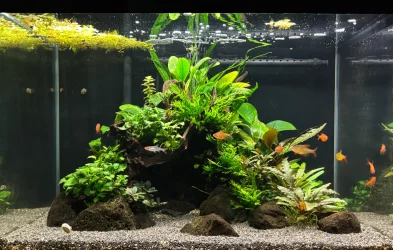
Thanks for that info! The tank is pretty much a central plant volcano with a base of lava rock and wood. Lots of natural dark areas and caves to retreat to if needed. The filter has a 600 l/ph turnover, I use a spray bar to even out the outflow so the fish don't get thrown about. I will look again at clown plecs then. I do sadly have a taste for the less common species in this hobby, so that doesnt help with finding what I'm looking for either:lol:

I did come across a zebra pleco that didn't grow too big. The Colombian L129. After a quick read, my tank temps and parameters do fit this species. Another was the very small Parotocinclus haroldoi. Again, a fit for this tank with some minor adjustments, the only issue being that it prefers to be in groups. But could I get away with a small group of 3-4 in this tank without overstocking?
 

Attachments

  • IMG_0524.webp
    IMG_0524.webp
    332.1 KB · Views: 3
A single Sturisomatichthys whiptail might work in a 23 gallon. Mine aren't extremely active or social, though they do get fairly big. They don't seem to eat a ton so I doubt they produce a lot of bioload. But they do get fairly big; mine are around 7-8" long.

In a tank that size, I'd probably stick to ottos. They are really cool little fish.
 
A single Sturisomatichthys whiptail might work in a 23 gallon. Mine aren't extremely active or social, though they do get fairly big. They don't seem to eat a ton so I doubt they produce a lot of bioload. But they do get fairly big; mine are around 7-8" long.

In a tank that size, I'd probably stick to ottos. They are really cool little fish.
My first thought was the Farlowella but tank size seems to be the issue.
I kept the Farlowella before it was undemanding as far as activity level so I did not think a smaller tank here was a big deal.
But every link I found said bigger tank and mine was in a larger tank.
Leading to my Oto suggestion.
I like your whiptail also.
 
My first thought was the Farlowella but tank size seems to be the issue.
I kept the Farlowella before it was undemanding as far as activity level so I did not think a smaller tank here was a big deal.
But every link I found said bigger tank and mine was in a larger tank.
Leading to my Oto suggestion.
I like your whiptail also.
Mine are in a 150 gallon tank, so I don't know for sure how they'd do in a 23 gallon. Just guessing. 🤷‍♂️
 
The tricky thing with farlowella is they're usually labeled as either f. vittata or f. acus in store and they can be any species. They will *never* be acus unless you have major good lottery luck because acus is not actually collected. It's not from a location people collect from.

Vittata is pretty common, buuut they grow too long for a 23g, as they can reach 8 inches long.

They are very tricky to identify from one another. You need to look at rostrum length, belly scute counts, side scute counts, and other measurements to tell them apart from one another. Some might work, say farlowella mariaelenae or farlowella platorynchus but you'd need to see the fish in person first and get a look at all of the features needed to key out an identification otherwise you'll bring home one that will get too large for the tank size.
 

Most reactions

Back
Top