Dr. Tanks #7 Snail Remover

Apparently when I said I'd report weekly I was feeling a little too optimistic about any free time I might have to do so.
I really hate this time of year, work-wise.

Anyway I never did get around to doing any large water changes but managed 25% on both tanks last night. Other than an automated response I still haven't received any info on what's in this stuff, and at this point it looks like I'll never know.

What I do know is that nothing other than snails died. Again, I don't have any particularly delicate fish, unless you count the ottos-which I don't.

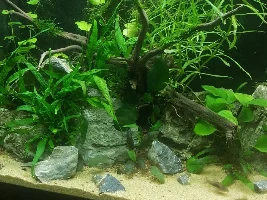
Both tanks are still snail-free and I am so glad squishing is removed from the daily routine. I never really liked that anyway.
 
I wish I knew what this was. I'd be tempted to remove fish to another tank (a luxury I have), zap the tank and then do a few water changes to clear it out. But not knowing what it is is a cause for concern.

I have a few tanks infested with a larger burrowing/trumpet snail than I've encountered before, and they eat fish eggs. The production of the next generation of uncommon fish in those tanks has ground to a halt. I'm back to trapping them and doing manual removal.

I was careless with cleaning plants, and you always seem to pay for carelessness... I had no burrowing snails for close to 2 years, and those were the good old days for those tanks.
 
when I 1st started cleaning up tanks, after my 30 year break, I pulled out the gravel, and under gravel filter plates, and 2 tanks were completely full of trumpet snail shells under the filter plates, literally an inch deep... that was part of the reason a few of my 1st tank restarts, didn't reuse the under gravel filters... it's funny, because I didn't really remember seeing them, and if I did, I'm sure it was just one or two, I was blown away filling half a shop vac full of shells preparing them, to restart them....
 
when I 1st started cleaning up tanks, after my 30 year break, I pulled out the gravel, and under gravel filter plates, and 2 tanks were completely full of trumpet snail shells under the filter plates, literally an inch deep... that was part of the reason a few of my 1st tank restarts, didn't reuse the under gravel filters... it's funny, because I didn't really remember seeing them, and if I did, I'm sure it was just one or two, I was blown away filling half a shop vac full of shells preparing them, to restart them....

It's experiences like this that leave me in wonder when people think these creatures are valuable contributors to a tank. Every snail shell you find had an animal in it that decomposed unseen in your gravel. That in turn fed ammonia.

The smaller the tank, the worse they are.

As survivors, they're admirable creatures, and if people like them, they should have their own tanks. One you have them in a tank, the damage they do is far greater than the good, if you keep fish. Cockroaches and rats are also admirable survivors, but I don't wish to share my human space with them. Burrowing snails are able to flourish with very little food, and breed incredibly well. They are of no value to a healthy fishtank, and ideal if you want a snail only tank with invisible residents.

I know people with snail only tanks, and burrowers can be part of that. But for a fishtank, they are roaches, and the use of poisons against them can have longterm repercussions.
 
The majority of my working days were at the phone company, and as I progressed through various duties for a while I went into installation and repair.
I can't tell you how many times I pulled a non-working jack off the wall to find it literally packed with cockroaches. Not the big 'uns you see in Texas, but equally as disgusting. They create some sort of goo that corrodes copper.
As much as I hate them, I'd MUCH rather deal with snails!
 
A scenario for a nightmare - if pond snails and cockroaches could interbreed... I wouldn't go to that movie.
 
It's very easy to rid yourself of snails. All it takes is 24 hours. Transfer your fish to a holding tank. Then add the equivalent of 5mg of copper sulfate to the problem tank. Wait 24 hours and then do a 90% water change. Refill the tank and repeat. The tiny amount of copper that remains will not harm the fish and will actually benefit the plants.
 
That sounds like a lot of work compared to dropping in a few tablets! Anyway I thought I'd read that the eggs are resistant to copper sulfate?
 
Copper sulfate raises a few questions I haven't found researched answers on. I've always erred on the side of caution, if I've erred.

Hobby lore says copper gets into the silicone, as methelyne blue does. I don't care what it does to inverts (other than killing snails), as I don't keep them, but seemingly anecdotal evidence suggests it can reduce fertility, as a spermicide in very low concentrations. For me as a fish breeder, that matters.

Has anyone found grounded research on that?
 
I'm beginning to think whatever is in this stuff must be pretty mild. As before, everything is thriving, but today I spotted one of the dreaded mobile snot machines. A quick squish remedied that but I'll have to keep an eye on it. I'm thinking an egg (hopefully just one) must have survived the treatment.
 

Most reactions

Back
Top