How to Lower Nitrate Levels?

TGOATW

Fish Fanatic
Joined
Mar 19, 2024
Messages
73
Reaction score
4
Location
Malaysia
I have a hillstream loach in my tank and i am worried i am doing too much of a water change.

My nitrate spike is probably due to excessive detritus in my gravel plus exploding bladder snail population. I have tried vacumming my gravel and taking out snails manually, but detritus suddenly appears out of no where and there are still lots of tiny snail children.

I would like some tips on changing water without stressing mainly my loach, since i've heard they are more sensitive.
 
I would do ten percent. The next day 20, vaccuuming. Keep it going like that for a week, then lock into regular weekly changes.

Somehow, I sense it may be a small tank. How many litres?
 
About 10 gallons (about 35 litres) if i remember correctly.
I would do ten percent. The next day 20, vaccuuming. Keep it going like that for a week, then lock into regular weekly changes.

Somehow, I sense it may be a small tank. How many litres?
 
About 10 gallons (about 35 litres) if i remember correctly.
water changes is definitely one of the most straightforward approaches to getting rid of nitrates
What species is your loach?

In the long term, i like to keep floating plants in my tank. If you let them take over, they can lower it to zero.
Duckweed especially does well indoors
 
water changes is definitely one of the most straightforward approaches to getting rid of nitrates
What species is your loach?

In the long term, i like to keep floating plants in my tank. If you let them take over, they can lower it to zero.
Duckweed especially does well indoors
I didnt know there were multiple hillstream loach species, and from a quick research, it's probably Sewellia Lineolata.

I love duckweed, but it's weirdly hard to find in my city. I've recently randomly gotten a very small amount of duckweed though, but i'm worried they will block the light from the plants below.
 
I didnt know there were multiple hillstream loach species, and from a quick research, it's probably Sewellia Lineolata.

I love duckweed, but it's weirdly hard to find in my city. I've recently randomly gotten a very small amount of duckweed though, but i'm worried they will block the light from the plants below.
i see, a few of those probably aren't the bioload problem then

it's quite invasive, maybe local laws restrict it or something. as long as the duckweed is kept thin on the surface it will not suffocate anything below
 
i see, a few of those probably aren't the bioload problem then

it's quite invasive, maybe local laws restrict it or something. as long as the duckweed is kept thin on the surface it will not suffocate anything below
I have a single loach in the tank, i think the problem is bladder snails. I keep removing them manually but they keep appearing, and the offsprings are so small, i can't see them sometimes.
 
I have a single loach in the tank, i think the problem is bladder snails. I keep removing them manually but they keep appearing, and the offsprings are so small, i can't see them sometimes.
a single loach will not eat a lot, how much are you feeding the tank? I used to have a problem with them because I overfed.
 
a single loach will not eat a lot, how much are you feeding the tank? I used to have a problem with them because I overfed.
Once per day, i also have danios in my tank. But now i think it's the snail's problem, because i just noticed tons of bladder snail shells at the gravel, idk how i didnt notice them before.
It's probably because those darn snails dying and are just rotting there, although i'm unsure why they died.
 
Post a picture showing the entire aquarium so we can see how well its planted.

How long has the tank been set up for?
What sort of filter is on the aquarium?
How often and how do you clean the filter?
What is the ammonia and nitrite level of the aquarium water?

--------------------

If it's a new tank and you have a nitrite reading, that will give you a high nitrate reading. This is due to nitrate test kits reading nitrite as well as nitrate and giving you a false reading.

If the aquarium has been setup for a few months and the filter has cycled, the easiest way to reduce nitrates is with big (75-90%) water changes. Fish that have been in an aquarium for a few months and they have been getting regular water changes, are fine with big water changes as long as the new water has a similar chemistry (pH, GH & KH) and temperature to the tank water. And as long as the new water is free of chlorine/ chloramine before it's added to the tank.

If you have lots of fast growing aquatic plants in the aquarium, they will use ammonia and less ammonia means lower nitrite and nitrate levels in the water. Plants can also use nitrite and nitrate but process ammonia easier than nitrite or nitrate.

Floating plants like Water Sprite (Ceratopteris thalictroides/ cornuta) and Duckweed (as mentioned by Sgooosh) will help and you don't have to let them cover the entire surface but they might do that. You can make a plastic ring our of airline and an airline joiner and have it float on the surface. Put the floating plants in that to control them and stop them covering the entire tank.
 
Post a picture showing the entire aquarium so we can see how well its planted.

How long has the tank been set up for?
What sort of filter is on the aquarium?
How often and how do you clean the filter?
What is the ammonia and nitrite level of the aquarium water?

--------------------

If it's a new tank and you have a nitrite reading, that will give you a high nitrate reading. This is due to nitrate test kits reading nitrite as well as nitrate and giving you a false reading.

If the aquarium has been setup for a few months and the filter has cycled, the easiest way to reduce nitrates is with big (75-90%) water changes. Fish that have been in an aquarium for a few months and they have been getting regular water changes, are fine with big water changes as long as the new water has a similar chemistry (pH, GH & KH) and temperature to the tank water. And as long as the new water is free of chlorine/ chloramine before it's added to the tank.

If you have lots of fast growing aquatic plants in the aquarium, they will use ammonia and less ammonia means lower nitrite and nitrate levels in the water. Plants can also use nitrite and nitrate but process ammonia easier than nitrite or nitrate.

Floating plants like Water Sprite (Ceratopteris thalictroides/ cornuta) and Duckweed (as mentioned by Sgooosh) will help and you don't have to let them cover the entire surface but they might do that. You can make a plastic ring our of airline and an airline joiner and have it float on the surface. Put the floating plants in that to control them and stop them covering the entire tank.
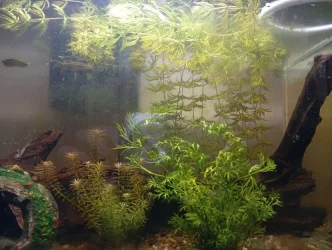
I only have a few plants. I'm pretty sure i have guppy grass and hornwort, but unsure about the left one. And the store sells me these wrapped in a cotton bundle, and was worried there were too many floating plants. So i planted them into the ground.
 

Attachments

  • IMG_20251012_144147.jpg
    IMG_20251012_144147.jpg
    344.5 KB · Views: 49
Floating plant looks like hornwort, although some of it looks like it's upside down (the stuff going into the gravel).

Plant in gravel on left looks like Elodea.

Plant in gravel on right looks like water sprite (Ceratopteris thalictroides or cornuta). This can be grown as a floating plant or planted in the substrate.

It's not a heavily planted tank but the plants appear to be doing ok (new growth on the Elodea) and should be helping keep ammonia and nitrate levels down. The algae will be helping too.

The tank doesn't appear to be heavily stocked.

You might have nitrate in your tap water. Have you checked the tap water for ammonia, nitrite and nitrate?
If you have nitrate in your tap water, you can do all the water changes you like and it will never go down.
 
Floating plant looks like hornwort, although some of it looks like it's upside down (the stuff going into the gravel).

Plant in gravel on left looks like Elodea.

Plant in gravel on right looks like water sprite (Ceratopteris thalictroides or cornuta). This can be grown as a floating plant or planted in the substrate.

It's not a heavily planted tank but the plants appear to be doing ok (new growth on the Elodea) and should be helping keep ammonia and nitrate levels down. The algae will be helping too.

The tank doesn't appear to be heavily stocked.

You might have nitrate in your tap water. Have you checked the tap water for ammonia, nitrite and nitrate?
If you have nitrate in your tap water, you can do all the water changes you like and it will never go down.
It's zero across everything. I dont remember the tap water's pH and GH, but kH is also zero. But the substrate i bought has crushed shells and other organic stuffs.
 
What is the nitrate level in the aquarium water (in numbers)?

If your tap water is clean (doesn't have any ammonia, nitrite or nitrate) and the filter is established (you don't have ammonia or nitrite readings in the tank), then you need to do more water changes and gravel cleans to get rid of the nitrates.

Water changes don't stress fish that much as long as the new water has a similar chemistry (pH, GH & KH) and temperature to the aquarium water. If you haven't been doing weekly water changes, then do as Gary suggested in post #2. Do a 10% water change and gravel clean some of the substrate each day for a week. Then increase it to 20% each day for a week, then 30% for a week, then 50% for a week, then do a 50-75% water change and gravel clean the substrate once a week after that.

If the aquarium has been getting small weekly water changes, then just do a 30-50% water change and gravel clean each day for a week. Then do a 50-75% water change and gravel clean once a week after that.

Make sure any new water is free of chlorine/ chloramine before it's added to the aquarium.
 
What is the nitrate level in the aquarium water (in numbers)?

If your tap water is clean (doesn't have any ammonia, nitrite or nitrate) and the filter is established (you don't have ammonia or nitrite readings in the tank), then you need to do more water changes and gravel cleans to get rid of the nitrates.

Water changes don't stress fish that much as long as the new water has a similar chemistry (pH, GH & KH) and temperature to the aquarium water. If you haven't been doing weekly water changes, then do as Gary suggested in post #2. Do a 10% water change and gravel clean some of the substrate each day for a week. Then increase it to 20% each day for a week, then 30% for a week, then 50% for a week, then do a 50-75% water change and gravel clean the substrate once a week after that.

If the aquarium has been getting small weekly water changes, then just do a 30-50% water change and gravel clean each day for a week. Then do a 50-75% water change and gravel clean once a week after that.

Make sure any new water is free of chlorine/ chloramine before it's added to the aquarium.
Nitrate is about 100 ppm, and has been like that for quite a while. It has lowered once or twice to about 50 ppm but shot back up.
 

Most reactions

Back
Top