How Bad Is My Water?

madjoker14

Fish Fanatic
Joined
Oct 5, 2007
Messages
181
Reaction score
0
last night i bought a API masterkit water test and this is my results as of lastnight.
PH->>>>>> 7.4---7.6
Ammonia->> 8.0+
Nitrite->>>> .25
Nitrate->>>> 40


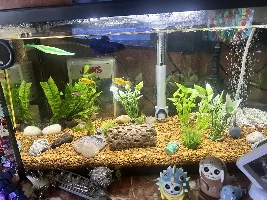
Now i know these are pretty bad reading,but i never tested my water till today,iv a 10 gallon tank with 3 mollies,2 glass fish, and 1 platy and they seem to be acting perfectly fine,i do a 25%water change every weekend,i go to work in the morning so i leave the light on for about 10-12 hours a day with a very dull moonlight at night,and feed them twice a day.

Is there any way that i can bring down these level of toxic??
 
:S I am no expert but I do know you need to do at least 50% water change, and quick!
Then test the water again. You might have to do another water change. You need the ammonia to go below 1, at elast. The acceptable level is 0.25. And I think it is the same for the nitrite. Don't worry about the nitrate too much at this point, just change the water, quick!
 
You mean this is an established tank or a new tank?

You do need to do large water change, 50% atleast and probably more to get the ammonia and nitrite reduced.

If this is an established tank for more then a few months then it is very worrying why this would happen. First, get the water tested by a LFS to make sure that things are wrong. Next, figure out why ammonia is still there. Do you use a water conditioner to do water changes? What filter do you have and how do you clean or maintain it?

Nim
 
Also, what are all these same tests on your tapwater? Are you following the API test instructions very carefully?

And I agree with Nim, are you telling us of each and every type of chemical/action you are performing on your tank water? Sometimes people using Ammo-Lock type things and not mentioning it.

...waterdrop
 
well i moved the tank to my new house so its got about 1 and half months so i guess its a semi-established tank, the filter that im using is the filter that the tank came with,

its the one that sucks up the water,filters it into a blue filter and black stuff in it (sorry i dont know the name of that filter :blush: )and then into a kinda brillo pad filter then is just waterfalls back into the tank.

as for the water i just pour in tap water nothing added to the water whats so ever and i go for a 25% water change like iv read around this forum, algae is not a big issue.

and the tests that include in the API that i did in order are as fallowed...
PH low
PH high
Ammonia
Nitrite
Nitrate

should i go ahead and remove 50% of the water and retest as suggested ?
 
okay so i just re-tested my water again and i think i might of messed up the first time because the readings are so much lower,these are the results

PH------------>7.2--7.6 (for mollies)
Ammon.----->0ppm
Nitrite-------->0.0ppm--0.25ppm (it was in between the two colors)
Nitrate------->40ppm

wich seem normal right?

Another thing, with these test can i combine them to determin Co2 level like i saw in a website combining PH and Kh will determin your Co2 level because im planing on the doing DIY yeast Co2, any advice or hints
 
as for the water i just pour in tap water nothing added to the water whats so ever and i go for a 25% water change like iv read around this forum, algae is not a big issue.

When you add water during your water changes you need to remove the chlorine from the tap water. There are loads of brands but all make tap water safe. By adding untreated water you are killing the bacteria in your filter. I'm surprised by your last readings if you haven't treated the water. Chlorine is also detrimental to the fishes health.

Best of luck
 
OK madjoker,

I agree with bronzecat, we are not sure whether you are using a dechlor/dechloram product on your tap water. Its a reasonable possibility that you have just forgotten to tell us that but that you are doing it. Now that you have redone the api tests they look more reasonable, so your tank may be better established and running than first appeared.

Hey, yours is the tank that moved from RI to the Big Apple, right? You've been caught up in the move and the members here have been helping you with that but its not clear whether you've really had time to read up on the nitrogen cycle and how bacteria gets established and maintained in your filter. Let us know if you already know this stuff or if it is new and you'd like help getting this info. It sounds arcane to new people but its actually fairly simple and important!

My take is that you are really lucky to be in nyc, as a fishkeeper it would be so great to be able to go on a detective hunt for all the great fish shops that must be hiding there in a great city like that.

~~waterdrop~~
 
yup thats me,and unfortunately i haven't found a good fish store even though iv visted about 5 diff one,they each had like 3 or 4 dead fishes in there tanks so i didnt buy any fishes or anything from them but i will keep searching and post if i come across anything good

But i forgot to tell u guys that im using aquarium salt and im puting in 2 teaspoons for my 10 gallon,well as the box told me but i heard mollies needed more then that and also i am using a dechloram called AquaSafe Water conditioner

and for the cycle i know how ammonia > nitrite >nitrate then to get rid of nitrate u do a water change and i test my tap water and it has a nitrate of 0.0-1.0
but i dont know how to take care of my filter even though i know thats where the bacteria lives but to be honest that really what i know, could u guys point me or tell me what else im missing
 
They don't tend to need a lot of maintenance, take the sponge out and wash it in a bucket of tank water once a month or so.The only other maintenance i could think of would be if you notice reduced flow.

I wouldn't worry about a few dead fish, a lot of stores have so many tanks and fish that a few dead are unavoidable. Plus if it was delivery day for the store there'd be almost certainly a few dead lying around.
 
Yea, I agree completely with Olly, the more you go to these stores and the more closely you look, the more you'll learn. Sometimes a store that originally looked bad to you will start to seem like the one that really cares. A good LFS can look fairly grimy on first take. You have an incredible opportunity! You could enjoy all sorts of other things, cafes & shops around nyc while investigating all the LFSs. I would do some web searches followed with phone calls maybe and work up some lists for yourself. Seeing a dead fish is just a piece of info you have to file in your head and then try to put it in context with other things.

re filters, yes, that was one of the most important things, just being sure you understood that its tank water that you use for the cleaning of your sponges and other filter media, not tap water. Also it seems, getting a feel for when your filter is doing a nice solid job (amm and no2 dropping to zero in 24 hours, nitrates building up as expected) versus when things seem not right and something might have disturbed this steady cycle process. I'm still learning this but it is fascinating to see how refined the experienced TFF members are at understanding the subtle signs of this overall process.

I'm not familiar with AquaSafe water conditioner, maybe one of the others can tell you whether this is just a straight dechlorinator/dechloraminator or whether it attempts to do some other things that are not needed. As far as salt goes, I would also question that if I were you. It may be that it is justified for your mollies or it may be that it should really only be used to accomplish certain short-term goals. In my reading, salt is one of those areas where you may find that the experts here on TFF have different and often better opinions than what you read on boxes or hear from fish stores - not saying I know this for your case but just that I'd look into it further if I were you!

Good Luck with your tank! ~~waterdrop~~
 
great advise, i just want to say thanks to everyone that has givin info on this topic seeing as im new to this its good to know that im on the right track with my fishes n there living grounds

but 2 more question still lurks,

(1)what is PH - i though it was fishes waste and decaying food matter but that ammonia so what the heck is ph ?

(2)and nitrATE, i know bacteria converts ammonia into nitrite then another set of bacteria convert nitrite into nitrate, but the only way to get rid of nitrite is by water change? so what do plants use as nutrients cuz i though it was nitrate
 
great advise, i just want to say thanks to everyone that has givin info on this topic seeing as im new to this its good to know that im on the right track with my fishes n there living grounds

but 2 more question still lurks,

(1)what is PH - i though it was fishes waste and decaying food matter but that ammonia so what the heck is ph ?

(2)and nitrATE, i know bacteria converts ammonia into nitrite then another set of bacteria convert nitrite into nitrate, but the only way to get rid of nitrite is by water change? so what do plants use as nutrients cuz i though it was nitrate
2) Nitrate (NO3) is commonly kept under control via water changes. Yup, plants do indeed take in Nitrate but you'd need a true jungle of them to create a balanced system for the fish - its much better to think of our little aquariums as aritificial environments that need some nice weekly habitual tending to be healthy for the fish. Also, for a beginner its hard enough to learn the art of keeping fish. Keeping a few easy plants is not too bad but keeping the kind of vibrant planted aquarium that would use up a lot of nitrates is even harder to learn I think. BTW, nitrates are not really so bad that the beginner should overly worry about them, but regular water changes should be taken seriously.

1) pH is a measure of how acid or basic (alkaline) the water is. Look it up on wikipedia. (haven't looked myself, so let me know if you need further help with that.)

~~waterdrop~~
 
pH is potential hydrogen. It is a measure of how acidic or alkaline water is. A pH of 7 is neutral. Above 7 is alkaline, below 7 is acidic.
Most tanks are somewhere between 6.5 - 8. Different fish have different preferences for pH, but most common fish will be happy in quite a wide range of pH. A stable pH is better than reaching a specific pH.

If pH changes too quickly it can harm fish.

For cycling, a low pH can hinder the multiplication of bacteria.
 

Most reactions

Back
Top