
I inherited a 10g tank from my dad and it has a shallow layer of Fluval Stratum and no sand. I have bronze corys and pygmy corys and also one salt & pepper cory. The other one died which think was down to the substrate as I couldn't see any barbles although it's so difficult to see them as they are super tiny. I tried adding sand but it made such a mess, I gave up. The others seem to be doing fine but there's always the danger of damage with corys.

You are using an out of date browser. It may not display this or other websites correctly.
You should upgrade or use an alternative browser.
You should upgrade or use an alternative browser.
First tank sand question
- Thread starter ambrosia04
- Start date
-
- Tags
- aquasoil begginer freshwater sand

BanjoFish
Fish Crazy
I use Fluval bio and have 12 pygmy corys ( the blue one).
Panda_Monium
New Member
I recommend green tetras - they're a little bit smaller than the neons and, having had a little school of 6, along with panda corydoras and kuhli loaches (I recommend an absolute minimum of 6 panda corys, with 10-12 being a better number for their happiness and your entertainment), as they are big enough to avoid being eaten by the gourami, if you choose to get one, because they are beautiful, and they actually get along really well with the pandas. I was sure my tetras had an identity crisis, because they would happily zoom around with the corys! The best match is an equal number of green tetras and panda corydoras. Then again, I am totally biased.Then I'll get another schooling fish instead, maybe some neon tetras, don't think I'll get more than 8 as they are my first fishes xD
 good luck no matter what you choose.
BanjoFish
Fish Crazy
In a 10 gallon tank the best Corys are the pygmy corys.
The pygmy corys are the only ones I can have in my 15 gallon tank.
BUT they are best with a minimum of 8.
The pygmy corys are the only ones I can have in my 15 gallon tank.
BUT they are best with a minimum of 8.
Yeah totally agree about pygmy corys. I will stick to these for now on. The two Bronze I inherited get on beautifully but my 10g is way too small for these corys. They are very skittish whenever anyone approaches the tank and hit the sides quite frequently. It's amazing they have lasted so long in there. It was my dad's tank and I don't have a bigger tank for them.

TwoTankAmin
Fish Maniac
Corys really do best on sand. However, they can be kept on gravel if it is small size and has rounded edges. The corys eat from the bottom and find the food using their barbels. They root around in the substrate and will even sift sand when the grain size is not too big. But, if the food falls between gravel bits, they work to get it. When the gravel is rough (abrasive) or has sharp edges, this will injure barbels which can then become infected and will soon be gone. A bare bottom is better than the wrong sort of substrate.
Corys should be kept in groups and the more there are the better. In nature they often live in large groups, larger than we can keep in most tanks. At the very least one should get 5 and more is better. But tank size and tank mates should be considered when gettingc orys.
(edited to change the second sentence so it reads "However, they can be kept on gravel if it is small size and has rounded edges.)
Corys should be kept in groups and the more there are the better. In nature they often live in large groups, larger than we can keep in most tanks. At the very least one should get 5 and more is better. But tank size and tank mates should be considered when gettingc orys.
(edited to change the second sentence so it reads "However, they can be kept on gravel if it is small size and has rounded edges.)
Last edited:
BanjoFish
Fish Crazy
Corys really do best on sand. However, they can be kept off gravel is it is small size and has rounded edges. The corys eat from the bottom and find the food using their barbels. They root around in the substrate and will even sift sand when the grain size is not too big. But, if the food falls between gravel bits, they work to get it. When the gravel is rough (abrasive) or has sharp edges, this will injure barbels which can then become infected and will soon be gone. A bare bottom is better than the wrong sort of substrate.
Corys should be kept in groups and the more there are the better. In nature they often live in large groups, larger than we can keep in most tanks. At the very least one should get 5 and more is better. But tank size and tank mates should be considered when gettingc orys.
I use Fluval Bio and have 12 in a 60L
ABCAquarium
New Member
sand is a bit too fine on its owAquasoil absorbs nutrients from the water. That's how it sort of recharges itself. Putting a sand cap on it can inhibit or block that process.
None of the plants you listed are particularly high tech. I'm a low tech guy too. Which means that aqua soil isn't really necessary for them. Sand with root tabs would work just fine and also be suitable for corys.
I recommend green tetras - they're a little bit smaller than the neons and, having had a little school of 6, along with panda corydoras and kuhli loaches (I recommend an absolute minimum of 6 panda corys, with 10-12 being a better number for their happiness and your entertainment), as they are big enough to avoid being eaten by the gourami, if you choose to get one, because they are beautiful, and they actually get along really well with the pandas. I was sure my tetras had an identity crisis, because they would happily zoom around with the corys! The best match is an equal number of green tetras and panda corydoras. Then again, I am totally biased.
ABCAquarium
New Member
recommend an absolute minimum of 6 panda corys, with 10-12 being a better number for their happiness and your entertainment), as they are big enough to avoid being eaten by the gourami, if you choose to get one, --- sorry but it is absurd about gourami potentially eating corys. specially dwarf gourami.sand is a bit too fine on its ow
Corys really do best on sand. However, they can be kept off gravel is it is small size and has rounded edges. The corys eat from the bottom and find the food using their barbels. They root around in the substrate and will even sift sand when the grain size is not too big. But, if the food falls between gravel bits, they work to get it. When the gravel is rough (abrasive) or has sharp edges, this will injure barbels which can then become infected and will soon be gone. A bare bottom is better than the wrong sort of substrate.
Corys should be kept in groups and the more there are the better. In nature they often live in large groups, larger than we can keep in most tanks. At the very least one should get 5 and more is better. But tank size and tank mates should be considered when gettingc orys.
Hi, thanks for this. I am kicking myself now as i bought some aquarium sand and tried to wash it but it all fell through the sieve! I put some unwashed sand in the tank and it clouded up so badly that I chucked it all in the pond!!
So basically what I've got atm is Fluval Stratum with gravel. Some of the gravel has sharp edges so I have got rid of as much as I can. What I want to know is should I try adding sand again on top of this substrate and if so, what should I use? Is there such a thing as washed sand? Thanks ❤
So basically what I've got atm is Fluval Stratum with gravel. Some of the gravel has sharp edges so I have got rid of as much as I can. What I want to know is should I try adding sand again on top of this substrate and if so, what should I use? Is there such a thing as washed sand? Thanks ❤

To wash sand, you put some in a bucket and run water in, swirling the sand round. Then empty the water and repeat until the water is clean. Set the cleaned sand aside then clean the next portion and so on till all the sand had been cleaned. Yes it is tedious with a large amount of sand, but it does work.
The issue with putting sand on top of stratum is the particle size. Small particles will always work though larger particles till all the small particles are on the bottom.
The issue with putting sand on top of stratum is the particle size. Small particles will always work though larger particles till all the small particles are on the bottom.
TwoTankAmin
Fish Maniac
Just as an FYI here. For many years I used only gravel for substrates in tanks. And then I finally felt I was ready to try to keep Altum angels. I was told by a person who had visited almost all the places where Altums are found that the commercial sand which looked most like what he had seen where the Altums lived was the Carib Sea Torpedo Beach.
Back then when DrsFosterSmith still existed they did summer promotions where they offered free shipping even in heavy weight items. Over two simmers when I was still ramping up my tank count and buying things almost weekly O would add 20-40 pounds of the sand to every order.
Most of the other tank where I used the sand were for my plecos and I only used a 1 inch layer and no plants at all. However, I so have a planted sand bittom 115 gal. tank and it is a jungle. In most of my tanks with sand and plants I keep the sand at 1 inch and the palnts are all either attached to wood and rocks or else in pots.
The grain size of sand does matter as well as its shape. Pool sand is intended for filtration use. As such it needs sharper edges. Over time the filtration actions causes the edges to wear down and get more smooth, This is when we have to change the sand out as smooth sand compacts more easily. What drew me to the Torpedo beach was more than how it looked it was also that grain size.
Planted tanks can be difficult to vacuum. Plans and decor can make it hard to use a larger diameter siphon. My solution is to use a smaller diameter one so I can get it into all the smaller places where junk accumulates. I can also vacuum of even delicate plants which tend to catch debris sinking towards the bottom. Using a bigger siphon would uproot some plants, especially those newly planted in the sand which gave not yet become well rooted. Where a bigger size siphon would suck sand out of the tank, the smaller 1 inch diameter tube will not do this.
Back then when DrsFosterSmith still existed they did summer promotions where they offered free shipping even in heavy weight items. Over two simmers when I was still ramping up my tank count and buying things almost weekly O would add 20-40 pounds of the sand to every order.
Most of the other tank where I used the sand were for my plecos and I only used a 1 inch layer and no plants at all. However, I so have a planted sand bittom 115 gal. tank and it is a jungle. In most of my tanks with sand and plants I keep the sand at 1 inch and the palnts are all either attached to wood and rocks or else in pots.
The grain size of sand does matter as well as its shape. Pool sand is intended for filtration use. As such it needs sharper edges. Over time the filtration actions causes the edges to wear down and get more smooth, This is when we have to change the sand out as smooth sand compacts more easily. What drew me to the Torpedo beach was more than how it looked it was also that grain size.
Torpedo Beach
Typical Size: 0.5 - 2.0mm
Average Density: 94 pounds per cubic foot
Planted tanks can be difficult to vacuum. Plans and decor can make it hard to use a larger diameter siphon. My solution is to use a smaller diameter one so I can get it into all the smaller places where junk accumulates. I can also vacuum of even delicate plants which tend to catch debris sinking towards the bottom. Using a bigger siphon would uproot some plants, especially those newly planted in the sand which gave not yet become well rooted. Where a bigger size siphon would suck sand out of the tank, the smaller 1 inch diameter tube will not do this.
To wash sand, you put some in a bucket and run water in, swirling the sand round. Then empty the water and repeat until the water is clean. Set the cleaned sand aside then clean the next portion and so on till all the sand had been cleaned. Yes it is tedious with a large amount of sand, but it does work.
The issue with putting sand on top of stratum is the particle size. Small particles will always work though larger particles till all the small particles are on the bottom.
Thanks for the advice. Yes I did notice the particles were sinking below the Stratum. I think when I start a new set-up with a larger tank, I'll follow the Father Fish method as my dad has done. He uses 1 inch of potting compost with 2-3 inches of sand on top of that and lets it all settle for a few days before adding anything.
Similar threads


- Replies
- 2
- Views
- 503

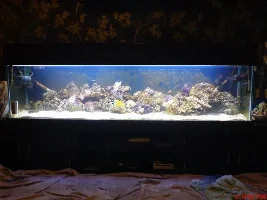

Fish and Aquarium Photos
Fish and Aquarium Photos
Most reactions
-
 760
760 -
 402
402 -
 306
306 -
 197
197 -
 192
192 -
 191
191 -
 187
187 -
 185
185 -
 177
177 -
 158
158 -
 151
151 -
 151
151 -
 92
92 -
 91
91 -
 84
84