Water Turn Over

if you could double the amount of filter media ,that would double the amount of bacteria ,right :blush:
It doesn't matter how much media you have, there will only be enough bacteria to handle the bio-load of the fish, ie., only enough to handle the food present. As you add more fish, the bacteria colony will grow to handle more waste. If you remove fish, bacteria will die off as there isn't enough food to go around.
 
if you could double the amount of filter media ,that would double the amount of bacteria ,right :blush:
It doesn't matter how much media you have, there will only be enough bacteria to handle the bio-load of the fish, ie., only enough to handle the food present. As you add more fish, the bacteria colony will grow to handle more waste. If you remove fish, bacteria will die off as there isn't enough food to go around.
so in a way you are saying the flow rate is not that inportant as long as the media is enough to hold the bacteria ?
so how do you work out how much bacteria you need to keep fish in :blush: :blush: just typed this in and its when your ammonia is zero :blush: so if you put a smallish filter in a big tank and it kept the ammonia at zero it would be ok .
just playing around with figures here :hyper: so more fish bigger filter or am i on the wrong lines here :hyper:

eric
 
IMO a turnover of 4x is fine with the fish you have, I run 9-10x on my predatory fish and my community tank is roughly 4-5x with no problems. But as you said, more fish is going to need a bigger filter and you can never have too much filtration.
 
The slower the flow over the media, the more efficiently ammonia and other polutants will be removed and the less passes you will require the filter to undergo to do that. The slower the flow in the tank, the more time it takes for that ammonia to get processed and the higher the ammonia reading in the tank (remember, ammonia is always present in a tank that has fish in, it's just so low we cannot detect it). You need to strike a ballence between the flow being too fast for the media to work right, and the flow being too slow to keep ammonia undetectable. The ballence point is generaly considered between 3 and 15 times an hour in most cases, depending uppon application, with 8X being a good goal :good:

Fluvals are good filter while they are in warrenty. After that, they tend to have *minor issues* with reliability, leading to wet floors usualy or electric shocks, excess noise, loss of flow and/or complete failure of the motor unit less usualy. Typically, this is within a year of warrenty running out, though a few get lucky. As for those that call them easy to maintain; Most of them probibly haven't ran any other brands. Having ran a total of four brands, Fluvals were the worst to work on IME. They tend to clogg quicker than an equivelant filter for the tank from almost any other make also, so you have to work them more often...

For good exturnal brands, look at Tetratec, Eheim, and Rena, in that order. :good:

All the best
Rabbut
 
IMO a turnover of 4x is fine with the fish you have, I run 9-10x on my predatory fish and my community tank is roughly 4-5x with no problems. But as you said, more fish is going to need a bigger filter and you can never have too much filtration.
cheers jonny so i think i will have to think of a bigger filter because i want to fully stock if not a bit more/any ideas on a filter lol
 
if you could double the amount of filter media ,that would double the amount of bacteria ,right :blush:
It doesn't matter how much media you have, there will only be enough bacteria to handle the bio-load of the fish, ie., only enough to handle the food present. As you add more fish, the bacteria colony will grow to handle more waste. If you remove fish, bacteria will die off as there isn't enough food to go around.
so in a way you are saying the flow rate is not that inportant as long as the media is enough to hold the bacteria ?
so how do you work out how much bacteria you need to keep fish in :blush: :blush: just typed this in and its when your ammonia is zero :blush: so if you put a smallish filter in a big tank and it kept the ammonia at zero it would be ok .
just playing around with figures here :hyper: so more fish bigger filter or am i on the wrong lines here :hyper:
Actually flow rate is important. As mentioned, you need a balance but as a general rule more flow is better. If the flow rate is very low, say 1 time per hour, the ammonia is in contact with the media longer but it will take a full hour for all the water to pass over the media. On the other hand, if you are processing the water 5 times per hour, every 12 minutes, the water is being turned over. Does that mean that every molecule of water in that tank passes through the filter every 12 minutes or even every hour? Alsolutely not. But enough does that the remaining water that still has a minute amoount of ammonia or nitrite in it is diluted to the point it doesn't matter.

As for working out how much bacteria you need, you don't have to work out anything. The bacteria colony will ebb and flow up and down in size depending on how much food (ammonia and nitrite) is present. It will take care of the numbers game. If there is a sudden increase in the amount of ammonia in the water such as when you add new fish, the bacteria will start to multiply and increase it's mass so that it can handle the extra load.

Kind of think of it this way. If you walked out on main street in the town you live in and started giving away $20 bills (or what ever it is in your part of the world), you would suddenly start to make a lot of new "friends" and the crowd would build. But as soon as that money was gone, your new "friends would suddenly go their own way as there was nothing for them there any more.
 
Breeding tanks (or any tank thats pretty bare and with minimal to NO substrate) 8 - 10 times per hour over multiple forums of media

Planted tanks (or any tank with water passing over a veggie filter / refugium) 3 - 4 times per hour to allow the plants and the now loaded substrate to process detritus ect.

Reef Tanks.... how much pump could a good pump pump if you had, 500 bucks.

Marine, non reef. Refugium is a must with algaes. this is in addition to a wet dry. 5 - 7 times per hour. but depending on the size of the refugium, very limited flow over the refugium. say if your doing 350 gallons per hour, you want to send maybe 50 gph to a 20gallon refugium. thats only 2.5 cycles per hour.

and there's something like 30 other variations and counting but this is basic.
 
cheers guys :good:
in your opnion which is bettr a wet and dry filter or a external

cheers
eric
 
Planted tanks (or any tank with water passing over a veggie filter / refugium) 3 - 4 times per hour to allow the plants and the now loaded substrate to process detritus ect.

You should have a minimum of 10x turnover in a planted tank, this is to minimize dead spots, deliver nutrients & CO2 to all 4 corners of the tank and it moves organic watse around the tank and into the filter, to stop it rotting and possible causing algae.
 
going to go for the tetratec 1200 :rolleyes:
does anybodt use one and how good are they
also any body use this store(1st 4 aquatics .com ?
are they realiable :shifty:

cheers
eric
 
Planted tanks (or any tank with water passing over a veggie filter / refugium) 3 - 4 times per hour to allow the plants and the now loaded substrate to process detritus ect.

You should have a minimum of 10x turnover in a planted tank, this is to minimize dead spots, deliver nutrients & CO2 to all 4 corners of the tank and it moves organic watse around the tank and into the filter, to stop it rotting and possible causing algae.

Ive always slowed down my waterflow in my planted tanks. granted im using more then just a spray bar and hope to cover my areas.

I have a PVC manifold under the sand with flanges that poke up and through the substrate to make sure i have good flow in all areas of the tank. 10x turnover in a planted tank is not TOO fast, but all co2, and nutrients would be passed appropriately at half your suggestion. not to say your wrong, but 10x is alot of water flow in one place just to make sure there's no dead spots.

Perhaps a better question isn't how many times we need to flop a tank. but how to EFFICIENTLY do it without pumping almost 600 gph into a 55G tank.

Plus your plants will be blowing all this way and that with water pressure like that.

To answer the other question above, Wet/dry filters / sumps... i swear by them. maximum versatility and performance and you can handle all nutrients co2 injection heating and whatever else you run, all in your sump leaving the tank free of distraction. with good plumbing up in the tank you can almost completely hide everything. (almost). Also i recommend drilled tanks to overflow boxes any day but they do work.
 
Planted tanks (or any tank with water passing over a veggie filter / refugium) 3 - 4 times per hour to allow the plants and the now loaded substrate to process detritus ect.

You should have a minimum of 10x turnover in a planted tank, this is to minimize dead spots, deliver nutrients & CO2 to all 4 corners of the tank and it moves organic watse around the tank and into the filter, to stop it rotting and possible causing algae.

Ive always slowed down my waterflow in my planted tanks. granted im using more then just a spray bar and hope to cover my areas.

I have a PVC manifold under the sand with flanges that poke up and through the substrate to make sure i have good flow in all areas of the tank. 10x turnover in a planted tank is not TOO fast, but all co2, and nutrients would be passed appropriately at half your suggestion. not to say your wrong, but 10x is alot of water flow in one place just to make sure there's no dead spots.

Perhaps a better question isn't how many times we need to flop a tank. but how to EFFICIENTLY do it without pumping almost 600 gph into a 55G tank.

Plus your plants will be blowing all this way and that with water pressure like that.
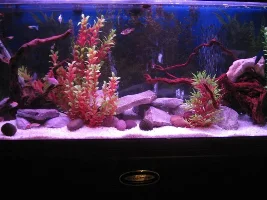
can that be done? anything taken out must be replaced, if you take 600lph out, 600lph needs to go back in, or the tank will slowly empty! and there is no way to make the bacteria grow, more effectively, with out a 5 or so x turnover. (with a cannister or standard internal anyway). its also worth remembering, water flow and water pressure are not the same. you can have low pressure and high water speed/flow, you just make the outlet pipe smaller. you can have high pressure and low speed/flow, by making the outlet bigger.

planted tanks are a different proposition, often needing less flow to maintain a colony. indeed i believe some need no bio filtration at all.

believe me this gets worse as you look into it. though its difficult to get information, it seems, many, filters push less than half their claimed output! even the "good" ones only manage 60-70% of their claims. and that's with, clean unused media!

its an, absolute, minefield. my Eheim and Hydor-Prime, have a combined pump rate of 1600lph thats 8x my 190l tank. the true flow is closer to 900-1000lph, 6x"ish". Even so my figures are not accurate, just a bit more accurat than the writing on the box.lol
So, why are my figures more reliable than those of the makers? Many filter makers measure the rate of their filters with no media, common sence says, if you put something in the way, the water will be slowed( i must admit, it took a long time for it to dawn on me though). at least one maker lists both a pump rating and a filter flow rating. the reduction in flow is, around, 30%. (proviging you use a full set of their reccomended media). this is in line with, admitedly none independent tests, done by many, when you search around the net. reading these the reduction is between 30 and 60%, media dependent.
like i said A Minefield!
 

Most reactions

Back
Top