Undergravel Filter

lukecrossland

New Member
Joined
Oct 6, 2009
Messages
3
Reaction score
0
Points
0
Evening all,

New to the forum so sorry if this is in the wrong room???

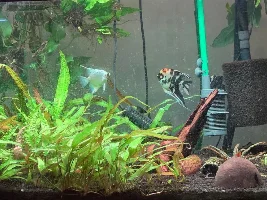
I have a 200 lt tank and have an undergravel filter. I have some gravel in my downpipe that leads from the powerhead. How can i get it out without emptying the tank. There is a small crack at the joint of the filter and downpipe but hasnt been a problem before.

As i was doing a water change and gravel clean i disrupted some un eaten food and it became suspended in the water. Usually my filter would draw it into the gravel. At the moment it doesnt seem to be :unsure: Could this be beacuse of the gravel in the downpipe?

I dont want to wake in the morning to find dead fish from the water not being crystal clear. Any ideas???

Bit of a novice so suggest even it it sounds obvious.

Many thanks in advance

Luke
 
Do yourself a favour and replace the UGF with a descent internal filter. :good:
 
Do yourself a favour and replace the UGF with a descent internal filter. :good:

Are they really that bad? I have a smaller tank with a internal but the undergravel seems ok as long as its cleaned weekly. What kind of price am i looking at for a 200l tank? What make is best? Should i then run both or just the internal. Sorry for all the questions :(
 
You need to get the gravel out. Start a syphon in a tube wide enough to suck down the gravel. Once it's going, take the pump off the up-lift and stick the syphoning pipe down the uplift. It will pull all the gravel out from under the plate and into the bucket for you. Remove all the gravel from your powerhead and then set it on top of your uplift again. This should be problem solved - for now :/ If you have a crack in the plate, it's clearly letting gravel under the plate and into the workings of your filter. This means the plate is knackered and in need of replacement :sad: Total tank strip-down job that means :sad: There are some boshes you can apply as a quick fix, but quick fixes tend to come back and bite you later... Could you post pictures of the plate crack for us? Do this before you try to clear the gravel mind, as more will fall down the hole when you push the gravel back over the plate...

As Dorsey says, you'd be better off swapping the filter you are using on the tank if you are a new-comer to the hobby. UGF's, while efficient biological and mechanical filters, are high maintenance and problem prone, making them challenging to run well :sad:

All the best
Rabbut

EDIT to add, if you replace the filter, you'll need to run the UGF and new filter side by side for 4-8 weeks to let the new filter "bed in". After that, you'll need to remove the old UGF filter. Alternatively you'll can run them both together on the tank :nod:

If you strip the tank and replace the plate keep the gravel wet and do not rinse it in tap water e.t.c. This is where your good bacteria are living, and you need to keep them living. If they die, your fish (probably) will too :crazy:
 
Thanks for the advice. The crack is where the downpipe meets the plate, at the circle on the place the plastic is perished slightly. Will try to remove the gravel as a short term fix but think a new filter will have to be brought.

Its annoying as UG was working fine really. Just hope that all is fine until then really.

Thanks again
 
Undergravel filters aren't that bad at all. If it's been working for you, then feel free to stick with it.

The thing with undergravel filters is that they have a lot of limitations. But if you can accept them, they are very efficient, and contrary to what has been said by some, are generally very low maintenance. Undergravel filters can't be used with plants that have roots. They're fine with floating plants and those plants attached to wood (like Java ferns). Undergravel filters can't be used with fish that dig. Undergravel filters can't be used in tanks with a lot of rocks or bogwood. Undergravel filters aren't a good choice for big or messy fish -- unless in the reverse-flow mode incorporating a canister filter, in which case, they're superb.

If those shortcomings aren't a problem for you, then undergravel filters may well be ideal filters.

In terms of maintenance, you must stir the gravel each week. Do this just before you do a water change so you can siphon out any dirt. Don't worry -- your fish won't mind! (But this gives you one example of why you can't use them with plants that have roots.) Once in a long while, stripping down the undergravel filter so you can clean beneath the plate is worthwhile. When I used undergravel filters, I did this once a year.

A small crack in an uplift (the pipe between the powerhead and the filter plate) shouldn't cause major problems, but leaky attachments between the uplift and the filter plate will be troublesome. Undergravel filters work well provided the water can't follow a shortcut and avoid going through the gravel. This is why you can't use them with digging fish: if a big cichlid makes a crater in the gravel, exposing the filter plate, all the water will go the easy way, through that crater, and not through the rest of the gravel.

It's well worth having *two* uplifts, one at each end of the tank. For a 200-litre tank, this would surely be mandatory. There's no way the average powerhead will suck water across the whole filter plate. A single powerhead is okay for tanks up to about 60 cm in length, but above that, you need a second one.

Undergravel filters have a very poor reputation among some aquarists, but this is very largely because people nowadays have no idea how to set them up or how to maintain them. But back in their heyday, these were very reliable and widely used pieces of kit.

Cheers, Neale
 
The issue I find with a modern UGF, is that most plates are made on the cheap with very flimsy plastic that is very prone to breaking. A small amount of weight (like a medium sized rock) or a light knock on the uplift will tend to break most modern UGF plates. This is why I view them as high-maintenance, you spend a lot of time trying to remove gravel from under them, and working out how it's getting in and from where, so you can fix the hole and stop more gravel getting under. I have only come across one plate that does not flake into bits with more than a moderate weight, it's those slot-together ones by Hagen, and their grates are very prone to clogging up with detritus making you have to strip and clean beneath the plate at least every few months. A full tank stip every few months to clean the filter on top of usual weekly maintenance on said filter isn't exactly "low maintenance" when your average modern canister needs attention every 3 months in the way of media, impeller and impeller chamber cleans, or fortnightly-monthly cleans on an internal, no tank strips involved with either.

I agree that UGF's can be very good when correctly set-up with a good plate. The catch is setting them up right for the set-up, and getting a good plate. The latter nowadays is no easy feet unless you make your own from something like corrugated plastic sheet... If you know of a good off-the-shelf plate that's still available these days, do let me know :hyper:

As for digging fish, there is a trick you can use there, like a substrate mat half way though the bed. The fish cannot dig lower than the mat, and water can pass though said mat, hence you can ensure you always have some gravel on every bit of the plate if you install the mat at the same time as the rest of the filter, between layers of gravel :good: This said, I'd expect you Neale already knew that trick with your experience and background :nod:

All the best
Rabbut
 
Hi Rabbut,

Yes, I did know about the mat thing. Back when people kept undergravel filters widely, that's precisely what gravel tidies were used for. It was actually fairly common to combine two types of gravel in one filter. Perhaps ordinary gravel on top, and something finer underneath, the theory being the top layer was the mechanical media, and the lower layer the biological media. Alternatively, coral sand on top, crushed coral rubble underneath. This was good for marines and Rift Valley cichlids.

As for rocks, as I said, you don't use them with undergravel filters. The gravel underneath them is effectively wasted.

Canister filters. Like you, I tend to leave them a while. To be honest, months at a time. I don't open them until the water current slackens. But having said that, there's good arguments against this approach. Unless opened and cleaned at least monthly, canister filters *are said* to become "nitrate factories" by many respected aquarists (particularly in the marine world). While that might not be a huge problem in many cases, if you have nitrate-sensitive fish like cichlids or mollies, it could very easily be a major problem.

I never found maintaining undergravels a big deal. Monthly stir, siphon out the silt, and an annual deep clean. Since all the plants were attached to bogwood, and there were very few other objects in the tank, this wasn't a major project. Catch the fish, scoop out the gravel, slide out the filter plate, clean it all, and put back together. A Sunday afternoon's work at worst. If you're needing to clean your undergravel more often than annually, the tank is either grossly overstocked, or else the substrate hasn't been adequately raked and siphoned with your weekly water changes. There's also a bit of an art to choosing the right size gravel for the fish being kept and the size of the tank. The bigger the fish, the coarser the gravel.

Cheers, Neale

PS. I used Algarde filter plates, and these were generally pretty good. Eheim have their own filter plates, and I'd expect these are very good.
 

Most reactions

Back
Top