plants that play dead

GaryE27 25

Moderator
Staff member
Global Moderator ⚒️
2x Fish of the Month 🌟
Joined
Oct 14, 2011
Messages
11,468
Reaction score
21,109
Points
113
Location
Eastern Canada
I've had plants in my tanks since I was a kid, but my approach has been conservative - I stuck to a small number of plants I knew I could grow, and ran from anything new. But as I've seen the changes in lighting, ferts and interest, I've tried some new to me things over about the last 3 years.

I have question about one thing I'm seeing. How many of you have plants that seem to die off, and when you give up on them, start to reappear?

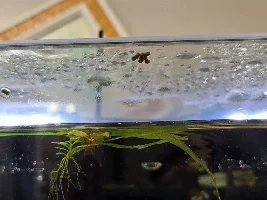
I've long had a weak spot for Crypts, and they're notorious for melting away and rebounding. But I recently lost "all" my 'subwassertang", for many months. It has begun to reappear attached to wood in several tanks, and looks extremely healthy.

I bought a beautiful tissue culture of Marsilea last winter, planted it lovingly and watched it fade back in spite of my doing and acting on a lot of reading up on how to grow it. I had real ambitions for that one, and it turned into a stringy bedraggled thing that looked like me when I was 16. I was just doing water changes, and realized the plant wreck was a wreck no more, as just a little new life was appearing, and there had been some of the ground it had lost in its retreat taken back.

So that gives me two comeback kids in my tanks. We won't dwell on the ones that bailed out and didn't have parachutes. How many of you leave the wreckage unbothered, just in case? Or, like me, leave it because you don't get around to ruining its chances?
 
I am like you I normally keep to the "easy keepers", but I will time to time try something new. If I do and it starts to die off I leave it in place to give it a chance to get back. Recently though I have had the opposite issue. I put some Christmas Moss (It might be a different species) into my main tank from a shrimp tank, its growing gangbusters in the main tank, its ugly, traps debris making it uglier, and I remove about a liter of moss at every cleaning and I cannot get rid of it. I suspect it has spores throughout the tank just waiting to sprout another horrid moss plant.
 
I have had some new plant, especially crypts, which were raised emersed have die offs from which they recover pretty fast. After that they are likely to become more invasive than to have a potential die off with or without a recovery. A lot f how our plants do ends to be from conditions we do not and/or cannot measure.

I am a seat-of-the-pants gardener and have been since the the early 1980s. I did mostly flowers but also ssome veggies for almost 20 years before i got my first tank which held all artificial plants. That changed in less than a year when I learned plants let one have more fish in many cases.

Withing a few years I was setting up my high light CO2 added tank and when I hit 20 tanks almost half held live lants and I stopped gardening outside. I mostly credit my well water for any success I have had breeding fish or growing plants. mostly I did the water changes the cleaning and the feeding. The fish and plants did the rest.

Many years ago I saw a segment on the TC show 60 minutes. It was about why French strawberries teased to great and why it was almost impossible to grow hem like that elsewhere. Apparently, the flavor superiority is due to the profile of the trace type things in the soil. The specific combination was unique to the country.

The substrate and water in our tanks is somewhat like that. I can move my fish between my tanks (except for when I had Altum angels). I can do so with most of the plants. However, now and then such a move actually works out badly. I chalk this up the the parameter profiles in the tanks. Even coming from the same water source, each develops its own profile based on the specific decor, fish and the foods and ferts we add to them.

As for Cyrpts, this from Google is pretty right on the mark, IMO.

AI Overview

Yes, Cryptocorynes are famous for this exact behavior, a phenomenon universally known in the aquarium hobby as "Crypt Melt."
[1]

During a melt, the leaves of a Cryptocoryne plant will rapidly deteriorate, turning mushy, translucent, or brown, and completely dissolve above the substrate. However, this is a natural survival and adaptation mechanism rather than the death of the plant. [1, 2]

Why It Happens
Crypts are highly sensitive to changes in their environment. A melt is typically triggered by:
  • Transplantation: Moving the plant to a new aquarium or even shifting its position within the same tank.
  • Emersed-to-Submerged Transition: Many commercial crypts are grown commercially out of water (emersed). When placed underwater (submerged), they intentionally shed their terrestrial leaves to grow aquatic ones.
  • Water Parameter Shifts: Sudden fluctuations in water chemistry, temperature, lighting, or nutrient levels. [1, 2, 3]
The Recovery Process
As long as the root system remains healthy and intact beneath the substrate, the plant is still very much alive. Crypts have extensive, robust root networks that store significant energy. [1, 2, 3, 4]
  • Timeline: After the leaves completely vanish, it requires a fair amount of patience. New sprouts typically begin to push through the substrate within a few weeks to a couple of months once the plant adapts to its new environment. In extreme cases or low-nutrient setups, it can take even longer for the resurrection to become visible. [1, 2, 3]
What You Should Do
  1. Do not dig it up: Leaving the roots undisturbed is critical. Pulling the plant out to check on it will only reset its acclimation timeline or kill the remaining root base. [1]
  2. Clean up the debris: Gently siphon away the dissolved, mushy leaves to prevent a spike in ammonia or organic waste in your water column. [1]
  3. Provide root nutrients: Since crypts feed heavily through their roots, adding root tabs to the substrate nearby can provide the energy they need to push out new growth. [1, 2]
 

Most reactions

Back
Top