Nerates Test without a kit

Do you mean nitrate? Or nitrite? The only way to test for these is using a test kit, either strips or a liquid based tester. (Or very expensively by sending a water sample to a testing company).
 
Do you mean nitrate? Or nitrite? The only way to test for these is using a test kit, either strips or a liquid based tester. (Or very expensively by sending a water sample to a testing company).
Nitrate. The kit I have does Nitrite, PH and Ammonia only.
 
Ammonia and nitrite can kill fish quickly; nitrate is a slower killer. But weekly water canages and not over feeding the fish (once they are in the tank) will stop nitrate getting high - this usually occurs when water changes are few and far between and "old tank syndrome" develops.
However, the upper limit in the UK for nitrate in tap water is 50 ppm, which is too high for many species. You don't need a tester for tap water nitrate as your water company should list nitrate in your water quality report on their website. (If you can't find it, tell us the name of the water company and we'll see what we can find)
 
Ammonia and nitrite can kill fish quickly; nitrate is a slower killer. But weekly water canages and not over feeding the fish (once they are in the tank) will stop nitrate getting high - this usually occurs when water changes are few and far between and "old tank syndrome" develops.
However, the upper limit in the UK for nitrate in tap water is 50 ppm, which is too high for many species. You don't need a tester for tap water nitrate as your water company should list nitrate in your water quality report on their website. (If you can't find it, tell us the name of the water company and we'll see what we can find)
Anglia Water for Bedford.
 
Go to this page
and type your postcode in the box at the top right.

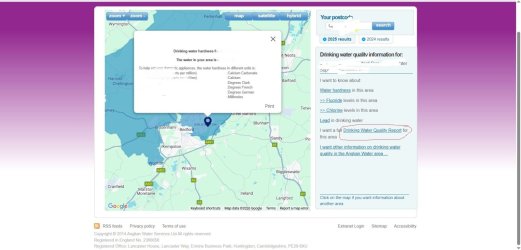
That will take you to a page like this -

Anglian Water.jpg

Click on "drinking Water Quality Report (I have circled that in red in the screenshot). That will pull up a smaller screen on top of the first one

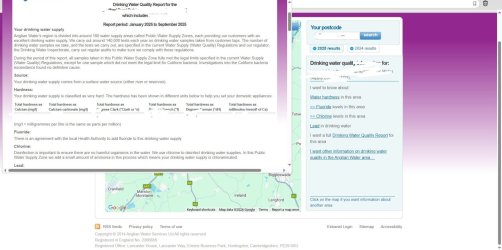
Anglian Water 2.jpg

Scroll down in that box till you come to a list of things they've tested for (in alphabetical order) until you reach nitrate. It will give 3 figures under the heading "samples" - the minimum value they tested, the maximum and the average. Make a note of the 'average' one.


[I have just discovered that when using a windows 10 laptop, that smaller box overlaying the main page causes the laptop to freeze. To get things back to normal, you have to close it. I thought something nasty had happened to my laptop till I realised that :blush: ]
 
Go to this page
and type your postcode in the box at the top right.

That will take you to a page like this -

View attachment 376624

Click on "drinking Water Quality Report (I have circled that in red in the screenshot). That will pull up a smaller screen on top of the first one

View attachment 376625

Scroll down in that box till you come to a list of things they've tested for (in alphabetical order) until you reach nitrate. It will give 3 figures under the heading "samples" - the minimum value they tested, the maximum and the average. Make a note of the 'average' one.


[I have just discovered that when using a windows 10 laptop, that smaller box overlaying the main page causes the laptop to freeze. To get things back to normal, you have to get rid of it. I thought something nasty had happened to my laptop till I realised that :blush: ]
Technology is a pain at times

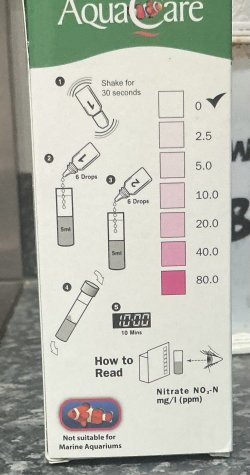
Anyway 24.468 is the average.
 
So, not too bad but higher than some species are happy with. As long as you avoid nitrate-sensitive species, and make sure to do weekly water changes to keep nitrate down to tap water level you should be OK.
Plants will help by using the ammonia made by fish as plant fertiliser so it doesn't all get converted to nitrite and then on to nitrate; if there are enough fast growing plants it is possible they'll also remove some nitrate.
 
So, not too bad but higher than some species are happy with. As long as you avoid nitrate-sensitive species, and make sure to do weekly water changes to keep nitrate down to tap water level you should be OK.
Plants will help by using the ammonia made by fish as plant fertiliser so it doesn't all get converted to nitrite and then on to nitrate; if there are enough fast growing plants it is possible they'll also remove some nitrate.
Just made a list on my devices notepad of the plants in the tank.

Java Fern x 3
Anubias Barteri
Salvinia Natans
Hygrophila Diformis
Juncus Repens
 
Java fern and anubias (both of which are usually grown attached to decor as the rhizome rots if buried) are slow growing plants so won't take up much ammonia.
Salvinia is a floating plant so it can get oxygen from the air and it's near the light; these mean it takes up a fair amount of ammonia. I have red root floater in both my tanks and I have to remove handfuls at every weekly water change or it would take over.
Hygrophila is a stem plant, reasonably fast growing so it should take up ammonia.
Juncus - I've never attempted to grow this but images show a small creeping plant. Depending on how fast it spreads it may or may not take up much ammonia.
 
Was this tank water of tap water? If it was tank, I'd test tap water as well as that should be similar to what Anglian Water says. It is always best to have a 'starting' level, which with fish tanks is whatever you put in at the beginning, usually tap water; then you can see how much, if any, the level changes over time.
 

Most reactions

Back
Top