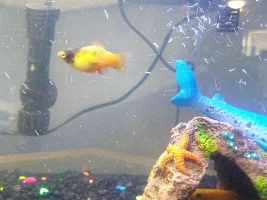
Aquarium crashed what to do next

Yeah we gonna have to agree to disagree there.. Stability isnt garbage..lol

Like I said, the best place to put stability is in your toilet.

The need to deal with ammonia is not a universal response. What matters is how much of the ammonia in a tank is in the form of the gas NH3. However most of the total ammonia in a tank is due to ammonium NH4 which is way less toxic.

The way to deal with ammonia in a tank over the longer term- more than what is measured in days, is by having the bacteria reproduce. it does his when there is more ammonia than what one has already cannot use it all. The result is reproduction speeds up. Under optimal conditions the bacteria can double in about 8 hours. However, it is rare to have ideal conditions in a tank.

The point of cycling is to develop enough of the ammonia oxidizers to deal with the amount of ammonia the tank creates. Normally, this level occurs at the outset when there are very few of the needed microorganisms present. This is why we add 2 -3 ppms of ammonia when doing a fishless cycle. However, this is not how an established tank crates ammonia. Producing that 2-3 ppm takes 24 hours depending on the what is creating the ammonia. Mostly this comes from the fish. Every time a fish "exhales" it releases ammonia into the water. In addition, any organic waste as it is broken down also creates ammonia. This would include fish poop, uneaten food, dying plant or algae, a dead fish etc.

So there is a second way to reduce the amount of ammonia being created in a tank which is to reduce the sources. Stop feeding, remove dead fish and plants etc.

When there are fish in a tank and there is ammonia which is actually at a dangerous level, then we have to act. But we need to be aware of what is happening. When we change water that lowers the ppm of ammonia but it does nothing to reduce the creation of more ammonia. For that we need the n]bacteria to multiply. If we use ammonia detoxifier that also will reduce the amount of ammonia as NH3 but not the ammonium NH4 which may actually increase. But at lower levels and for shorter term only a few days, this may not be harming fish.

The bacteria can process NH4m but the do so less efficiently so they will be reducing the total ammonia levels more slowly. The bacteria work best when consuming NH3. So, when we use something like prime or other conditioners to deal with ammonia we are also slowing down how rapidly the bacteria will reproduce. So there is a trade-off between how fast the bacteria will reproduce to provide a permanent solution as opposed to how long fish might be exposed to a lowered level of NH3. Longer exposure to lower levels is still harmful.

In writing the 3 cycling articles on this site my goal was to do two things. The first was to protect any living things in a tank from being harmed or killed by the presence of ammonia, especially in the form of NH3. Elevated NH4 over time can still be pretty harmful or even fatal. But it takes a higher concentration of NH4 to cause harm than how bad NH3 can be.

The second concern is how the fishkeeper reacts. The last thing one should ever do is to panic. This often causes us to make bad decisions. If we do understand what is going on and the appropriate way to deal with things, we will likely make mistakes. So, the articles are intended to help folks who may not be sure of how to react to avoid reacting in a panic. Yes there are times when we must act quickly and in the right way, but staying level headed goes a long way to understanding what to do in any given situation.

The 2nr and 3rd cycling articles dealing with cycling issues when there are fish in a tank use pretty conservative levels of ammonia both for Total ammonia and for NH3 itself are designed to protect our fish and our "sanity" when we need to deal with ammonia.

Finally, there is rarely any need to change water for nitrite because using chloride will block that from even entering a fish. So we need not do the things we believe will protect the fish from nitrite such as dosing Prime or changing lots of water which will slow down the reproduction of the needed bacterial which will solve the problem for the longer term. Once inside a fish it takes a day or two for that nitrite to work its way out of the fish. And, if there is still nitrite in the water, it will continue to enter the fish. Chloride prevents this.
Also using salt in a freshwater tank on fish that are already exposed to stress can do more harm than just using Prime. Everything you said i agree with except the stability being garbage. I understand why people say this as traditional nitrifying bacteria dont reproduce using endospores but that doesnt mean you cannot get them to a state of dormancy or that the product doesnt still have dormant bacteria that reanimates from endospores
 
Last edited:
Like I said, the best place to put stability is in your toilet.

The need to deal with ammonia is not a universal response. What matters is how much of the ammonia in a tank is in the form of the gas NH3. However most of the total ammonia in a tank is due to ammonium NH4 which is way less toxic.

The way to deal with ammonia in a tank over the longer term- more than what is measured in days, is by having the bacteria reproduce. it does his when there is more ammonia than what one has already cannot use it all. The result is reproduction speeds up. Under optimal conditions the bacteria can double in about 8 hours. However, it is rare to have ideal conditions in a tank.

The point of cycling is to develop enough of the ammonia oxidizers to deal with the amount of ammonia the tank creates. Normally, this level occurs at the outset when there are very few of the needed microorganisms present. This is why we add 2 -3 ppms of ammonia when doing a fishless cycle. However, this is not how an established tank crates ammonia. Producing that 2-3 ppm takes 24 hours depending on the what is creating the ammonia. Mostly this comes from the fish. Every time a fish "exhales" it releases ammonia into the water. In addition, any organic waste as it is broken down also creates ammonia. This would include fish poop, uneaten food, dying plant or algae, a dead fish etc.

So there is a second way to reduce the amount of ammonia being created in a tank which is to reduce the sources. Stop feeding, remove dead fish and plants etc.

When there are fish in a tank and there is ammonia which is actually at a dangerous level, then we have to act. But we need to be aware of what is happening. When we change water that lowers the ppm of ammonia but it does nothing to reduce the creation of more ammonia. For that we need the n]bacteria to multiply. If we use ammonia detoxifier that also will reduce the amount of ammonia as NH3 but not the ammonium NH4 which may actually increase. But at lower levels and for shorter term only a few days, this may not be harming fish.

The bacteria can process NH4m but the do so less efficiently so they will be reducing the total ammonia levels more slowly. The bacteria work best when consuming NH3. So, when we use something like prime or other conditioners to deal with ammonia we are also slowing down how rapidly the bacteria will reproduce. So there is a trade-off between how fast the bacteria will reproduce to provide a permanent solution as opposed to how long fish might be exposed to a lowered level of NH3. Longer exposure to lower levels is still harmful.

In writing the 3 cycling articles on this site my goal was to do two things. The first was to protect any living things in a tank from being harmed or killed by the presence of ammonia, especially in the form of NH3. Elevated NH4 over time can still be pretty harmful or even fatal. But it takes a higher concentration of NH4 to cause harm than how bad NH3 can be.

The second concern is how the fishkeeper reacts. The last thing one should ever do is to panic. This often causes us to make bad decisions. If we do understand what is going on and the appropriate way to deal with things, we will likely make mistakes. So, the articles are intended to help folks who may not be sure of how to react to avoid reacting in a panic. Yes there are times when we must act quickly and in the right way, but staying level headed goes a long way to understanding what to do in any given situation.

The 2nr and 3rd cycling articles dealing with cycling issues when there are fish in a tank use pretty conservative levels of ammonia both for Total ammonia and for NH3 itself are designed to protect our fish and our "sanity" when we need to deal with ammonia.

Finally, there is rarely any need to change water for nitrite because using chloride will block that from even entering a fish. So we need not do the things we believe will protect the fish from nitrite such as dosing Prime or changing lots of water which will slow down the reproduction of the needed bacterial which will solve the problem for the longer term. Once inside a fish it takes a day or two for that nitrite to work its way out of the fish. And, if there is still nitrite in the water, it will continue to enter the fish. Chloride prevents this.
It is safer to use a water conditioner like Seachem Prime to manage acute ammonia and nitrite spikes. Using salt is an effective method to specifically counteract toxicity but can be detrimental to freshwater plants and some fish species. Prime is salt, but there is no calculations or worry about overdosing and it has easy to follow instructions and isnt as scary to use. Its a sulfer based salt, which is far safer, that also includes binding and buffering agents to maintain pH, bind toxicity and promote the fish's slime coat. Speed of cycle should take a backseat to safety during the cycle in my mind.
 
Last edited:
It is safer to use a water conditioner like Seachem Prime to manage acute ammonia and nitrite spikes. Using salt is an effective method to specifically counteract toxicity but can be detrimental to freshwater plants and some fish species.

This is not the case. Yes, salt in larger concentrations than what is needed to block nitrite can be an issue. But the amount of salt needed to produce the chloride which will block nitrite from entering the fish is usually so minimal it will not harm almost anything we might have in a tank.

I have never believed what SeaChem claims about it blocking nitrite from harming a fish. By their own admission they say they have no science to support this claim but rather are relying on reports from fish keepers that it does. Since most fish keepers have little clue about the science behind the hobby and what is actually involved, I am even more inclined to believe as I do. What I do know is the scientific community concluded many years ago that any research into nitrite and fish which does not include data on chloride levels cannot be trusted.

Using chloride to protect fish is only a short term solution. The source of the nitrite needs to be addressed. One of the problems with elevated nitrite levels is at elevated levels they begin to interfere with the nitrogen cycle. This is due to the fact that nitrite in water creates acid. When in enough quantity this can effect the nitrogen cycle as it become harmful to the ammonia oxidizing bacteria and it can also cause pH levels to drop, possibly drastically. Chloride does not remove nitrite from the water or once inside a fish. However, chloride will block nitrite from entering a fish.

What this means for us as fish keepers is, in most situations, adding the amount of salt needed to produce the protective defense against nitrite gives us time to correct the cause of nitrite being formed in a tank. The chloride protects the fish from the effects of nitrite while we are doing what is needed to fix the cause. Water changes will lower the concentration but that level of nitrite is still entering a fish and likely accumulating to greater levels inside the fish.

As I noted, the amount of salt needed to protect our fish from nitrite is much less than if we are using salt as a medication. However, there is one big difference. When we use salt as a med (or a real med) we have no idea how many nasty things are in the water. We cannot know how many infectious bacterial or viral cells may be in the water. But we can test for nitrite levels. This means we can add the amount of salt needed to combat any given nitrite reading. Moreover, since nitrite is normally the result of cycling related issues, we can remove the salt from the water via water changes as soon as nitrite levels are gone.

Consider that the level of nitrite which may be high enough that the amount of salt need might be harmful to the fish, the odds are really high that the nitrite will kill the fish before the salt would do so. This is another string argument for doing a fishless cycle in a new tank. The levels of ammonia and nitrite generated during a fishless cycle done correctly should not disrupt the cycling process. More importantly, if we make a mistake doing a fishless cycle all we can lose is the extra time needed to correct the problem and finish the cycling process.

And then there is this. Water changes tend to be stressful to some extent to the fish. Most of them will hide when we are working in their home and will come back out when we are finished. Stress is a known factor in a the ability of a fish to fight off diseases and parasites etc. So, when fish are being exposed to ammonia or nitrite which is harmful, adding stress when it might be avoided is a good thing.

I have had to walk a number of folks through doing calculations for the salt treatment for nitrite. I know that the amount of salt needed is not great when compared to its use as a med for other things.
 
Last edited:
This is not the case. Yest sat in larger concentrations can be an issue. But the amount of salt needed to produce the chloride which will block nitrite from entering the fish is so minimal it will not harm almost anything we might have in a tank.

But, I have never believed what SeaChem claims about it blocking nitrite from entering a fish. By their own admission they say they have no science to support this claim but rather are relying on reports from fish keepers that it does. Since most fish keepers have little clue about the science behind the hobby and what is actually involved, I am even more inclined to believe as I do.

What I do know is the scientific community concluded many years ago that any research into nitrite and fish which does not include data on chloride levels cannot be trusted.

Using chloride to protect fish is only a short term solution. The source of the nitrite needs to be addressed. One of the problems with elevated nitrite levels is at some point they begin to interfere with the nitrogen cycle. This is due to the fact that nitrite in water creates acid. When in enough quantity this can effect the nitrogen cycle as it become harmful to the ammonia oxidizing bacteria and it can also cause pH levels to drop, possibly drastically. Chloride does not remove nitrite from the water or once inside a fish. However, chloride will block nitrite from entering a fish.

What this means for us as fish keepers is, in most situations, adding the amount of salt needed to produce the protective effects from nitrite gives us time to correct the cause of nitrite being formed in a tank. What the chloride does is to protect the fish from the effects of nitrite while we are doing what is needed to fix the cause. Water changes will lower the concentration but that level of nitrite is still entering a fish and likely accumulating to greater levels.

As I noted, the amount of salt needed to protect our fish from nitrite is much less than if we are using salt as a medication. However, theere is one big difference. When we use salt as a med we have no idea how many nasty things are in the water.
Depending on the soure of the table salt it can include iodine and anti-caking agents among other things. Some fish and plants cant even handle small amounts. I would rather the slower safer option. Different strokes for different folks as they say.
 
This is not the case. Yest sat in larger concentrations can be an issue. But the amount of salt needed to produce the chloride which will block nitrite from entering the fish is so minimal it will not harm almost anything we might have in a tank.

But, I have never believed what SeaChem claims about it blocking nitrite from entering a fish. By their own admission they say they have no science to support this claim but rather are relying on reports from fish keepers that it does. Since most fish keepers have little clue about the science behind the hobby and what is actually involved, I am even more inclined to believe as I do.

What I do know is the scientific community concluded many years ago that any research into nitrite and fish which does not include data on chloride levels cannot be trusted.

Using chloride to protect fish is only a short term solution. The source of the nitrite needs to be addressed. One of the problems with elevated nitrite levels is at some point they begin to interfere with the nitrogen cycle. This is due to the fact that nitrite in water creates acid. When in enough quantity this can effect the nitrogen cycle as it become harmful to the ammonia oxidizing bacteria and it can also cause pH levels to drop, possibly drastically. Chloride does not remove nitrite from the water or once inside a fish. However, chloride will block nitrite from entering a fish.

What this means for us as fish keepers is, in most situations, adding the amount of salt needed to produce the protective effects from nitrite gives us time to correct the cause of nitrite being formed in a tank. What the chloride does is to protect the fish from the effects of nitrite while we are doing what is needed to fix the cause. Water changes will lower the concentration but that level of nitrite is still entering a fish and likely accumulating to greater levels.

As I noted, the amount of salt needed to protect our fish from nitrite is much less than if we are using salt as a medication. However, theere is one big difference. When we use salt as a med we have no idea how many nasty things are in the water.
From what i know the nitrite are blocked by Prime because it binds them into a non-absorbable complex compound which can still be utilized by the nitrifying bacteria. Seachem just keeps their stuff under wraps for job security. They dont generally disclose how many of their products work or what they actually include. I have actually witnessed them remove such info from packaging over the years.
 
Last edited:
Yes, but despite what SeaChem does or doesn't reveal, science itself does. Seachem sells a bottle of spores top deal with ammonia and nitrite. But Science knows that the nitrifying bacteria which are in out tanks for the long term do not form spores. In fact SeaChem hides the fact that this is the case by secreting their info on cycling in their library. Their article is so old it still attributes nitrite oxidation to Nitrobacter when it is actually done by Nitrospira bacteria.
http://www.seachem.com/Library/SeaGrams/Biofiltration.pdf

When Dr. Timothy Hovanec et al discovered that it was the Nitrospira in tanks handling nitrite, they had to invent probes for detecting them. Then they had to figure out how this all worked, As a result they were able to process it all, This meant that nobody else could use Nitrospria in their bottled bacteria with out the permission of the patent holders. This Included Aquaria Inc, the parent of Marineland Aquarium Products. Dr. Hovanec was their chief scientist.

Aquaria, Inc. (founded by Sherman) originally developed and marketed www.marineland.com Marineland Aquarium Products in the 1970s, based on technology from Marineland of the Pacific. Over time, the brand went through acquisitions and is now part of Spectrum Brands (specifically their Global Pet Care division), which owns other brands like Tetra and Instant Ocean.

When Spectrum bought Aquaria Inc., Dr. H. chose not to stay with them and he started his own business using the Aquaria Inc. facilities in Moorepark CA. However, Aquaria Inc. had rights to the patent. When Spectrum bought out Aquaria Inc the right to use Nitrospira came with them. Spectrum assigned this to Tetra which is why Tetra;s Safe Start and Safe Start+ also contain Nitrospira.

So other products cannot use Nitrospira in their bacterial starter products. They use Nitrobacter instead. The problem is this bacteria only thrives on higher levels of Nitrite like those found in waste water. Nitrobacter does not persist in aquariums, they are replaced by Nitrospira by the time a cycle is completed in a tank. Seachem chose not to use any nitrifying bacteria in Stability but chose to use spores. This means the wrong stuff can ersist im a bottle for decades while the nitrifying bacteria can only be usefull for 6 months to a year. It must be refrigerated to last over 6 months at use full levels. Byt a year even cooled there will no longer be enouhg sirviving cells to be much more effective than not using it at all. This is why One and Omly for Dr. H. as a bottling date onm their label. it informs us how good the contents will be until 6 months to a year later.

Incicdentally, a few years ago it was discovered that some strains of Nitrospira are actually able to oxidize ammonia directly to nitrate. Yhis means they do not create any nitrite in the process.

Daims, H., Lebedeva, E., Pjevac, P. et al. Complete nitrification by Nitrospira bacteria.
Nature 528, 504–509 (2015). https://doi.org/10.1038/nature16461

Abstract​

Nitrification, the oxidation of ammonia via nitrite to nitrate, has always been considered to be a two-step process catalysed by chemolithoautotrophic microorganisms oxidizing either ammonia or nitrite. No known nitrifier carries out both steps, although complete nitrification should be energetically advantageous. This functional separation has puzzled microbiologists for a century. Here we report on the discovery and cultivation of a completely nitrifying bacterium from the genus Nitrospira, a globally distributed group of nitrite oxidizers. The genome of this chemolithoautotrophic organism encodes the pathways both for ammonia and nitrite oxidation, which are concomitantly activated during growth by ammonia oxidation to nitrate. Genes affiliated with the phylogenetically distinct ammonia monooxygenase and hydroxylamine dehydrogenase genes of Nitrospira are present in many environments and were retrieved on Nitrospira-contigs in new metagenomes from engineered systems. These findings fundamentally change our picture of nitrification and point to completely nitrifying Nitrospira as key components of nitrogen-cycling microbial communities.

Full paper here: https://pmc.ncbi.nlm.nih.gov/articles/PMC5152751/pdf/emss-66095.pdf
 
Yes, but despite what SeaChem does or doesn't reveal, science itself does. Seachem sells a bottle of spores top deal with ammonia and nitrite. But Science knows that the nitrifying bacteria which are in out tanks for the long term do not form spores. In fact SeaChem hides the fact that this is the case by secreting their info on cycling in their library. Their article is so old it still attributes nitrite oxidation to Nitrobacter when it is actually done by Nitrospira bacteria.
http://www.seachem.com/Library/SeaGrams/Biofiltration.pdf

When Dr. Timothy Hovanec et al discovered that it was the Nitrospira in tanks handling nitrite, they had to invent probes for detecting them. Then they had to figure out how this all worked, As a result they were able to process it all, This meant that nobody else could use Nitrospria in their bottled bacteria with out the permission of the patent holders. This Included Aquaria Inc, the parent of Marineland Aquarium Products. Dr. Hovanec was their chief scientist.


When Spectrum bought Aquaria Inc., Dr. H. chose not to stay with them and he started his own business using the Aquaria Inc. facilities in Moorepark CA. However, Aquaria Inc. had rights to the patent. When Spectrum bought out Aquaria Inc the right to use Nitrospira came with them. Spectrum assigned this to Tetra which is why Tetra;s Safe Start and Safe Start+ also contain Nitrospira.

So other products cannot use Nitrospira in their bacterial starter products. They use Nitrobacter instead. The problem is this bacteria only thrives on higher levels of Nitrite like those found in waste water. Nitrobacter does not persist in aquariums, they are replaced by Nitrospira by the time a cycle is completed in a tank. Seachem chose not to use any nitrifying bacteria in Stability but chose to use spores. This means the wrong stuff can ersist im a bottle for decades while the nitrifying bacteria can only be usefull for 6 months to a year. It must be refrigerated to last over 6 months at use full levels. Byt a year even cooled there will no longer be enouhg sirviving cells to be much more effective than not using it at all. This is why One and Omly for Dr. H. as a bottling date onm their label. it informs us how good the contents will be until 6 months to a year later.

Incicdentally, a few years ago it was discovered that some strains of Nitrospira are actually able to oxidize ammonia directly to nitrate. Yhis means they do not create any nitrite in the process.

Daims, H., Lebedeva, E., Pjevac, P. et al. Complete nitrification by Nitrospira bacteria.
Nature 528, 504–509 (2015). https://doi.org/10.1038/nature16461

Abstract​

Nitrification, the oxidation of ammonia via nitrite to nitrate, has always been considered to be a two-step process catalysed by chemolithoautotrophic microorganisms oxidizing either ammonia or nitrite. No known nitrifier carries out both steps, although complete nitrification should be energetically advantageous. This functional separation has puzzled microbiologists for a century. Here we report on the discovery and cultivation of a completely nitrifying bacterium from the genus Nitrospira, a globally distributed group of nitrite oxidizers. The genome of this chemolithoautotrophic organism encodes the pathways both for ammonia and nitrite oxidation, which are concomitantly activated during growth by ammonia oxidation to nitrate. Genes affiliated with the phylogenetically distinct ammonia monooxygenase and hydroxylamine dehydrogenase genes of Nitrospira are present in many environments and were retrieved on Nitrospira-contigs in new metagenomes from engineered systems. These findings fundamentally change our picture of nitrification and point to completely nitrifying Nitrospira as key components of nitrogen-cycling microbial communities.

Full paper here: https://pmc.ncbi.nlm.nih.gov/articles/PMC5152751/pdf/emss-66095.pdf
What critics of stability dont know or refuse to acknowledge is that depriving bacteria of essential nutrients causes them to enter a slow-growth or dormant state, sometimes forming protective endospores even when they dont reproduce using them in nature. The bottle doesnt say it includes only nitrifying bacteria either it says aerobic, anaerobic, and facultative bacteria. The endospores can be either denitrifying or facultative and it never insinuates that the endospores are formed by nitrifying bacteria.
 
Last edited:
Yes, but despite what SeaChem does or doesn't reveal, science itself does. Seachem sells a bottle of spores top deal with ammonia and nitrite. But Science knows that the nitrifying bacteria which are in out tanks for the long term do not form spores. In fact SeaChem hides the fact that this is the case by secreting their info on cycling in their library. Their article is so old it still attributes nitrite oxidation to Nitrobacter when it is actually done by Nitrospira bacteria.
http://www.seachem.com/Library/SeaGrams/Biofiltration.pdf

When Dr. Timothy Hovanec et al discovered that it was the Nitrospira in tanks handling nitrite, they had to invent probes for detecting them. Then they had to figure out how this all worked, As a result they were able to process it all, This meant that nobody else could use Nitrospria in their bottled bacteria with out the permission of the patent holders. This Included Aquaria Inc, the parent of Marineland Aquarium Products. Dr. Hovanec was their chief scientist.


When Spectrum bought Aquaria Inc., Dr. H. chose not to stay with them and he started his own business using the Aquaria Inc. facilities in Moorepark CA. However, Aquaria Inc. had rights to the patent. When Spectrum bought out Aquaria Inc the right to use Nitrospira came with them. Spectrum assigned this to Tetra which is why Tetra;s Safe Start and Safe Start+ also contain Nitrospira.

So other products cannot use Nitrospira in their bacterial starter products. They use Nitrobacter instead. The problem is this bacteria only thrives on higher levels of Nitrite like those found in waste water. Nitrobacter does not persist in aquariums, they are replaced by Nitrospira by the time a cycle is completed in a tank. Seachem chose not to use any nitrifying bacteria in Stability but chose to use spores. This means the wrong stuff can ersist im a bottle for decades while the nitrifying bacteria can only be usefull for 6 months to a year. It must be refrigerated to last over 6 months at use full levels. Byt a year even cooled there will no longer be enouhg sirviving cells to be much more effective than not using it at all. This is why One and Omly for Dr. H. as a bottling date onm their label. it informs us how good the contents will be until 6 months to a year later.

Incicdentally, a few years ago it was discovered that some strains of Nitrospira are actually able to oxidize ammonia directly to nitrate. Yhis means they do not create any nitrite in the process.

Daims, H., Lebedeva, E., Pjevac, P. et al. Complete nitrification by Nitrospira bacteria.
Nature 528, 504–509 (2015). https://doi.org/10.1038/nature16461

Abstract​

Nitrification, the oxidation of ammonia via nitrite to nitrate, has always been considered to be a two-step process catalysed by chemolithoautotrophic microorganisms oxidizing either ammonia or nitrite. No known nitrifier carries out both steps, although complete nitrification should be energetically advantageous. This functional separation has puzzled microbiologists for a century. Here we report on the discovery and cultivation of a completely nitrifying bacterium from the genus Nitrospira, a globally distributed group of nitrite oxidizers. The genome of this chemolithoautotrophic organism encodes the pathways both for ammonia and nitrite oxidation, which are concomitantly activated during growth by ammonia oxidation to nitrate. Genes affiliated with the phylogenetically distinct ammonia monooxygenase and hydroxylamine dehydrogenase genes of Nitrospira are present in many environments and were retrieved on Nitrospira-contigs in new metagenomes from engineered systems. These findings fundamentally change our picture of nitrification and point to completely nitrifying Nitrospira as key components of nitrogen-cycling microbial communities.

Full paper here: https://pmc.ncbi.nlm.nih.gov/articles/PMC5152751/pdf/emss-66095.pdf
Nitrobacter does indeed perform that task. They just found that there was one better at that job that like you pointed out earlier can even go from ammonia straight to nitrate and is more efficient than nitrobactor.
Yes, but despite what SeaChem does or doesn't reveal, science itself does. Seachem sells a bottle of spores top deal with ammonia and nitrite. But Science knows that the nitrifying bacteria which are in out tanks for the long term do not form spores. In fact SeaChem hides the fact that this is the case by secreting their info on cycling in their library. Their article is so old it still attributes nitrite oxidation to Nitrobacter when it is actually done by Nitrospira bacteria.
http://www.seachem.com/Library/SeaGrams/Biofiltration.pdf

When Dr. Timothy Hovanec et al discovered that it was the Nitrospira in tanks handling nitrite, they had to invent probes for detecting them. Then they had to figure out how this all worked, As a result they were able to process it all, This meant that nobody else could use Nitrospria in their bottled bacteria with out the permission of the patent holders. This Included Aquaria Inc, the parent of Marineland Aquarium Products. Dr. Hovanec was their chief scientist.


When Spectrum bought Aquaria Inc., Dr. H. chose not to stay with them and he started his own business using the Aquaria Inc. facilities in Moorepark CA. However, Aquaria Inc. had rights to the patent. When Spectrum bought out Aquaria Inc the right to use Nitrospira came with them. Spectrum assigned this to Tetra which is why Tetra;s Safe Start and Safe Start+ also contain Nitrospira.

So other products cannot use Nitrospira in their bacterial starter products. They use Nitrobacter instead. The problem is this bacteria only thrives on higher levels of Nitrite like those found in waste water. Nitrobacter does not persist in aquariums, they are replaced by Nitrospira by the time a cycle is completed in a tank. Seachem chose not to use any nitrifying bacteria in Stability but chose to use spores. This means the wrong stuff can ersist im a bottle for decades while the nitrifying bacteria can only be usefull for 6 months to a year. It must be refrigerated to last over 6 months at use full levels. Byt a year even cooled there will no longer be enouhg sirviving cells to be much more effective than not using it at all. This is why One and Omly for Dr. H. as a bottling date onm their label. it informs us how good the contents will be until 6 months to a year later.

Incicdentally, a few years ago it was discovered that some strains of Nitrospira are actually able to oxidize ammonia directly to nitrate. Yhis means they do not create any nitrite in the process.

Daims, H., Lebedeva, E., Pjevac, P. et al. Complete nitrification by Nitrospira bacteria.
Nature 528, 504–509 (2015). https://doi.org/10.1038/nature16461

Abstract​

Nitrification, the oxidation of ammonia via nitrite to nitrate, has always been considered to be a two-step process catalysed by chemolithoautotrophic microorganisms oxidizing either ammonia or nitrite. No known nitrifier carries out both steps, although complete nitrification should be energetically advantageous. This functional separation has puzzled microbiologists for a century. Here we report on the discovery and cultivation of a completely nitrifying bacterium from the genus Nitrospira, a globally distributed group of nitrite oxidizers. The genome of this chemolithoautotrophic organism encodes the pathways both for ammonia and nitrite oxidation, which are concomitantly activated during growth by ammonia oxidation to nitrate. Genes affiliated with the phylogenetically distinct ammonia monooxygenase and hydroxylamine dehydrogenase genes of Nitrospira are present in many environments and were retrieved on Nitrospira-contigs in new metagenomes from engineered systems. These findings fundamentally change our picture of nitrification and point to completely nitrifying Nitrospira as key components of nitrogen-cycling microbial communities.

Full paper here: https://pmc.ncbi.nlm.nih.gov/articles/PMC5152751/pdf/emss-66095.pdf
"Their article is so old it still attributes nitrite oxidation to Nitrobacter when it is actually done by Nitrospira bacteria."

Its actually done by nitrobacter as well. Its just no longer believed to be the most efficient at it.
 
Last edited:
Warnign what follows is pretty long and detailed.

I hate to make you look bad, but you are again incorrect when you stated "Nitrobacter does indeed perform that task. They just found that there was one better at that job that like you pointed out earlier can even go from ammonia straight to nitrate and is more efficient than nitrobactor."

Bacteria are not one size fits all. You need to investigate the what substrate affinity for different bacterial strains means. This does not refer to sand or gravel at the bottom of a tank. It refers to the level of ammonia or nitrite that any given strain needs to survive and thrive.
Nitrite Oxidation: Nitrite-oxidizing bacteria (NOB) convert nitrite to nitrate.
  • NOB species vary significantly in affinity. Nitrospira species generally have a higher affinity for nitrite (lower Km cap K sub m𝐾𝑚 values, around 9-27 μMmu cap M𝜇𝑀) than Nitrobacter species (49-544 μMmu cap M𝜇𝑀), making Nitrospira more competitive in low-nitrite environments.

The above was confirmed by Dr. Hoavanec et. al. in the peer reviewed published paper,

Hovanec TATaylor LTBlakis A, Delong EF 1998. Nitrospira-Like Bacteria Associated with Nitrite Oxidation in Freshwater Aquaria.
Appl Environ Microbiol 64:.
https://doi.org/10.1128/AEM.64.1.258-264.1998

ABSTRACT​

Oxidation of nitrite to nitrate in aquaria is typically attributed to bacteria belonging to the genus Nitrobacter which are members of the α subdivision of the class Proteobacteria. In order to identify bacteria responsible for nitrite oxidation in aquaria, clone libraries of rRNA genes were developed from biofilms of several freshwater aquaria. Analysis of the rDNA libraries, along with results from denaturing gradient gel electrophoresis (DGGE) on frequently sampled biofilms, indicated the presence of putative nitrite-oxidizing bacteria closely related to other members of the genus Nitrospira. Nucleic acid hybridization experiments with rRNA from biofilms of freshwater aquaria demonstrated thatNitrospira-like rRNA comprised nearly 5% of the rRNA extracted from the biofilms during the establishment of nitrification. Nitrite-oxidizing bacteria belonging to the α subdivision of the class Proteobacteria (e.g., Nitrobacter spp.) were not detected in these samples. Aquaria which received a commercial preparation containing Nitrobacter species did not show evidence of Nitrobacter growth and development but did develop substantial populations of Nitrospira-like species. Time series analysis of rDNA phylotypes on aquaria biofilms by DGGE, combined with nitrite and nitrate analysis, showed a correspondence between the appearance of Nitrospira-like bacterial ribosomal DNA and the initiation of nitrite oxidation. In total, the data suggest that Nitrobacter winogradskyi and close relatives were not the dominant nitrite-oxidizing bacteria in freshwater aquaria. Instead, nitrite oxidation in freshwater aquaria appeared to be mediated by bacteria closely related to Nitrospira moscoviensis and Nitrospira marina.

But, the authors and paper above are far from the only sources of this fact. Her is but one msuch example.

Nowka B, Daims H, Spieck E.2015.Comparison of Oxidation Kinetics of Nitrite-Oxidizing Bacteria: Nitrite Availability as a Key Factor in Niche Differentiation. Appl Environ Microbiol81:.https://doi.org/10.1128/AEM.02734-14

ABSTRACT​

Nitrification has an immense impact on nitrogen cycling in natural ecosystems and in wastewater treatment plants. Mathematical models function as tools to capture the complexity of these biological systems, but kinetic parameters especially of nitrite-oxidizing bacteria (NOB) are lacking because of a limited number of pure cultures until recently. In this study, we compared the nitrite oxidation kinetics of six pure cultures and one enrichment culture representing three genera of NOB (Nitrobacter, Nitrospira, Nitrotoga). With half-saturation constants (Km ) between 9 and 27 μM nitrite, Nitrospira bacteria are adapted to live under significant substrate limitation. Nitrobacter showed a wide range of lower substrate affinities, with Km values between 49 and 544 μM nitrite. However, the advantage of Nitrobacter emerged under excess nitrite supply, sustaining high maximum specific activities (V max) of 64 to 164 μmol nitrite/mg protein/h, contrary to the lower activities of Nitrospira of 18 to 48 μmol nitrite/mg protein/h. The V max (26 μmol nitrite/mg protein/h) and Km (58 μM nitrite) of “Candidatus Nitrotoga arctica” measured at a low temperature of 17°C suggest that Nitrotoga can advantageously compete with other NOB, especially in cold habitats. The kinetic parameters determined represent improved basis values for nitrifying models and will support predictions of community structure and nitrification rates in natural and engineered ecosystems.


As I mentioed in my earlier post, Nitrospira were patented as a result of the above paper by Hovanec et. al. This meant only Nitrobacter could be used in the bacterial starter products. During a fishless cycle where we add a lot of ammonia all at once, initial nitrite levels get pretty high. So they may favor Nitrobacter at that time. However, as the cycle establishes and nitrite levels lower, the Nitrobacter basically are gone and are replaced by Nitrospira. In fact it, turns out that a few Nitrobacter cells do survive and will reproduce if nitrite levels rise to much higher levels. The reason Dr. H. et al did not detect them in cycled tanks had to do with the state of measurement techniques in the early 1990s when they did the research.

The reason I know this is that I am not a microbiologist and while I did study experimental design in college, I was not educated in the types of measurements that can be done to detect bacteria. These methods have greatly improved over the decades since the above Hovanec et. al. research which makes detection of various minute levels of a bacterial strain detectable. I had to consiult with a few current PhDs when I would read a new paper in order to become informed about the quality of the testing methods used. I would be told if these were the most current ones or if they were dated. This was how I cam to know Dr. Stephan Tanner before I learned he owned Swiss tropicals. My initital contact was because of the potential role of ammonia oxidizing Archaea played in aquariums. At the time their existence was a relatively new discovery.

Incidentally, the same affinity differences also apply for the ammonia oxidizers. Early on when I began reading the research papers I was confuse by affinity. It took me a while to realize that a high affinity meant that the strain could thrive in lower levels while a lower affinity meant they needed a higher concentration to thrive. Nitrobacter has a low affinity for nitrite.

"Sergei Winogradsky the pioneering Russian microbiologist, discovered the nitrifying bacteria, including the genus Nitrobacter, in the 1890s, isolating them in pure culture and showing they perform the second step of nitrification (nitrite to nitrate). He named the nitrite-oxidizing bacteria Nitrobacter (meaning "nitrogen-bearer") in his 1892 studies, with the type species Nitrobacter winogradskyi later proposed in 1917 to honor his foundational work on these chemoautotrophs.


You were also incorrect when you wrote "Depending on the soure of the table salt it can include iodine and anti-caking agents among other things."

There is no iodine in salt. And the level of cacking agets is so small one's fish would be pickled before the anti-caking agents reached jarmful levels.

Iodine is a halogen, and is required for vertebrates in its ionic form. Iodine is the element; iodide is the ionic form. Do not confuse either of those with “tincture of iodine” which is a topical antiseptic and quite toxic.

Read the label on salt and it will say it contains iodide not idodine.

Iodine (I) is the element, often found as diatomic molecules , while iodide (I⁻) is the ion, an iodine atom that has gained an electron, giving it a negative charge, and is the form the body primarily uses for thyroid function, typically ingested as salts like potassium or sodium iodide in fortified salt and supplements. Think of Iodine as the raw, reactive element and Iodide as the stable, usable form (I) raised to the negative power (𝐼−) that your body readily absorbs and utilizes, especially for hormone production.

Finally, to understand salt in tanks and how safe it is to use iodized salt which contains anti-caking agents I suggest your read this paper:
https://www.thepufferforum.com/forum/library/water-filtration/thesaltoftheearth/#more-137

It was written by:

Author: Robert T. Ricketts​

Retired research scientist (biochemistry and physiology, pharmaceutical development) and senior process analyst. Started fishkeeping in the dark ages (1950s), first SW tanks in the mid-60s, first puffers in the early 60s. Started with two tanks and never less than multi-tanked excepting some periods in college and grad school. Specialty if any would be filtration and water management. Primarily species tanks, planted whenever possible/practical and some where it not really practical. Ran something on the order of >150 tank-years* in studying optimum tank conditions for F-8 puffers, the largest tank study I have done. Other studies have been significantly less. Alternate canister use was mid-40s, OERFUG just over 60, veggie filters only about 25 to publication, but still going on less intently. If it had been known that the F-8s would live so long, it probably would not have been started at all.
*One tank-year is one tank for one year.

I was fortunate in that I knew RTR from my very first fish forum. The owner has since died and the forum closed down as a result. I met a lot of other fish folks there who have gone on to speak at events and to become internationally respected experts in the world of fish keeping. It was also where I was taught the basics of keeping live plants in aquariums. There I got the best advice on CO2 which was not to bother with the DIY yeast method but to get pressurized CO2 rather than starting with DIY. I listened to that advice. RTR's salt article is why I have used table salt in my tanks when I needed to use salt. My fish and plants all did OK when I did and still do.

Finally, I would be happy to say I am wrong about any of the above if you can provide me with links to current papers which suggest I am incorrect in what I have written. Non-scientific information is acceptable as long as the author(s) qualitifications can be researched and that the papers are not outdated.

 

Attachments

  • 1765331785874.gif
    1765331785874.gif
    43 bytes · Views: 4
  • 1765331785891.gif
    1765331785891.gif
    43 bytes · Views: 4
  • 1765331785883.gif
    1765331785883.gif
    43 bytes · Views: 4
  • 1765332314566.gif
    1765332314566.gif
    43 bytes · Views: 4
  • 1765332314575.gif
    1765332314575.gif
    43 bytes · Views: 3
  • 1765332314559.gif
    1765332314559.gif
    43 bytes · Views: 4
  • 1765336053406.gif
    1765336053406.gif
    43 bytes · Views: 4
  • 1765336053416.gif
    1765336053416.gif
    43 bytes · Views: 4
  • 1765336053397.gif
    1765336053397.gif
    43 bytes · Views: 4
Last edited:
I hate to make you look bad, but you are again incorrect when you stated "Nitrobacter does indeed perform that task. They just found that there was one better at that job that like you pointed out earlier can even go from ammonia straight to nitrate and is more efficient than nitrobactor."

Bacteria are not one size fits all. You need to investigate the what substrate affinity for different bacterial strains means. This does not refer to sand or gravel at the bottom of a tank. It refers to the level of ammonia or nitrite that any given strain needs to survive and thrive.


The above was confirmed by Dr. Hoavanec et al in the peer reviewed published paper,

Hovanec TATaylor LTBlakis A, Delong EF 1998. Nitrospira-Like Bacteria Associated with Nitrite Oxidation in Freshwater Aquaria.
Appl Environ Microbiol 64:.
https://doi.org/10.1128/AEM.64.1.258-264.1998

ABSTRACT​

Oxidation of nitrite to nitrate in aquaria is typically attributed to bacteria belonging to the genus Nitrobacter which are members of the α subdivision of the class Proteobacteria. In order to identify bacteria responsible for nitrite oxidation in aquaria, clone libraries of rRNA genes were developed from biofilms of several freshwater aquaria. Analysis of the rDNA libraries, along with results from denaturing gradient gel electrophoresis (DGGE) on frequently sampled biofilms, indicated the presence of putative nitrite-oxidizing bacteria closely related to other members of the genus Nitrospira. Nucleic acid hybridization experiments with rRNA from biofilms of freshwater aquaria demonstrated thatNitrospira-like rRNA comprised nearly 5% of the rRNA extracted from the biofilms during the establishment of nitrification. Nitrite-oxidizing bacteria belonging to the α subdivision of the class Proteobacteria (e.g., Nitrobacter spp.) were not detected in these samples. Aquaria which received a commercial preparation containing Nitrobacter species did not show evidence of Nitrobacter growth and development but did develop substantial populations of Nitrospira-like species. Time series analysis of rDNA phylotypes on aquaria biofilms by DGGE, combined with nitrite and nitrate analysis, showed a correspondence between the appearance of Nitrospira-like bacterial ribosomal DNA and the initiation of nitrite oxidation. In total, the data suggest that Nitrobacter winogradskyi and close relatives were not the dominant nitrite-oxidizing bacteria in freshwater aquaria. Instead, nitrite oxidation in freshwater aquaria appeared to be mediated by bacteria closely related to Nitrospira moscoviensis and Nitrospira marina.

But, the authors and paper above are far from the only sources of this fact.

Nowka B, Daims H, Spieck E.2015.Comparison of Oxidation Kinetics of Nitrite-Oxidizing Bacteria: Nitrite Availability as a Key Factor in Niche Differentiation. Appl Environ Microbiol81:.https://doi.org/10.1128/AEM.02734-14

ABSTRACT​

Nitrification has an immense impact on nitrogen cycling in natural ecosystems and in wastewater treatment plants. Mathematical models function as tools to capture the complexity of these biological systems, but kinetic parameters especially of nitrite-oxidizing bacteria (NOB) are lacking because of a limited number of pure cultures until recently. In this study, we compared the nitrite oxidation kinetics of six pure cultures and one enrichment culture representing three genera of NOB (Nitrobacter, Nitrospira, Nitrotoga). With half-saturation constants (Km ) between 9 and 27 μM nitrite, Nitrospira bacteria are adapted to live under significant substrate limitation. Nitrobacter showed a wide range of lower substrate affinities, with Km values between 49 and 544 μM nitrite. However, the advantage of Nitrobacter emerged under excess nitrite supply, sustaining high maximum specific activities (V max) of 64 to 164 μmol nitrite/mg protein/h, contrary to the lower activities of Nitrospira of 18 to 48 μmol nitrite/mg protein/h. The V max (26 μmol nitrite/mg protein/h) and Km (58 μM nitrite) of “Candidatus Nitrotoga arctica” measured at a low temperature of 17°C suggest that Nitrotoga can advantageously compete with other NOB, especially in cold habitats. The kinetic parameters determined represent improved basis values for nitrifying models and will support predictions of community structure and nitrification rates in natural and engineered ecosystems.


As I mentioed in my earlier post, Nitrospira were patented as a result of the above paper by Hivanec et al. This meant only Nitrobacter could be used in the bacterial started products. During a fishless cycle where we add a lot of ammonia all at once, initial nitrite levels get pretty high. So they may favor Nitrobacter at that time. However, as the cycle establishes and nitrite levels lower, the notrobacteria basically are gone and are replaced by Nitrospira. In fact it turns out that a fe Nitrobacter cells do survive and will reproduce when nitrite levels rise to much higher levels. The reason Dr. H/ et al did not detect them in cycled tanks had to do with the state of measurement techniques in the early 1990s when they did the research.

The reason I know this is that I am not a microbiologist and while I did study experimental design in college, I was not educated in the types of measurement that can be done to detect bacteria. this methods have greatly improved over the decades since the above research which makes detection of various minute levels of a bacterial strain detectable. I had to consiult with a few current PhDs when I would read a new paper in order to become informed on the quality of the testing methods used. I would be told if they were the most current ones ir were dated. This was how i cam to know Dr. Tanner before i learned he owned Swiss tropicals. That initital contact was because of the role of ammonia oxidizing Arahaea played in aquariums. AT the time it was a relatively new discovery.

Incidentally the same affinity differences also apply for the ammonia oxidizers. Early on when I began reading the research papers i was confuse by affinity. it took me a while to realize that a high affinity meant that the strain could thrive in lower levels while a lower affinity meant they needed a higher concentration to thrive. Nitrobacteria has a low affinity for nitrite.

"Sergei Winogradsky the pioneering Russian microbiologist, discovered the nitrifying bacteria, including the genus Nitrobacter, in the 1890s, isolating them in pure culture and showing they perform the second step of nitrification (nitrite to nitrate). He named the nitrite-oxidizing bacteria Nitrobacter (meaning "nitrogen-bearer") in his 1892 studies, with the type species Nitrobacter winogradskyi later proposed in 1917 to honor his foundational work on these chemoautotrophs.
It’s worth noting that more recent microbiome surveys (e.g., in aquaria, soils, wastewater) often find Nitrobacter less abundant than Nitrospira or other NOB—thus, in practice, many nitrite-oxidizing communities may be dominated by non-Nitrobacter taxa. Which I didn't deny!

But that does not contradict the fact that Nitrobacter can oxidize nitrite; it just means ecological prevalence depends on environment and conditions (nitrite and nutrient concentration, pH, oxygen, competition, etc.).

If you can't admit nitrobacter oxidizes even at low nitrite levels but less efficiently than nitrospira, I don't know what to do to convince you. There is study after study that proves it to be true. Your statement was that Nitrobacter doesn't do that job. It does.

Also,

iodide = ionized iodine

For freshwater aquaria you should avoid iodized table salt if possible and use non-iodized salt or aquarium salt. This should be common practice. Yes i know people have used it safely time and again but that doesnt mean we should or that its never toxic.

I respect you a lot, I would just like to add, and I'm not here trying to prove you wrong and would just like to point out that just because I don't agree with your assessment about prime and stability and we don't fish in cycle the same way, that doesn't mean we can't be friends. I used to do it your way and know it works. I understand well everything you have stated. I just think Prime is safer than salt, especially ionized table salt.

I hope you have a wonderful day, and we can move on from this. lol

Dominick
 
Last edited:
Wastewater treatment in a multistage process. In the earlier stages nitrite levels are usually quite high. But as the water moves trhough the system they gave been reduced. At the earlier stages where the nitrite it highest the Nitrobacter dominate, but in the later stages when the nitrite levels are much lower, the Nitrospira dominates. So it is true both species are present in great numbers but not in the same place or time during the remediation process/

Similarly, there are more bacteria strains in soils and wastewater dealing with Nitrogen than in our tank biofilters. If one looks at what ammonia oxidizers are found in fresh vs. salt water, there are a greater variety of ammonia oxidizers in fresh water than there are in salt water.

When I first began reading research papers my thinking was the nitrifiers in soil, wastewater and aquariums were the same. I soon learned this they were different. This doesn't mean some strains might be found in all three areas. But which ones dominated was usually different and some were unique to each of the different environments.

Over the years on a variety of sites I have read a lot of misinformation regarding the nitrifying bacteria and now the ammonia oxidizing Archaea as well.

I joined this site in 2004 and had to walk away for a number of years until the ownership/management changed, I returned because of the Scientific Section. i was engaged in discussions about bottled bacteria with most posters claiming they did not work. It was back then that I found Dr. Hovanec and his papers. I even exchanged a few emails with him. At htat tine this forum had a plethora of posts about members who had problems with fishless cycling. The articles on it her were awful. So I offered to redo them. As you can see the three main ones were written by me.

I actually had to create some of the charts etc. because most of what existed at the time was related to fish in cycling which I dislike. After my articles replaced the older ones I began to notice a drop in the posts about stalled cycles. Over time there were very few. I also was, and still am, willing to walk people through doing a fishless cycle step by step. I am able to do a fish in cycle properly and without causing any harm to the fish. I do not do them because of one basic fact. I am not perfect, i do make mistakes. A mistake in a fish in cycle means fish either suffer or die.

Most people have issues doing a fishless cycle for one reason, they are getting advice from multiple sources. Since that advice tends to be different it only helped to confuse people, especially those newer to the hobby. What I told such folks was that they should pick on person to whom they would listen and ignore the rest. That way they would either learn that person knew what they were talking about and the cycle would happen as it should. If the cycled did not go correctly they would at least learn to whom they should not listen.

What I told those who chose to use me as their guide through cycling was not to use prime for nitrite but to add salt. i even did the calculation for them. Nobody ever lost fish and nobody ever need extra time to complete the cycle, The one thing I will not do is walk people through a fish in cycle. I will help folks who get into trouble doing one. Hence the two articles here in rescuing a fish-in cycle gone wild.

I do not mind how you choose to do things if you believe they work for you. What, I do not accept when anybody posts incorrect information. Most of what I know about cycling and the microorganisms involved I learned from PhD microbiologists and from reading peer reviewed published scientific papers. This is why you will see all the paper I reference in my posts. it is also why I am happy to admit i am incorrect in something as long as what somebody state to the contrary thay support with similar evidence. So far you have not done this so i am not willing to accept what you have posted.

The facts are simple. Using a dechlor which also detoxifies ammonia slows down a cycle. It does this because the ammonia is not neutralized, it is temporarily converted to ammonium. The bacferia in our filters are evplved to process ammonia, NH3, and thy do this pretty efficiently. Some of them do not use ammonium, NH4, as they lack receptor for doing so, But others of them do and can use NH4. The problem is they do so less efficiently. because of this it cause a cycle to take longer.

You suggest that Prime helps fiwht nitrite. yet no science exoists to confirm or even expalin this. Here is what Seachem states about this in the FAQ section for Prime:

How does Prime® make a difference in reducing nitrates?

A: The detoxification of nitrite and nitrate by Prime® (when used at elevated levels) is not well understood from a mechanistic standpoint. The most likely explanation is that the nitrite and nitrate is removed in a manner similar to the way ammonia is removed; i.e. it is bound and held in a inert state until such time that bacteria in the biological filter are able to take a hold of it, break it apart and use it. Two other possible scenarios are reduction to nitrogen (N2) gas or conversion into a benign organic nitrogen compound.

I wish we had some more "concrete" explanation, but the end result is the same, it does actually detoxify nitrite and nitrate. This was unexpected chemically and thus initially we were not even aware of this, however we received numerous reports from customers stating that when they overdosed with Prime® they were able to reduce or eliminate the high death rates they experienced when their nitrite and nitrate levels were high. We have received enough reports to date to ensure that this is no fluke and is in fact a verifiable function of the product.

The above is not science it is anecdotal evidence. I can fidn all sorts of science to support the role of chloride in how it deals with nitrite and none at all to syupport the SeaChem claims. But I would suggest that if one slows the rate of ammonia conversion to nitrite this means nitrite is created more slowly and thus also builds up to lower levels. lets not forget that as long as there is detectable ammmonia or nitrite in a tank that the bacteria will be multiplying to handle it. So this would explain why the prime cuctomers reported theY experienced reduce or eliminate the high death rates . What they could not report was any internal damege the fish may have had which shrotened their lives. Anecdotal evidence is not scientific evidence. Bear in mind SeaChem's goal is to sell their products.

It is why they tell people heir bott;le of spores is better than the real nitrifying bacteria that end up in tanks dose with Stability. Where is the scientific support for this claim. It does not exist. To my knowledge there have been only two major discovereies relating to the mircorganisms dealing with ammonia nad nitrite since Dr. Hovenec and the other scientis who were involved in the reaserch identified. His is not the only name on the ammonia and nitrite papers.

One was the discovery of ammonia oxidizing Archaea on the underside of a rock in a public sawltwater aquarium, The second was the accidental discover in a tank in the basement of a university which belonged to the scientist doing research in the floors above of straims of Nitrospira able to process ammonia straight to nitrate. I have read both of the papers an subsequent one which built on these discoveries. In one of the last Email exchanges I had with Dr. Hovanec he informed me that his One and Only now contains some of the ammonia oxidizing Archaea.

A few summers ago my cish club sponsered a group a kids aged 10-12 involved with a regional 4H club who wanted to get into fish keeping keeping. Their parents were involved. At no cost to them the club set them all up with a 10 gal, tank, all the needed equipment and supplied them with fish and love plants. At the organizational meeting a asked one Q, were we expecting the kids to start by cycoing their tanks which would have waste 1/3 of the summer. The result was I got Swiss Tropicals to donate a cubfilter for each tank which I then cycled in advance so that the kids just dumped the mulm in the bag into the tank and then put in the cycled filter from the bag.. They were told to pour the mulm into the tanks and then to add the filter.

I stopped cycling tanks years ago when I was having to cycle 8 -12 tanks all at the same time. Instead of cycling the tanks, I set up a bio-farm to cycle filters. I was able to do this in 12-14 days. It is alot easier to do this than to cucle that many tanks. This is especially true if all of the tanks will not be stocked at the same time. I dosed the ammonia into the single bio-farm and kept doing so until all the filters wernt into the ir resepective tanks which were stocked within 24 hours of the filters going into them. Towards the end of getting all of the filters cycled I was adding 25+ ppm of ammonia to the farm every day- but not all at once, it was done in multiple smaller amounts 2-3 times.day. I normally used a 40B tank to cycle 12-14 Poret foam cubefilters all at the same time.

I am much more knowledgeable about cycling realated issues than I am about a large number of specific fish or species. I know a lot about the fish I keep or have kept but very little about those I have not done so.

I will repeat this yet one more time. What Dr. Hovanec and Tetra sell is a bottle of living bacteria some of which are Nitrospira. What is in Stability are spores. The nitrifying bacteria in our biofilters do not form spores. Seachem actually lies about things in their info on Stability. They claim lkive bacteria in a bottle need food. This is not true. In the bottle the bacteria are in a state of dormancy. You can read about this on Dr. Tim's site here. Warnoing of yu believe him, then you cannot believe some of what SeaChem claims.
https://www.drtimsaquatics.com/blog/nitrifying-bacteria-arent-human/

SeaChem claims:

Why does Stability™ not need refrigeration? If there's living bacteria in the solution, how do they stay alive for so long? Or is there something else besides bacteria in the product altogether?

A: The bacteria in Stability™ are alive but not active. They exist in a spore form. They can withstand extreme temperatures and do not require food to survive. When you add them to your aquarium they become active due to dilution.

The bacteria that require refrigeration are active. Refrigerating them slows down their life cycle and they require less food when cold. Because they are active they do require food, and that is packaged with them. They also will not survive extreme heat or cold and will die when they run out of food.

Here is what Dr. Tim says and which there is a plethora of science to support.
Once put into the bottle, nitrifying bacteria no longer have access to food (ammonia or nitrite), and the oxygen level in the liquid in the bottle will drop. The bacteria will sense their environment is changing and they will start to go into the viable but nonculturable state. How long it takes the bacteria to reach this state depends on the temperature, their condition when first placed in the bottle and a few other factors.

Is is any wonder that I distrust Satability and what SeaChem states about the actual bacteria we need and will have in pour dfilters in spite of when one adds the wrong things. In the end, the nitrifiiers always colonize.
 
Last edited:
Wastewater treatment in a multistage process. In the earlier stages nitrite levels are usually quite high. But as the water moves trhough the system they gave been reduced. At the earlier stages where the nitrite it highest the Nitrobacter dominate, but in the later stages when the nitrite levels are much lower, the Nitrospira dominates. So it is true both species are present in great numbers but not in the same place or time during the remediation process/

Similarly, there are more bacteria strains in soils and wastewater dealing with Nitrogen than in our tank biofilters. If one looks at what ammonia oxidizers are found in fresh vs. salt water, there are a greater variety of ammonia oxidizers in fresh water than there are in salt water.

When I first began reading research papers my thinking was the nitrifiers in soil, wastewater and aquariums were the same. I soon learned this they were different. This doesn't mean some strains might be found in all three areas. But which ones dominated was usually different and some were unique to each of the different environments.

Over the years on a variety of sites I have read a lot of misinformation regarding the nitrifying bacteria and now the ammonia oxidizing Archaea as well.

I joined this site in 2004 and had to walk away for a number of years until the ownership/management changed, I returned because of the Scientific Section. i was engaged in discussions about bottled bacteria with most posters claiming they did not work. It was back then that I found Dr. Hovanec and his papers. I even exchanged a few emails with him. At htat tine this forum had a plethora of posts about members who had problems with fishless cycling. The articles on it her were awful. So I offered to redo them. As you can see the three main ones were written by me.

I actually had to create some of the charts etc. because most of what existed at the time was related to fish in cycling which I dislike. After my articles replaced the older ones I began to notice a drop in the posts about stalled cycles. Over time there were very few. I also was, and still am, willing to walk people through doing a fishless cycle step by step. I am able to do a fish in cycle properly and without causing any harm to the fish. I do not do them because of one basic fact. I am not perfect, i do make mistakes. A mistake in a fish in cycle means fish either suffer or die.

Most people have issues doing a fishless cycle for one reason, they are getting advice from multiple sources. Since that advice tends to be different it only helped to confuse people, especially those newer to the hobby. What I told such folks was that they should pick on person to whom they would listen and ignore the rest. That way they would either learn that person knew what they were talking about and the cycle would happen as it should. If the cycled did not go correctly they would at least learn to whom they should not listen.

What I told those who chose to use me as their guide through cycling was not to use prime for nitrite but to add salt. i even did the calculation for them. Nobody ever lost fish and nobody ever need extra time to complete the cycle, The one thing I will not do is walk people through a fish in cycle. I will help folks who get into trouble doing one. Hence the two articles here in rescuing a fish-in cycle gone wild.

I do not mind how you choose to do things if you believe they work for you. What, I do not accept when anybody posts incorrect information. Most of what I know about cycling and the microorganisms involved I learned from PhD microbiologists and from reading peer reviewed published scientific papers. This is why you will see all the paper I reference in my posts. it is also why I am happy to admit i am incorrect in something as long as what somebody state to the contrary thay support with similar evidence. So far you have not done this so i am not willing to accept what you have posted.

The facts are simple. Using a dechlor which also detoxifies ammonia slows down a cycle. It does this because the ammonia is not neutralized, it is temporarily converted to ammonium. The bacferia in our filters are evplved to process ammonia, NH3, and thy do this pretty efficiently. Some of them do not use ammonium, NH4, as they lack receptor for doing so, But others of them do and can use NH4. The problem is they do so less efficiently. because of this it cause a cycle to take longer.

You suggest that Prime helps fiwht nitrite. yet no science exoists to confirm or even expalin this. Here is what Seachem states about this in the FAQ section for Prime:

How does Prime® make a difference in reducing nitrates?

A: The detoxification of nitrite and nitrate by Prime® (when used at elevated levels) is not well understood from a mechanistic standpoint. The most likely explanation is that the nitrite and nitrate is removed in a manner similar to the way ammonia is removed; i.e. it is bound and held in a inert state until such time that bacteria in the biological filter are able to take a hold of it, break it apart and use it. Two other possible scenarios are reduction to nitrogen (N2) gas or conversion into a benign organic nitrogen compound.

I wish we had some more "concrete" explanation, but the end result is the same, it does actually detoxify nitrite and nitrate. This was unexpected chemically and thus initially we were not even aware of this, however we received numerous reports from customers stating that when they overdosed with Prime® they were able to reduce or eliminate the high death rates they experienced when their nitrite and nitrate levels were high. We have received enough reports to date to ensure that this is no fluke and is in fact a verifiable function of the product.

The above is not science it is anecdotal evidence. I can fidn all sorts of science to support the role of chloride in how it deals with nitrite and none at all to syupport the SeaChem claims. But I would suggest that if one slows the rate of ammonia conversion to nitrite this means nitrite is created more slowly and thus also builds up to lower levels. lets not forget that as long as there is detectable ammmonia or nitrite in a tank that the bacteria will be multiplying to handle it. So this would explain why the prime cuctomers reported theY experienced reduce or eliminate the high death rates . What they could not report was any internal damege the fish may have had which shrotened their lives. Anecdotal evidence is not scientific evidence. Bear in mind SeaChem's goal is to sell their products.

It is why they tell people heir bott;le of spores is better than the real nitrifying bacteria that end up in tanks dose with Stability. Where is the scientific support for this claim. It does not exist. To my knowledge there have been only two major discovereies relating to the mircorganisms dealing with ammonia nad nitrite since Dr. Hovenec and the other scientis who were involved in the reaserch identified. His is not the only name on the ammonia and nitrite papers.

One was the discovery of ammonia oxidizing Archaea on the underside of a rock in a public sawltwater aquarium, The second was the accidental discover in a tank in the basement of a university which belonged to the scientist doing research in the floors above of straims of Nitrospira able to process ammonia straight to nitrate. I have read both of the papers an subsequent one which built on these discoveries. In one of the last Email exchanges I had with Dr. Hovanec he informed me that his One and Only now contains some of the ammonia oxidizing Archaea.

A few summers ago my cish club sponsered a group a kids aged 10-12 involved with a regional 4H club who wanted to get into fish keeping keeping. Their parents were involved. At no cost to them the club set them all up with a 10 gal, tank, all the needed equipment and supplied them with fish and love plants. At the organizational meeting a asked one Q, were we expecting the kids to start by cycoing their tanks which would have waste 1/3 of the summer. The result was I got Swiss Tropicals to donate a cubfilter for each tank which I then cycled in advance so that the kids just dumped the mulm in the bag into the tank and then put in the cycled filter from the bag.. They were told to pour the mulm into the tanks and then to add the filter.

I stopped cycling tanks years ago when I was having to cycle 8 -12 tanks all at the same time. Instead of cycling the tanks, I set up a bio-farm to cycle filters. I was able to do this in 12-14 days. It is alot easier to do this than to cucle that many tanks. This is especially true if all of the tanks will not be stocked at the same time. I dosed the ammonia into the single bio-farm and kept doing so until all the filters wernt into the ir resepective tanks which were stocked within 24 hours of the filters going into them. Towards the end of getting all of the filters cycled I was adding 25+ ppm of ammonia to the farm every day- but not all at once, it was done in multiple smaller amounts 2-3 times.day. I normally used a 40B tank to cycle 12-14 Poret foam cubefilters all at the same time.

I am much more knowledgeable about cycling realated issues than I am about a large number of specific fish or species. I know a lot about the fish I keep or have kept but very little about those I have not done so.

I will repeat this yet one more time. What Dr. Hovanec and Tetra sell is a bottle of living bacteria some of which are Nitrospira. What is in Stability are spores. The nitrifying bacteria in our biofilters do not form spores. Seachem actually lies about things in their info on Stability. They claim lkive bacteria in a bottle need food. This is not true. In the bottle the bacteria are in a state of dormancy. You can read about this on Dr. Tim's site here. Warnoing of yu believe him, then you cannot believe some of what SeaChem claims.
https://www.drtimsaquatics.com/blog/nitrifying-bacteria-arent-human/

SeaChem claims:


Here is what Dr. Tim says and which there is a plethora of science to support.


Is is any wonder that I distrust Satability and what SeaChem states about the actual bacteria we need and will have in pour dfilters in spite of when one adds the wrong things. In the end, the nitrifiiers always colonize.
How do you feel about tetra safe start plus?
 

Most reactions

Back
Top