What's new

“naturally” breeding for colors???

Magnum Man

Fish Maniac
Tank of the Month 🏆
Fish of the Month 🌟
Joined
Jun 21, 2023
Messages
7,481
Reaction score
6,661
Points
113
Location
Southern MN
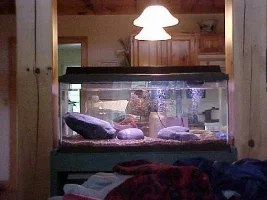
this is a picture of a group of my “wild type” sword females… note that on the larger more mature females, some get color in the dorsal, and some have a “plainer” dorsal, it’s about half and half… in fact the largest female in the tank has a plain dorsal ( not in this picture ) I have plenty of females, ( note the lowest mature also has more body color ) and both plain and more colorful get bred… I’m wondering if I should move out the ones with the plain dorsal, or just leave them as is, on these “wild type” fish, or if some selective breeding is allowed???
IMG_9707.webp
 
Last edited:
There are no rules. Personally, I never selected for colour or shape, beyond not breeding obviously misshapen fish that never would have made it to breeding in the wild. You don't know what you're eliminating, with the complexity of the unseen genetics. When I've had mutations appear in my killies and livebearers, I've left them in the breeding group to see what the story'll be.

In the end, the approach wasn't very valuable as I no longer have most of those livebearers. I have Heterandria formosa, and Xiphophorus milleri. The milleri, after many generations here have drifted from the original look and are more spotted and I think more golden sheened than the fish I first bought. That just happened along the way.

One of my killies was collected in 1989, and bred here since 92. I got some fish from a 2021 revisit to their small and isolated habitat, and the new ones were physically identical to the old ones. So they don't always change, to the eye.

I didn't like it when I found a species and discovered the one or two people keeping that rarity had selected for a trait. Sometimes the odd things hat would appear if you just let the fish sort themselves out were interesting to see.
 
it almost seems like line breeding for a more colorful female sword… 2 of the females in my group are very plain, several have the dorsal colors, and the 1 is highly colored throughout the body, as well as the dorsal… as someone who hasn’t been a fish breeder, I don’t know what would happen with these fish in 3-4 generations if only the more colorful fish were bred, and those offspring sorted… at minimum I’d think the attached “wild type” would no longer be accurate even if after several generations a high percentage still had the plainer looking fish… I find the wild blend pleasing to the eye, but one wonders how strong the particular traits are, and of coarse if both sexes were highly colored they are likely to be preferred if / when sold to the average aquarist…
 
this tank probably has 50 offspring born here, starting with 2 breeding groups in the same larger tank, and since they have only been here a little less than a year, with no visible males born here… if a high female rate is encountered , at maturity, over the long run, having highly colored girls might make them easier to find homes for, as they mature and I need to disperse them, if male / female pairs are not available…
 
There are no rules. Personally, I never selected for colour or shape, beyond not breeding obviously misshapen fish that never would have made it to breeding in the wild. You don't know what you're eliminating, with the complexity of the unseen genetics. When I've had mutations appear in my killies and livebearers, I've left them in the breeding group to see what the story'll be.

In the end, the approach wasn't very valuable as I no longer have most of those livebearers. I have Heterandria formosa, and Xiphophorus milleri. The milleri, after many generations here have drifted from the original look and are more spotted and I think more golden sheened than the fish I first bought. That just happened along the way.

One of my killies was collected in 1989, and bred here since 92. I got some fish from a 2021 revisit to their small and isolated habitat, and the new ones were physically identical to the old ones. So they don't always change, to the eye.

I didn't like it when I found a species and discovered the one or two people keeping that rarity had selected for a trait. Sometimes the odd things hat would appear if you just let the fish sort themselves out were interesting to see.
I wanted to know if it is possible to get wild-type looking Poecilia sphenops or Xiphophorus spp. from breeding fancy one? (Like how fancy guppies ended up looking like wild type after being introduced) Here in Thailand, no one sell wild-type fish except for P. wingei (I think?)

And with the feral guppy population I already have, how can I breed fish to preserve these color but also prevent inbreeding without having to catch more? Adding dullest fancy guppy from the store maybe?
 
The chances a linebred Poecilia sphenops is sphenops are close to zero. Most hobby versions are hybrids between molly species that wouldn't meet in nature, but can interbreed. I've had several sphenops from the wild (I had a friend who visited regularly from their home region) , and every location seemed to have a different form, all very different from pet trade ones.

P wingei has also been extensively hybridized and linebred.

For guppies, I would use a large tank and as large a group as you could support, then let them pretend it's a stream. I got about ten years out of wild Trinidad guppies, and 8 with Colombian ones.
 
For guppies, I would use a large tank and as large a group as you could support, then let them pretend it's a stream. I got about ten years out of wild Trinidad guppies, and 8 with Colombian ones.
Do you have photo of your tank or your fish by any chance? I remember seeing someone did Trinidad guppies biotope and they seem to like flowing water.
 
I don't have good pictures. But I had lots of plants, some large pebbles scattered on the bottom for fry cover, an HOB filter and hard water. I had a Trini colleague who retired and had kept the fish her backyard when she was homesick. She gave them to me since she was returning to that backyard stream.
She said it was fast moving - moving through forest cover.
 
The chances a linebred Poecilia sphenops is sphenops are close to zero. Most hobby versions are hybrids between molly species that wouldn't meet in nature, but can interbreed. I've had several sphenops from the wild (I had a friend who visited regularly from their home region) , and every location seemed to have a different form, all very different from pet trade ones.
Can we breed them just to make them looking close to wild-type just in color (dull grey-ish)?

What about Xiphophorus maculatus?
 
Not that dull....

X maculatus were crossed with swordtails (helleri) and variatus starting from the 1920s. I have tried to get wild form maculatus for most of my 60 years' fishkeeping, and have only seen unhybridized maculatus in Belize. Never in aquariums...
IMG_1234 (640x484).webp
orri1 (640x353).webp
IMG_2694.webp
gilli male2.webp
biulublue.webp
 
I have tried to get wild form maculatus for most of my 60 years' fishkeeping, and have only seen unhybridized maculatus in Belize. Never in aquariums...
:confused: Honestly, I don’t know why wild-type fishes aren’t more popular.

I understand breeding for aesthetic, but I never understand why they intentionally bred weak fishes with too large fin, or balloon, can’t even swim properly.
 
Last edited:
When I've had mutations appear in my killies and livebearers, I've left them in the breeding group to see what the story'll be.
I have an oddball gardneri that’s appeared . His colors are markedly and noticeably different than all the others . I have no illusions about selectively breeding to produce a new strain , he’s a just a random oddball .
Sadly we do not have @emeraldking here to chime in on this . I would love to hear what The Oracle has to say about this .
 
I have tried to get wild form maculatus for most of my 60 years' fishkeeping, and have only seen unhybridized maculatus in Belize. Never in aquariums...
There are several wild populations of X. maculatus for sale on aquabid, along with numerous other wild livebearer species. Would it be worth contacting the seller to see if any somehow made their way to Canada?
 
I don't even look. My last few purchases or trades of killifish eggs have been stopped before they left the US . They never even made Canadian customs. I'd have to get them shipped to a US address and drive down for them, but I'm on the travel boycott there, and even if I weren't, might have issues at the border crossing.

Why look at Aquabid, Wet Spot or other sellers and suffer... it might be easier to go to Mexico or Belize...
 

Most reactions

Back
Top