lazy... or is there really a need, to do it weekly... water change schedule...

Hum. You know that in nature co2 is never injected into the aquarium and frequently the 'bug' count is a bit higher than we would like in our homes.
Sure, but we try to compensate for how little our glass boxes can do, in terms of processes, compared to even a tiny stream.

My Parananochromis brevirostris came out of a stream we couldn't see into. They were caught with blind netsweeps of the shore roots, as the river was polluted by gold mining sludge.

Granted, that's not natural, but I ran UV on their tank when I got them here, in case of bacterial problems. The mining must have just started, because they were fine. Their habitat wasn't. What survived survived if the gold miners moved on to kill elsewhere. If I had money to invest, it wouldn't be in gold.

The streams we took fish from were generally drinking water for local villagers. That made the pesticides from corporate farms/plantations and gold mining run off and mercury doubly tragic. But before the rivers came under attack from people, they were clean.

However we achieve that, it's what we should want. Clean water.
 
Sure, but we try to compensate for how little our glass boxes can do, in terms of processes, compared to even a tiny stream.

My Parananochromis brevirostris came out of a stream we couldn't see into. They were caught with blind netsweeps of the shore roots, as the river was polluted by gold mining sludge.

Granted, that's not natural, but I ran UV on their tank when I got them here, in case of bacterial problems. The mining must have just started, because they were fine. Their habitat wasn't. What survived survived if the gold miners moved on to kill elsewhere. If I had money to invest, it wouldn't be in gold.

The streams we took fish from were generally drinking water for local villagers. That made the pesticides from corporate farms/plantations and gold mining run off and mercury doubly tragic. But before the rivers came under attack from people, they were clean.

However we achieve that, it's what we should want. Clean water.
No clue how that is relevant to injecting co2 in an aquarium but whatever.
 
Hum. You know that in nature co2 is never injected into the aquarium and frequently the 'bug' count is a bit higher than we would like in our homes.
In nature is such a wide field...
Nearby springs here in Germany, you can measure 70mg/l CO2. No fish, lot of swamp plants as you can imagine.

But inside an aquarium, we need a lot of fast growing plants for different reasons.
-They deliver oxygen
-They are part of the "biological filter system"
-Plants are surface for good bacteria
-Their roots help to clean the substrate
-They look fantastic
 
In nature is such a wide field...
Nearby springs here in Germany, you can measure 70mg/l CO2. No fish, lot of swamp plants as you can imagine.

But inside an aquarium, we need a lot of fast growing plants for different reasons.
-They deliver oxygen
-They are part of the "biological filter system"
-Plants are surface for good bacteria
-Their roots help to clean the substrate
-They look fantastic
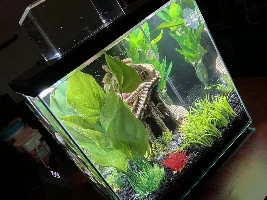
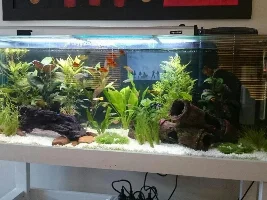
No offense but I think this is insane logic. these aquariums have no injected co2:
x.jpg


z.jpg
y.jpg


Don't get me wrong - if you want to inject co2 by all means inject co2 but don't pretend you are imitating nature or improving the environment for fishes.

As for plant growth I think the above 3 aquariums demonstrat that plants grow plenty fast without inject co2.
 
Last edited:
I personally refuse to add anything that is poison to the fish, yet my tanks are jungles... I just have to choose wisely on which plants
 
ok... I shamed myself into skipping putting my aching feet up for an hour, and did a full normal ( for me 33% ) water change tonight...

so everyone looks good after a 4 week interruption... but I suspect this only worked because my water was "so" good to start with,,, guessing I wouldn't be able to pull it off, if I skipped the next month, after only one normal change, but one has to wonder???
 
Plants can grow without injected CO2 and added ferts.
Plants can't grow without injected CO2 and added ferts.

I think we have to start by agreeing those two statements are true, since we've failed to say which plants we're talking about. @anewbie grows the plants I do, apparently about as I do. Good plants, but easier ones. Others grow plants I can't, and since plants aren't my priority, that's fine by me. But we have to accept both statements.

Similar things can be said about fish. The diversity of life means a diversity of needs, specializations and abilities to adapt to changes. "Fish" isn't a very informative word, any more than "plant".

Everyone here is doing something wildly unnatural. We make glass boxes that we place in isolation in air environments, and we keep aquatic life in them. We try to recreate natural processes that occur in waterways millions of times larger than those boxes. I have 45 tanks in what is a large fishroom for the hobby, and my total water volume is less than a cut off pond beside a dry season brook.

So I change water to try to emulate a natural turnover. I fail, because thousands of litres move through a brook every hour. But I get close enough that my fish can breed, and thrive with long lifespans and behaviour not unlike what I've seen in nature.

Others use plants, and try to absorb the inevitable pollution of a tiny water body. If they are meticulous, that too fails in a workable manner, and creates something very beautiful while operating as well as it does. It can be good enough.

We use technology. CO2. DIY hacks. Creativity. Inventiveness.

We even have people who develop faith in crazy theories and do nothing positive, a la father fish, trying to use wishes to make the world simpler than it is. Magic is a popular tool.

I think we have to call out the latter group, as they do active harm. But all of our fiddling, attempting, inventing - all of it can come from a sound scientific basis as we try to achieve a very weird dream. There's no one road.

We're a forum here, and there are many new aquarists who check in. So whatever we do we have to try to be clear about why. I have a friend who has taken up quilt making, and she works on technique as a matter of basic sense. Yet we have people who don't want to work on technique in fishkeeping, as if it were something different as a learning curve. I'll argue for water changes, but if an aquarist finds a different way to achieve temporary balances and can provide proof, I'll listen. Since it takes skill to pull off those techniques, I won't suggest them to newcomers.

Learn to work with water. Learn to define what your fish are, what your desired plants are what their natural history obliges you to do. Then, if you get fancy and learn to work with water chemistry (beyond the useful toy API kit) , develop and share a system. It will be different from what others do, but the goal's the same.

 
@f_luxus said... It's not poison if it's around 15-20mg/l...

to clarify my statement, in general, I don't like to "add" anything that doesn't benefit the fish ( and I don't currently have the means to test for those kinds of things ), and thus wouldn't add them... yes, for many years I was a plastic plant person, but through experimenting I have found many plants that thrive in my tanks, with water that is all about the fish... I don't think any less, and have great respect for people that fill their tanks with challenging plants to grow, and I do like a few plants in my "fish" tanks, but have chosen what works for me ( I have a pothos vine growing out of my tanks, that grew through a vent, onto a completely different floor of the house... so now I have a "house plant" in our living room, that is rooted in a tank in the basement ) I'm sure that single plant is going a long way towards keeping my water right, when I get too busy to do the water changes I usually do...
 
I do not claim to own all wisdom in the world, I'm still learning.
And there are so many ways!
I have and had also lowtech and even notech tanks. I just want to show another way here in that forum. Just for knowledge exchange.

Greetings, Felix
 
Do you use fertiliser?
I have used a few root tabs over the year - maybe one every 3 to 6 months under the large echinodorus. Of those three only the one with frogbit gets a small dose of very dilluted liquid fertilizer occasionally. The 100 gets no fertilizer - the substrate in all three are inert.
 
I have used a few root tabs over the year - maybe one every 3 to 6 months under the large echinodorus. Of those three only the one with frogbit gets a small dose of very dilluted liquid fertilizer occasionally. The 100 gets no fertilizer - the substrate in all three are inert.
These are very beautiful tanks :)
Frogbit has no CO2 limitations, because he takes it from the atmosphere.
I could see the same with Cyperus helferi.
It assimilated O2 but only near the surface.

Root tabs are a great way to feed the plants without feeding algae ☺️ And roots also clean the substrate and keep it healthy.
 

Most reactions

Back
Top