lazy... or is there really a need, to do it weekly... water change schedule...

I stick to a schedule of weekly partial water changes. Every Monday, at least a 50% change minimum.

I learned early on in fish keeping you're far more likely to change water if you get on a schedule as opposed to relying on water testing or some sort of imaginary ability to determine when water needs to be changed. When you're on a routine you are far more likely to stick with it and not procrastinate. When you're on a schedule you know exactly when you're last water change was. If you can't remember the exact day of your last water change off the top of your head, it's probably time for a water change.

Also a routine of regulat partial water changes gives you peace of mind for exactly the reasons @GaryE just mentioned. Life happens. It just happened to me. My 81 year old MIL fell and broke her hip on Thursday. I've been making daily trips to the hospital, 1 hour each way, for a few days. But I know because I've kept up with weekly water changes, if I have to be a day or two, or three, late on the next water change, I can do that and everything will be just fine.
 
This topic seems to come up a couple times a year or so. Here's my take on it: Almost all natural water bodies, other than stagnant puddles and elephant tracks that @GaryE's killis live in, are frequently replenished by rain, snow melt, and groundwater springs. Even desert rivers are replenished from these things somewhere upstream. So even with low stocking and good nitrate levels, it is still natural to replenish the old water with fresh. This seems to be an area where science is still catching up with common sense, as we gradually learn about all of the pheromones, allelochemicals, and other voc's that plants and animals release into their environment to communicate and defend themselves. Keeping those things diluted just seems like common sense.

Also, Walstad insists that changing the water replenishes the trace minerals that plants need to grow. This would seem especially important with softwater tanks.

Can it work without water changes? Sure. Missing one now and then probably isn't going to hurt anything. During the covid lockdown a few years ago, my 150g, which lives at a local business, went around three or four months without any maintenance except occasional feeding. When I finally made it back to the office, the plants were lush and the fish looked vibrant. But I wonder how bad the water smelled to them, and I wonder if some subsequent losses didn't have something to do with that lapse.
 
I'm lucky (in this discussion) in that I have directly seen both types of aquarium maintenance.

Between around 1972 and 1980, I never changed water. Not even once. I had a 20 gallon long with Xiphophorus variatus, all under one inch long. I was a kid, at the start and figured I'd lucked into a dwarf strain. Short lived, too. Females dropped one set of babies and died, but I had a steady supply.

Conventional wisdom even made me bottle up the water and bring it with me when we moved. It was 'old water', and that was a valued thing. The older aquarists who advised me would have considered me to be an idiot for changing water as I do now. How could I ever achieve a balanced aquarium? If you changed things, you destroyed the balance!

You had to have plants, and I did. I had more than just variatus - I regularly overstocked the tank with many different things. I think I was ready for annual killifish, because all fish were so short lived, except for one Cory that lasted 12 years in that yellowish soup. I liked going to aquarium stores, and met the same people over and over again, as we all bought new fish on a regular basis.

I saw a whole other side of things when I began reading about water changes, and started doing them. I've no intention of going backwards.
 
I only speak a little German, so most of that post I'll have to go translate
Sorry, usually my browser does the translation automatically. I write short answers myself in English, but if it's a complicated topic and many words i use the machine 😉😊
Now i changed it to English, can you see it?
 
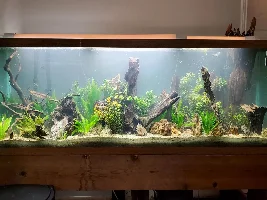
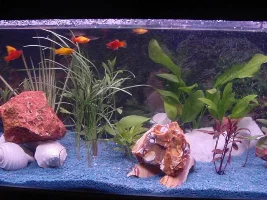
BTW this is the tank i change only every 2 months 30-50%. All Fish healthy, pH around 6 almost no temporary hardness.
20251106_191446 (3).jpg
 
Last edited:
BTW this is the tank i change only every 2 months 30-50%. All Fish healthy, pH around 6 almost no temporary hardness.
View attachment 373606
Rich plant life and very light stocking can allow that. The majority of readers here are fairly new to aquariums, and are wondering how many fish they can fit in with just a few plants they're learning to grow. It takes time and experience to be able to appreciate a sparsely populated showtank like that, so your water change routine is specific to how you set the tank up.
That tank is a thing of beauty. A system of beauty.
The OP, @Magnum Man , stocks at levels I wouldn't go near, but has success with his tanks. If he were to reduce water changes except occasionally, those reductions would probably cause trouble quickly. It's why we end up with so many contradictory looking answers to questions - we all have different ideas and set ups.
 
My "secret" lies in consistent and strong plant performance, both emersed (above water) and submersed (underwater). The plants are my biological filter engine.
🌿 My Concept in a Nutshell: Plant Growth and Water Parameters
* Source Water is Key: My concept only works because my source water has virtually no hardness (very soft).
* Water Mixing: I mix RO water with only approx. 10% tap water. This causes the temporary hardness (KH) to rise to a maximum of 1 °dKH, but it decreases again over time (due to plant consumption/precipitation).
* Dissolved Metals: I usually measure 50–70 ppm of Total Dissolved Solids (TDS).
* Nutrient Management: I pay close attention to the nutrient ratios, especially Calcium/Magnesium/Potassium (Target: approx. 3:1:1).
* Don't Let Nitrate Run Empty: A critical point: I NEVER let the nitrate level drop to zero! Plant growth requires nitrate, and maintaining a stable but low nitrate level (e.g., 5-15 ppm, depending on livestock/planting) is crucial for consistent growth.
🦠 Why This Works: The Cycle
This consistent plant growth ensures:
* Excellent oxygen supply (O₂ production).
* A high oxygen concentration is ESSENTIAL for the establishment and activity of the "good" aerobic microorganisms (bacteria) that process ammonium/nitrite/nitrate.
* These microorganisms (in the filter, substrate, and on surfaces) then keep the entire system stable, reducing the need for weekly emergency water changes.
* The plants consume the nutrients (including nitrate/phosphate) produced by the fish livestock, which slows down their accumulation and keeps the water parameters more stable over weeks.
In short: When the biology is working optimally, the plants are growing optimally, and the water chemistry is constantly within the correct window, the water change interval becomes more flexible. It is a strategic choice, but one that requires intensive monitoring during the initial phase!
I look forward to your thoughts on this!

"Fun fact: I've actually got ADHD, and whenever I'm busy looking after my aquariums, the whole flat looks like a bomb has gone off! Perhaps this deeper understanding of chaotic systems is precisely why my tanks run so stably, haha!"

20251106_191446.jpg
 
@f_luxus - what I take away from this is that you do as much work to have a low water change rate as a lot of us do to change water. You haven't found the time and effort saving dream that a lot of online gurus argue for, but have opted for extra learning and diligence to achieve having such a beautiful tank. I like that idea.

I think it's crucial for us to say what we do and why we do it, with a focus on why. If we don't do that, misunderstandings arise, especially with internet culture often acting as if explaining reasons is somehow a bad thing. How else are we going to bounce ideas off each other?
 

Most reactions

Back
Top