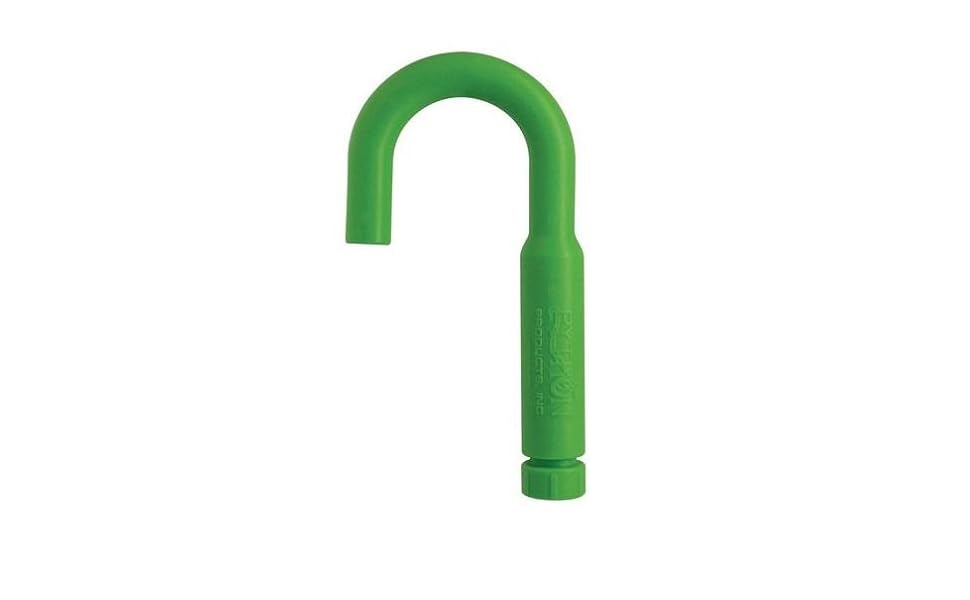
one of the most important parts of my "power" water changing, is control of the flow... the diaphragm pump I'm using, allows for the stall of a shut off/ control valve, I'm currently using a stainless "J" hook on my draw line, with a mesh end, that goes 9 inches into the tank, as a safety measure, so I can't accidentally completely drain a tank, if I were to get interrupted while doing water changes... this has been working exceptionally well, with no modifications needed, it hangs on the tank, and is hands free during use...
I'm now working on ( in my head, as I'm still really busy for another couple weeks ) a fill end... I'll need a couple different ones... I currently have a stainless "J" hook end, with no reducer valve, that works great for the bigger tanks, in my main group, but not so well, on the smaller tanks, and the couple hard water tanks I'm filling with well water from a garden hose, need an end yet... I'm looking at a coil of 1/2 inch stainless tube, and a stainless garden hose female end (they will be food grade tig welded ) with a compact stainless ball valve, which I'll be able to control or shut off the flow... I'll be adding a stainless ball valve to the fill "J" hook on the one for my main tank group, so I can reduce the flow, when filling my 10 gallon shrimp tanks, as at full flow, it blows everything around, in the tanks... I'm choosing stainless for a couple reasons... durability, and weight, over plastics, at full flow, when filling larger tanks, there is a tendency to want to jump out of the tank, and whip around like a fire hose... I have 2 of the 10 gallon shrimp tanks, that are only a few inches off the floor, and without the weight of the hose holding "J" hook down, it's "blasted off" from the tank, a couple times, if I don't wedge it in properly, of coarse this sprays water all over... adding the weight of a stainless ball valve will help significantly... plus being in the food industry, I have a lot of experience with stainless, and prefer it to other metals... with less chance of raising the copper level in the water for tanks that may contain shrimp...
anyone else eccentric enough to not use the normal??? what do you use, and why???
I'm now working on ( in my head, as I'm still really busy for another couple weeks ) a fill end... I'll need a couple different ones... I currently have a stainless "J" hook end, with no reducer valve, that works great for the bigger tanks, in my main group, but not so well, on the smaller tanks, and the couple hard water tanks I'm filling with well water from a garden hose, need an end yet... I'm looking at a coil of 1/2 inch stainless tube, and a stainless garden hose female end (they will be food grade tig welded ) with a compact stainless ball valve, which I'll be able to control or shut off the flow... I'll be adding a stainless ball valve to the fill "J" hook on the one for my main tank group, so I can reduce the flow, when filling my 10 gallon shrimp tanks, as at full flow, it blows everything around, in the tanks... I'm choosing stainless for a couple reasons... durability, and weight, over plastics, at full flow, when filling larger tanks, there is a tendency to want to jump out of the tank, and whip around like a fire hose... I have 2 of the 10 gallon shrimp tanks, that are only a few inches off the floor, and without the weight of the hose holding "J" hook down, it's "blasted off" from the tank, a couple times, if I don't wedge it in properly, of coarse this sprays water all over... adding the weight of a stainless ball valve will help significantly... plus being in the food industry, I have a lot of experience with stainless, and prefer it to other metals... with less chance of raising the copper level in the water for tanks that may contain shrimp...
anyone else eccentric enough to not use the normal??? what do you use, and why???
Last edited: