Ich??

MuddyWaters

Fish Addict
Supporting Member ⭐
Joined
Oct 5, 2021
Messages
867
Reaction score
1,153
Points
93
Location
Atlanta, GA, USA
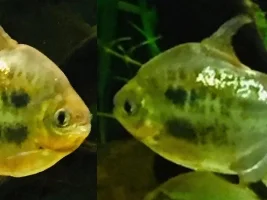
All my Royal Acaras have spots like this. None of the other fish do. I'm guessing it's ich. Anyone disagree?
5460.webp
 
I agree. It's the right size and the right shape. Malachite green, fast. It's established.
 
I put API's Super Ich (I think that's what it's called) in there. I've used that one a bunch (and had it around) and it seems to work well. I guess it's just Malachite green anyway. I also raised the temp to around 80- I didn't even have the heater plugged in before- temp stays around 78 or so- my fish room doesn't have direct AC vents in it. It's what my wife calls the "Laundry Room," I guess because of those noisy contraptions on the left wall. I have a fan blowing in there all the time to keep the temp lower. Anyway, all that is far off topic. I'm in "ramble" mode today.

I'll dose again on Tuesday and then change water again on Thursday- hopefully all good by then. Thanks for your help! I just thought it was weird that the other fish showed no signs of it. I guess the Acaras' immune system is a little less robust or something. All of the fish are eating like hogs today- Sunday is frozen food day, so they go crazy.
 
Just keep in mind that the others could have it in the gills or are likely to get it from the offspring of the ones on your fish in pic. Also, once you don’t see it anymore…..do another round of meds for several days or a week so as to kill off the ones hatching from the cysts that may very well be on the substrate.
 
Yeah I'm going to treat twice and monitor. I turned the heater on yesterday and set it to about 82. I checked today and it's 88!! Unplugged that thing. Dang... Gotta watch those heaters
 
Monitoring the fish- I see the spots on my hatchet fish tonight. Acaras fins are pinched and my severum has pinched fins in the back corner.


Next treatment is tomorrow...
5515.webp


Severum came to see me

5518.webp
 
It's a tough parasite. I don't raise the temperature for it, as sometimes, it's heat resistant. So you have to balance the stress and damage you do to the fish in such temperatures compared to the damage you do to a possibly resistant parasite.

The dyes work by disrupting the development of freeswimming ich, killing it. The problem as the severum shows, is the little rats are feeding on the fish the whole time they're safe in that cyst, and that does serious harm. It's why I use malachite green/formalin mixes rather than trusting heat or using equally harsh but not as effective salt.

Most of the time I've knocked off ich with one treatment and one follow up to be safe, but in a few cases it's taken up to five. You want it to be gone quickly, with good reason, but the little parasites are tough sometimes.
 
Yeah it bothered me that they seem to be spreading not dying, but dose 2 tonight. I've had similar experience w getting rid of it. It usually doesn't take more than 2, but we'll see
 
Depending on your particular situation, the white spots might get worse before they get better. Don’t be alarmed as this depends mostly on which stages of Ich are most abundant in your tank atm. You have a fairly heavy infestation and I would suspect it would take more than two treatments to eradicate. I have not, however, used the API Ich treatment. Good luck and keep us posted.
 
Yeah it bothered me that they seem to be spreading not dying, but dose 2 tonight. I've had similar experience w getting rid of it. It usually doesn't take more than 2, but we'll see
It often looks worse before getting better but that usually means you've accelerated the life cycle by raising the temp which is good. The meds will get a crack at killing off the buggers when they become free-swimming.

FWIW, the old literature repeatedly stated that hatchets were ich-prone.
 
FWIW, the old literature repeatedly stated that hatchets were ich-prone.
Hatchets and dwarf gouramis, which both are fish that are easily chilled as warmer water residents. If ich is around and the fish gets stressed, look out. When I was a kid, winter fish purchases traveled inside a warm, zipped up winter coat, close to your heart.
 
Hatchets and dwarf gouramis, which both are fish that are easily chilled as warmer water residents. If ich is around and the fish gets stressed, look out. When I was a kid, winter fish purchases traveled inside a warm, zipped up winter coat, close to your heart.
Absolutely. One reason why I always wince when some folks advocate that bettas can be kept at room temps. They can, especially by an advanced aquarist--though I never have-- but it is IMO bad counsel to share with newbies (as many betta-keepers are) who are likely to make other missteps which will stress the fish and which will be aggravated by a betta's suppressed immune system and appetite if kept at 72F rather than 80F.
 
Absolutely. One reason why I always wince when some folks advocate that bettas can be kept at room temps. They can, especially by an advanced aquarist--though I never have-- but it is IMO bad counsel to share with newbies (as many betta-keepers are) who are likely to make other missteps which will stress the fish and which will be aggravated by a betta's suppressed immune system and appetite if kept at 72F rather than 80F.
Not needing a heater for Betta splendens is a piece of advice I've given too many times - without thinking of that absolute newcomer angle. That is good and appreciated perspective.
 
@MuddyWaters
Very nice looking denisonii.

I have a few papers about Ich bookmarked. This one had the quote below in it.

REVIEW ARTICLE

Picon-Camacho, S.M., Marcos-Lopez, M., Bron, J.E. and Shinn, A.P., 2012. An assessment of the use of drug and non-drug interventions in the treatment of Ichthyophthirius multifiliis Fouquet, 1876, a protozoan parasite of freshwater fish. Parasitology, 139(2), pp.149-190.

It has a direct life cycle, which is temperature dependent such that the warmer the water temperature the faster the life cycle completes. The life cycle involves 4 diff erent stages: (1) the trophont, which resides within the surface epithelium of gills, fi ns and other body surfaces; (2) the protomont, a free-swimming stage that exits the fish and settles on the substrate to become the encysted tomocyst stage (3) which in turn repeatedly divides by binary fission to produce tomites which are released to the water column. Tomites differentiate into the infective stage (4) the theront, which needs to find a host within a short window to successfully complete the life cycle by penetrating the epidermis and developing into the trophont stage before it dies (Lom and Dyková, 1992; Matthews, 2005). Theronts can survive for up to 92 h at low water temperatures; their survival being inversely proportional to the ambient water temperature (Wagner, 1960; Aihua and Buchmann, 2001).

The above paper has a couple of extensive tables which review all the known methods which have ever been tried for dealing Ich (up until 2011 or earlier). This includes both chemical/medical based and natural treatments. The table reports the doasing, Ich stages where they if they did so, etc. It is an overwhelming amount of info.

The most important things to take from the above info, imo would be:
1. Warmer temps speed up the life cycle of ich. The fast er moves, the faster it can be attacked with succcess.
2. It requires more than a single treatment to wipe it out as it is resistant to almost evreything it the review article during at least 1 stage.

One more thing it noted and which I have read about in other papers is this:

Despite these non-drug interventions, fish that are exposed to a certain level of I. multifi liis infection are able to acquire a protective immunity which can last from several months to a year (Hines and Spira, 1974; Burkart et al. 1990; Matthews, 1994). This acquired immunity has stimulated efforts towards the development of a vaccine against I. multifi liis which is in progress (Matthews, 2005; Sommerset et al. 2005;
Dickerson, 2006).

For those so incllined, you can read the full paper here http://dspace.stir.ac.uk/bitstream/1893/10147/1/Picon Camacho et al Parasitology Ich chemo review.pdf
 

Most reactions

Back
Top