Let's look at that assumption a little closer:
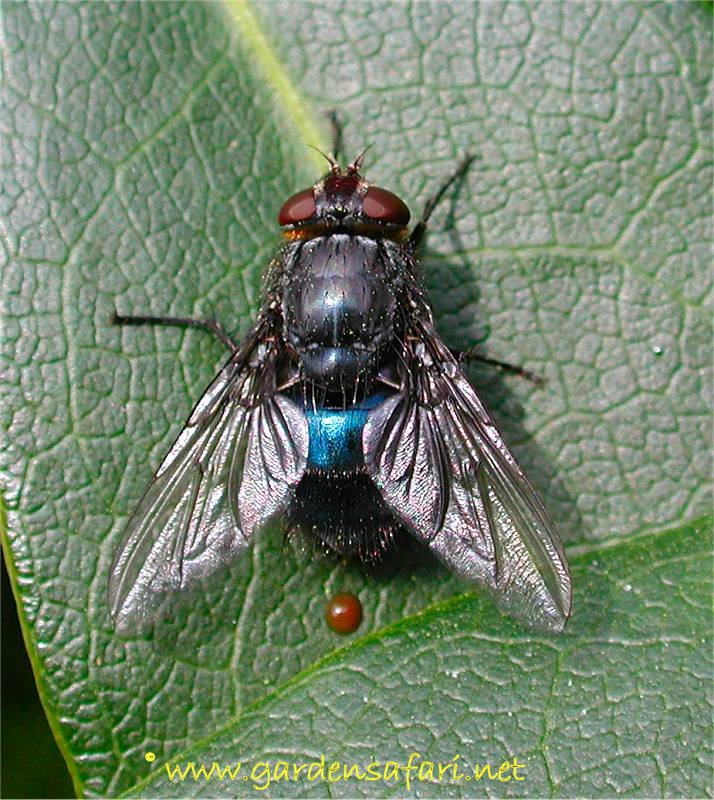
I couldn't find the mass of the bluebottle fly anywhere, but wikipedia describes it as "slightly larger than a housefly". One of the sources I found for the mass of a housefly cited it at 12 mg.
For calculation purposes, let's just triple that size to 36 mg and consider that enough an approximation for "slightly larger". (I think that this is probably far more than needed, and only a 50% increase of mass is probably enough).
Now, let's just assume that all of that mass decays into ammonia. It won't really, but in exploring the worst-case scenarios we can see if the worst-case is really all that bad.
So, now we have 36 mg of ammonia in the tank. 36 mg / 35 L of water in the tank = 1.03 ppm.
That really isn't that huge of an increase. At least two things should be going on that ameliorate that number. Firstly, the fly won't decay spontaneously. So, all 36 mg of possible ammonia won't be dumped into the tank at once. Secondly, the filter bacteria will be increasing in number with the increase in available food. As I wrote above, the filter bacteria, given ample food, will double in number in 24 hours. Most fish tanks that are reasonably fully stocked have a population of fish that are putting out more than 1 ppm of ammonia waste a day. 2-5 is pretty typical. So, it wouldn't take the bacteria more than 24 hours to increase in numbers enough to completely consume that extra 1.03 ppm of ammonia.
Finally, your pH will have an effect by at least some of that ammonia will be ammonium, which is much less toxic. See my old thread
[URL="http /www.fishforums.net/index.php?showto...&hl=ammonia"]http/www.fishforums.net/index.php?showto...&hl=ammonia
[/URL] for more information.
So, in review, in order to instantly add just a little over 1 ppm of ammonia -- which really isn't all that bad -- the fly has to die and decay instantly so your filter bacteria wouldn't have had a chance to respond yet, and all of its tissues have to be converted to ammonia. All this assuming a fly that is 3 times as massive as a common housefly.
If a common housefly (12 mg) were to decay into half ammonia (seems like as good a guess as any -- it really depends largely on what amount of the fish's tissues are nitrogen based), that only increases the ammonia by 0.17 ppm, assuming an instantaneous decay.
I'm just not buying that the decay of this fly spiked your numbers. Now, if you had 10 dead flies, maybe. And, I'm not discounting the foreign bacteria possibility, though there are some stretches in that hypothesis as well (like, the bacteria that came in on the fly would have had to found suitable sustenance in the tank -- bacteria are highly specialized over the long run. The dominant bacteria that would have been on the solid waste that the fly might have visited wouldn't be well-adapted to an aqueous environment where there isn't solid waste. The bacteria that is dominant in the tank should easily starve off any bacteria that isn't adapted for the environment). I'm just not buying the idea that a single fly that passed away in your tank could have spiked the levels enough that any fish would have even noticed. It just doesn't seem to jive with the numbers as I see them.





 ) the lid to my tank is never off for that long!!!


