Having A Nightmare With Sand

flippajh

Fish Crazy
Joined
Aug 10, 2008
Messages
211
Reaction score
0
Points
0
Location
Wimborne, Dorset
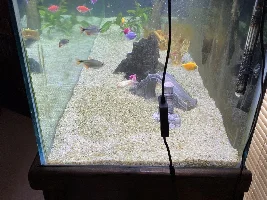
I changed from black gravel to silver sand from the lfs, about 3 weeks ago, and had real problems, my nitrite went through the roof and I lost one of my cories, I managed to get the readings back under control with plenty of water changes.

But I just can't get the tank to clear, the water still looks slightly cloudy and when you look at the water it's like tiny particles floating around in it. But it doesn't look like dust off the sand. I rinsed the sand really well when I put it in.

I've been doing a twice weekly water change to try and clear the tank out, but it just doesn't clear. When I did the water change on Wednesday I thought I'd give the filter a rinse in the removed water, which was ok, not too clogged. I did a water test yesterday and the nitrites are back up to 0.25, it's really strange, and this evening I've come home from work and another of my cories has died.

I've done a 25% water change and waft over the sand and the sand it's turned over is a grey/brown colour.

Do you think it's worth emptying the whole thing and starting again? It just looks really horrible, I do really want to keep the sand as I think it's best for the cories, but with the gravel my water was absolutely spotless. Have I bought the wrong sand?

Thanks
 
You really need a maximum substrate depth of around 3/4" with sand and it needs to be turned every couple of days to prevent gas build up (one tell-tale sign of a gas pocket is when the sand turns grey-black).

I would say that the colour change you are experiencing is due to the build up of gas. Anaaerobic bacteria within the substrate 'create' the gas in pockets beneath the surface. This gas is extremely poisonous to any fish so you need to turn the sand at least once every 48 hours.

Also, if you have any ornaments, make sure the substrate under them is no more than a few mm thick, otherwise you will have to move the ornaments every time you come to stir up the sand.

I would personally use Argos (or similar) play pit sand as this seems to be denser than other sand and settles a lot easier.


BTW, syphon off ALL sand that has turned a grey-brown-black colour. You really must remove any trace of the anaerobic bacteria. Oh, and the presence of these gases will affect test results.
 
You really need a maximum substrate depth of around 3/4" with sand and it needs to be turned every couple of days to prevent gas build up (one tell-tale sign of a gas pocket is when the sand turns grey-black).

I would say that the colour change you are experiencing is due to the build up of gas. Anaaerobic bacteria within the substrate 'create' the gas in pockets beneath the surface. This gas is extremely poisonous to any fish so you need to turn the sand at least once every 48 hours.

Also, if you have any ornaments, make sure the substrate under them is no more than a few mm thick, otherwise you will have to move the ornaments every time you come to stir up the sand.

I would personally use Argos (or similar) play pit sand as this seems to be denser than other sand and settles a lot easier.


BTW, syphon off ALL sand that has turned a grey-brown-black colour. You really must remove any trace of the anaerobic bacteria. Oh, and the presence of these gases will affect test results.
anaerobic bacteria is not harmful at all, as soon as it hits oxygen it is harmless, our water is crammed with oxygen otherwise our fish wouldnt be living in it
 
agreed on the argos [laysand. i changed my tank from gravel to sand and used it with no problems. it was already pretty clean didnt take lots of washing tank cleared in a day or so . personally my substrate varys in depth all over . i dont find depth to be an issue as long as the sand is kept turned its fine .
 
anaerobic bacteria is not harmful at all


I did not say the bacteria was harmful.


It's the gases they produce that are lethel to fish.
the gasses produced by anaerobic pockets are not lethal as soon as they hit oxygen they are harmless

equation: H2S + 3/2 O2 --> H2O + SO2 or you can multiply it by 2 so you will have 2H2S + 3O2 --> 2H2O + 2SO2.

the Sulphur Oxide smells like eggs and having anerobic pockets is good for the aquarium, as it can convert nitrates into Nitrogen. It also allows plant roots to grow better, having a substrate high in oxygen can keep elements such as iron locked up in their oxide precipitates which plants cannot use.

equation courtesy of aaron north
 
The general depth of the sand is around 1/2" to 3/4" but it has settled in different areas at slightly different depths, I do have quite a few plants in the sand, and a large piece of bogwood with java ferns on it, I've been doing the water changes with a sand vac twice a week at the moment, but if I disturb too near the plants it unplants them! I have some Hygrophilia, cabomba and a small sword.

I certainly haven't noticed a bad smell, and the filter sponges smell nice and earthy. Perhaps I need more sand. I think maybe a trip to Argos then and replace the sand with play sand, but the sand I bought was for the aquarium, so would have thought it was ok.

I'm just disappointed cos everyone's tanks with sand look so lovely on here, and mine is all cloudy and I've lost two of my cory's which never happened with the gravel.
 

Most reactions

Back
Top