Going fishing in West Africa - a journal

GaryE8 6

Moderator
Staff member
Global Moderator ⚒️
2x Fish of the Month 🌟
Joined
Oct 14, 2011
Messages
11,350
Reaction score
20,721
Points
113
Location
Eastern Canada
Benin – I could self promote as an explorer, but we crossed from one side of the western African country to the other without seeing many gaps between the houses and businesses that lined the well maintained highway. Along the coast, people-wise, I could just as well have visited the sidewalks of a major US city at rush hour, although Benin was safer and friendlier, but shabbier and poorer.

It was night and day to my previous African visit, to less developed Gabon. I have never been as surrounded by people as I was at almost every moment in this trip. Sometimes my really rough hotel room was an escape to a little solitude after the constant buzz of life around me.

I left home after a minus 24c morning and a day and a half later got off a plane into 33 degrees and sweltering night-time humidity. I'll admit, it was a shock even though I expected it. I wasn't ready for what adding the most intense and hot sun I have ever felt was going to add. I had weighed myself to calculate the suitcase allowance before leaving, and neither I nor the bag had been overweight. When I returned, seven days of fishing had taken eight pounds off me.

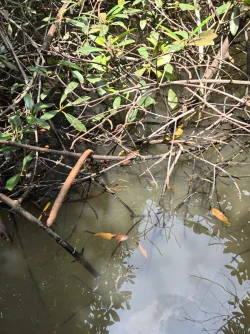
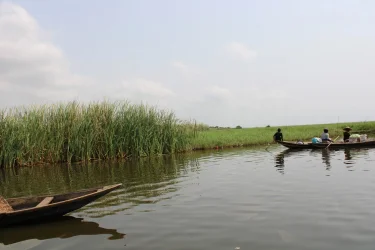
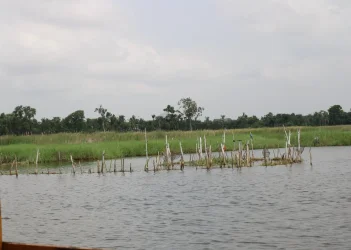
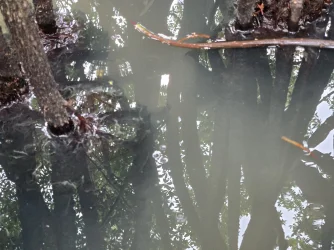
Day one: One of our party had missed a connection flight, so two of us went to visit a mangrove swamp. We took a boat ride and saw hundreds of Aplocheilichthys spilauchen, an uncommon (in the hobby) brackish water lampeye killie. The salt level of the river was low, and most of the fish were salt tolerant Tilapia of various sizes.


Hang on. This is just a starter. I'll post daily until I've covered the whole adventure. All I'll add is that we were desperately hoping to get into the fish hunt, and that came on day two...
 

Attachments

  • 20260305_071834.webp
    20260305_071834.webp
    292.9 KB · Views: 141
  • 20260305_073330.webp
    20260305_073330.webp
    365.3 KB · Views: 83
Day two was our first shot at fishing, and a failure of sorts.We were tourists again, though we tried. The plan was to go along the border with Togo to be across the river from the town of Agome Glozou. That was the origin of the first local form of Chromaphyosemion biteniatum I had ever bred, and I remember it as a beautiful fish, long lost to the hobby. One of my goals there was to collect this species from different drainages to see if there are distinct geographic variants, and there really is only one way to figure that out.
Our driver had a hard time getting this. He was used to tourists following tourism routes.
The history of Benin is scarred by the slave trade. in 1707, a revered king of one of the peoples there led his people to build a village on stilts in the middle of the lake. They prepared escape routes via dugout canoes, and developed a water based lifestyle that continues to this day. The lake is generally shallow, but the village of Ganvie had excellent sightlines for when slave raiders appeared on shore. The people of the village were able to stay free when other nations around them were packed up and exported as commodities. Historians suggest that without the capital generated by the trade in humans, capitalism would not have developed when it did.
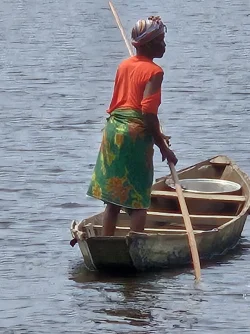
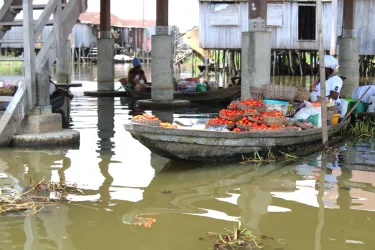
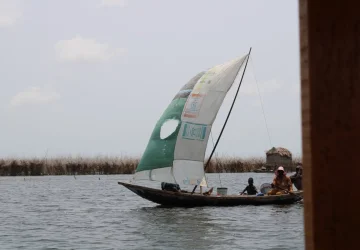
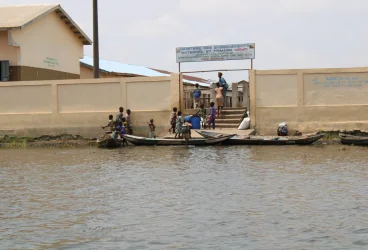
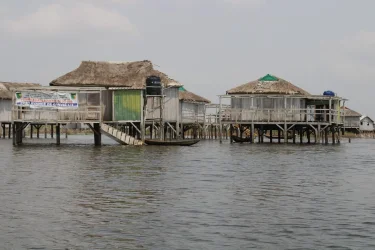
The Ganvie people built artificial islands so their children could learn to walk properly, and an entire water based economy. It's now a major tourism site, as much as the region has any. I have never been anywhere as fishing dependent, and it was a fascinating place. Kids go to school by boat, markets are on water, and the homes are constantly rebuilt. It was a good stop.
After, we headed toward the beautiful killifish, but after trying for a couple of hours, only caught Parachanna in partially dried up pools. The juvenile African channa had eaten all the killies in the dessicating habitat, and were in turn probably doomed to dry up before the rainy season. If we hadn't stopped at Ganvie, we might have found more permanent waters, but time defeated us and we returned empty handed. At another location closer to the coast, we found water where the sea had infiltrated, and only Aplocheilichthys spilauchen were doing well. We released them. Then we went back to Cotonou.

Ganvie homes
Ganvie schoolbuses
Pirogues
The food market
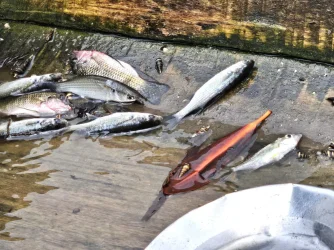
local catches on the bottom of a canoe
 

Attachments

  • boatganvie1.webp
    boatganvie1.webp
    480 KB · Views: 72
  • ganviemarket4.webp
    ganviemarket4.webp
    210.2 KB · Views: 76
  • pirogue2.webp
    pirogue2.webp
    114.2 KB · Views: 85
  • ganvie schoolbus.webp
    ganvie schoolbus.webp
    205 KB · Views: 76
  • ganviehouses.webp
    ganviehouses.webp
    212.9 KB · Views: 77
Here's an ancient, clever idea. In Ganvie, they build large fish traps consisting of thickets of emerging plants, They're circular, and ringed with posts. The fish move into them to breed, as they are ideal, and tend to use them as cover. When the population gets large enough, the fishermen surround the thickets with nets, and harvest.
Along riverbanks, they build artificial plant 'mini peninsulas' that jut out til the water gets deep. They have the same function. We later found fishing along the edge of them useful for catching normani lampeyes and killies.
The first photo has been harvested, the second not.
 

Attachments

  • fishing canoes.webp
    fishing canoes.webp
    161.4 KB · Views: 72
  • fishtrap1.webp
    fishtrap1.webp
    183.7 KB · Views: 75
Maybe it's just the angle, but in the picture of the houses there appears to be a set of stairs leading up from the water that only Spiderman could negotiate.

Thank you for an AMAZING write up so far....I've been waiting for this!
 
Okay, finally, successful fishing at location three.

We got our driver on the same page as us, and drove inland.

Beninois roads are mayhem, beyond Mario Kart. Your car is surrounded by thousands of small motorbikes, carrying everything. Cars and trucks weave out of traffic, passing where nothing can pass and missing each other by centimetres. Accidents are everywhere as you fly along the well made roads in what feels like an endless cavalry charge. It isn't thrilling. It's just astonishing.

One motorbike passed us carrying a coffin.

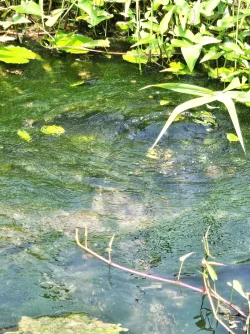
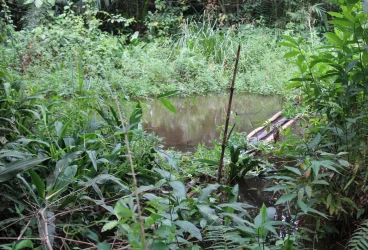
And then you bounce into a village and bump along slowly, in the world of red dust roads. I was the mouthpiece as I speak French and my companions didn't (Austrian and Danish), and I asked locals about nearby water. They sent us up a dusty footpath under a heartless sun. We walked on uncertainly, through what appeared to be irrigated fields with hot peppers, corn and a lot of early growth. Suddenly there was a pool with a spring bubbling up, and morning glory vines all over the ground. We received permission to fish, and immediately took out a beautiful green form Epiplatys bifasciatus and my target, a Chromaphyosemion biteniatum. I was able to bring the biteniatum back, though hours of fishing only gave us a few specimens of each.

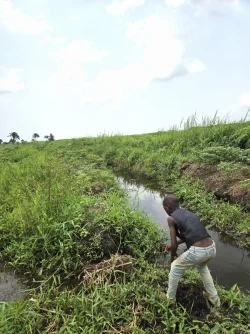
Irrigation ditches spread out, fed by the springwater but with about 3 feet of sucking mud on the bottom. We had to net the fish from the banks.

A kid joined us in our fishing, and was a really polite, intense young guy. We worked for a long time for what's usual in highly populated regions of Africa - not a lot of fish. The fish themselves were a bit in trouble. I always bred my biteniatum in summer, when my tanks got to 24c. In Gabon, the water had been around 22. In Benin, the savannah waters were hot, well above 30 degrees celsius. In some habitats, it hit 34c. The fish that were surviving were stressed, and few were more than half grown. You'll have to wait for fish photos. In many cases, they were just sexable.

Back at the hotel in the darkness, La Beninoise is a very good beer when served cold.
1- the spring
2- our helpful helper
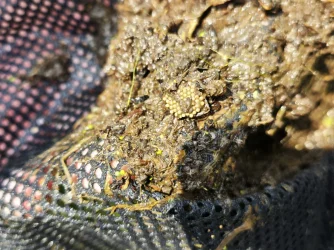
3- predatory water beetles carrying eggs
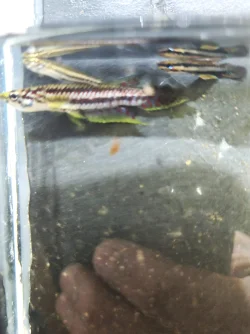
4- Epiplatys bifasciatus
 

Attachments

  • upwelling spring.webp
    upwelling spring.webp
    494.8 KB · Views: 77
  • coolkid.webp
    coolkid.webp
    439.6 KB · Views: 75
  • waterbeetleeggs2.webp
    waterbeetleeggs2.webp
    329.3 KB · Views: 82
  • bifbdel3green.webp
    bifbdel3green.webp
    128.6 KB · Views: 72
Last edited:
The next day, location 4 was a slow moving stream in the centre of the country. The bottom was muddy and hard to walk in, but we caught Thysochromis ansorgii, Chromaphyosemion biteniatum, and two Epiplatys - togolensis and grahami. The grahami, however, were killed by the police.
Right after they were caught a car showed up and started threatening us with all sorts of fines, although everyone involved knew we were legally fishing. It was a shakedown for cash, a problem with police in many places. The government has been cracking down on police corruption there, so the officers involved were cautious. I just played it as the ultra polite, naive Canadian who didn't get what it was really about, and they cut their losses and left. It was our only brush with crime in the country, which was quite peaceful and secure.
It took time before they gave up, and in that time, the grahami were roasted by the relentless sun.
It's also why I couldn't take habitat photos later.

At this site, I got into the edge of heat stroke, and felt really ill. There's no shade and no break on a savannah, and when you work hard in mud and water, you have to be careful. I stopped and rested in time, but I'd cut it close and felt the effects for days.

The next day, we were to find one of the loveliest fishing sites I've ever seen.
 
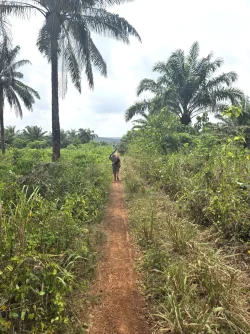
Paradises are everywhere if you can find them. We headed into the interior for some distance, and then using GPS coordinates from a trip that brought back no fish a long time ago, went up a dirt road til it was overgrown. We grabbed our gear and started walking. I was still feeling sick and dehydrated, even if I had downed a couple of litres of water overnight and into the morning. We came to a ravine, clambered down it and continued towards a sky that said water. And there it was, a lovely little river. It was a beautiful spot with luxurious shade trees, not that they cooled it down. They at least kept the sun off us.
We found a beautiful golden Pelvicachromis taeniatus. This dwarf Cichlid was responsible for me taking the move from being an interested aquarist into being a serious one, 35 years ago. Bracing against water to my hips and seeing one in my net was the highlight of the trip for me. We also caught electric blue lined Poropanchax luxopthalmus (which didn't survive the trip home), a wide array of barbs and Characins we didn't keep, Chromaphyosemion biteniatum, Phractura catfish, freshwater pipefish... it was a wondrous habitat. I had to stop fishing early as the heat got to me again though.
I thought I was in good shape. I do regular 7 km walks and such, but if I'm going to go back to Africa, I'll have to train. Sustained exertion in that heat left even the young guys panting, but the cardio and lung capacity need more attention. I'm not getting younger. I foresee many hours on the stationary bicycle in my future.
That's good. It'll motivate me to have a future that way!
I also foresee many hours of pleasure keeping the fish from that location.
A nice detail is that in the land of Vodoun, the drums were alive at that spot. Somewhere through the woods, there was a village, and at least five drummers were working on a pattern for about half the time we were there. It gave an exotic atmosphere to a beautiful little river.
 

Attachments

  • walkingin.webp
    walkingin.webp
    643.5 KB · Views: 69
  • iguedebridge.webp
    iguedebridge.webp
    438.6 KB · Views: 72
  • iguede2.webp
    iguede2.webp
    445.7 KB · Views: 73
The next day we went looking for a semi-annual killie, and found out why it had that adaptation. The stream was dried up. But we found a poisoned lake - people use herbal poisons (hey, natural products!) to kill fish as an easy harvest. The shores were littered with rotten Tilapia, but we caught many healthy Epiplatys bifasciatus, of the blue red form (there's a green form we caught elsewhere).
The fish survived.
I did too - as I was adjusting to the furnace at last.
Our final day of fishing found us by a mosque at a wide river, where we met a young villager who talked about all the fish in the water using their Latin names. He told us he built his own aquariums - we'd found a kindred soul. That young guy was quite brilliant, but in a village with no electricity or running water, far from the city, his chances of going to University as he should have were close to zero. I'd like to have offered help, but a teacher's pension doesn't allow for that. I gave him a net for his future aquaculture set up, which is the direction I hope he gets to go in.
There we caught normani lampeyes, as well as Epiplatys bifasciatus green form. There was a pair of Rubicatochromis jewel Cichlids guarding a nest in the shallows, and we netted and released a few R. guttatus. Hemichromis too.
On the way back we stopped at a ditch that would be dry within the week and caught a good number of magnificent, naturally long finned C. biteniatum, as well as nigerianus lampeyes.
That was it for fishing - successful, fun, informative, educational and sweltering hot. I feel I learned an enormous amount about a subject very few people are interested in.
Oh, and in the entire set of local voyages, all over the country, I saw no aquatic plants beyond a Riccia type in small quantities. None. Nada. Even less plant life or diversity than I would find in a summertime Canadian stream.
I flew Cotonou to Paris to Montreal, where I was delayed by a snowstorm. Welcome back to the real world. Instead of getting my fish conversation under African palm trees by the ocean, I'm now counting on my TFF gang!

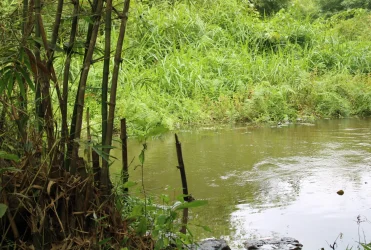
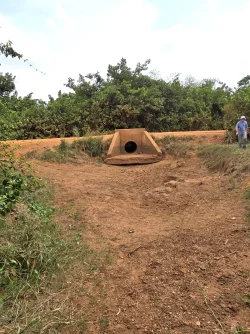
1- the dried up river, water filled on google earth. The rain will come, and the Fundulopanchax filamentosum will hatch.
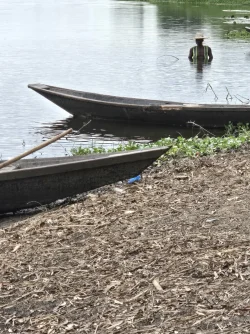
2- A man fishing for small species in a habitat full of normani lampeyes
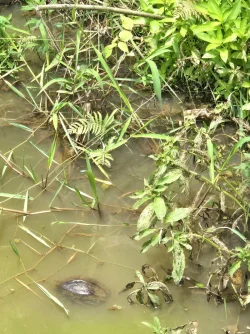
3- Home of the elusive ditchfish - Chromaphyosemion biteniatum.
 

Attachments

  • dryriver2.webp
    dryriver2.webp
    543 KB · Views: 64
  • fisherman.webp
    fisherman.webp
    576.1 KB · Views: 80
  • ditchfish.webp
    ditchfish.webp
    471.7 KB · Views: 64
If anyone has any questions or wants precisions - fire away and I'll try to answer.
 
did you bring back many fish???
 
If anyone has any questions or wants precisions - fire away and I'll try to answer.
Can you explain in some detail how you transported the fish back to Canada e.g., red tape paper work, container for fish etc. Did you carry the fish on to the plane or did you have to check the fish containers in baggage? How many fish did not survive the journey? How did you identify the fishing waters? Did you hire a driver? Did you buy a condo along the banks of the Congo river? 😉
 
It looks like you were mostly going for killi fishes; did you per chance run into any dwarf cichild or are those in a different part of west africa.
 

Most reactions

Back
Top