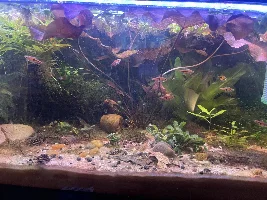
It is incorrect to think that the only place in a tank where the nitrifying bacteria will colonize is one's filter. They can live all over one's tank especially in almost the whole upper inch of substrate. It is actually likely a bit less than an inch as there is not enough oxygen for the bacteria by the time it gets to an inch deep. Some rooted live plant may change this.
We have no clue where in any given tank the bacteria is living. What I do know is that the total amount of bacteria in a tank is governed by ammonia levels. When these rise the bacteria reproduce faster than they die. The reverse applies when ammonia levels are lowered. So, unless there is a serious loss of total bacteria, we do not see ammonia or nitrite.
So it is very possible that if one allows their filter media to clog enough, the bacteria there will start to reduce their numbers elsewhere. This happens as there will be more ammonia available to the bacteria living in the other places which multiply in response to more ammonia becoming available. So the result is the total amount of bacteria tends to remain pretty stable.
The bacteria will colonize in the greatest numbers where they get the most of what they need. The better the circulation in any tank is, the more places the bacteria will colonize.
Finally, how we stock our tanks, whether or not we have live plants and how well we do needed maintenance all matter in terms of how ammonia is created and then handled. There are multiple factors which effect how effectively nitrogen is handled in any tank.
I have been changing water and rinsing both my pre-filters and media inside of most filters weekly. However, I had 3 canisters running at one point. Two of them get cleaned in June and December regardless of flow. The third uses different media than the other two. Number 3 uses all Poret 20 ppi foam in the two media baskets, This filter is only cleaned when the return flow slows. I am a bit overdue for the second cleaning in well over 5 years. However it is on a heavily planted and reasonably stocked 75 gal. The tank also has an Aquaclear 300gph filter as well. This filter uses to foams with floss between them. One of the foams is the Aquaclear one but the other one is 20 ppi Poret foam.
Finally, slowing flow is a sign media needs to be cleaned. It may also mean it is the pre-filter which is clogged as opposed to the media inside the filter. I have used pre-filters on my hang-on, my canisters and even my powerheads for a very long time. The only filtration I do not prefilter is my Poret cubefilters and a very few remaining ATI foam filters. These act as their own pre-filters until we let them clog. The problem is that the air bubbles will still rise even if the foam is very clogged. Unless we see a pre-filter or a foam filter start to collapse inward, we get no visual clue it is clogged.
I have seen the happen in the past when I was forced by health issues to stop doing weekly maint. and water changes. A heart attack and triple bypass surgery meant I did not work on my tanks for over 2 months. For a couple of weeks I did not even feed the fish. Fortunately, my brother did it for me on a reduced schedule and a couple of my fish club members helped out so that water changes got done a few times as well.
All of my community tanks have live plants. All of the pleco breeding and grow tanks had mostly Poret foam media, some even had Mattenfilters. These take years to glog in most applications. If live plants in substrate make the best filters, in the absence of live plants a Matten filter is the next best option. Where I do not use Mattens but wanted to, I have gone the next best route by using multiple Poret cubefilters and even one Poret 5x5x10 inch tower filter.
I chose 20 ppi as my preferred porosity for most Poret. The 10 ppi is less effective except for catching mechanical waste and I use ut for pre-filters. Those over 20 ppi clog increasingly faster as the porosity number goes up. I have only a few 30 ppi cubefilters. These do well for fry and shrimp as well as the smaller fish we might keep.
Of course, the above is how I do things, It works very well for me but that doesn't mean it is the best way for all tanks and set-up. Whatever methods of filtration and the media involved one uses, the only thing that matter is that it is able to do its job well. Our jobs as fish keepers is to keep our fish alive, healthy and thriving.
(edited for a bunch of typos and one missin "is')