Most likely from stored embryos. Unless you are 100% sure that your female had never been in contact with a male from her own species.
The fact that you can get viable tiger/lion crosses, as mentioned earlier in this thread, is absolutely no guide to whether platies and mollies can breed. As far as I can work out, the following is true:
Cross-breeding within the same genus is fairly common and in many instances produces viable offspring, sometimes even fertile offspring. Lions and tigers belong to the same genus. Donkeys and zebras also belong to the same genus. Platies and swordtails belong to the same genus and frequently interbreed, producing fertile offspring. Mollies and guppies also belong to the same genus, but interbreeding is much less common, though it has been documented (by a member of this forum inter alia). This tells us nothing about what is likely to happen between members of different genera.
Crossbreeding between different genera is not unknown, but it is much rarer and fraught with difficulties. In the case of livebearers, difficulties may involve not only genetic diversity but also practical physical problems: different shaped gonopodia, the fact that some species insert sperm quite far and others sort of leave it on the outside. John Dawes managed to get limia melanogasterxnigrofasciata hybrids to breed with some virgin sailfin mollies, but the fry were not viable.
There has never to my knowledge been a recorded case of a platy or other xiphophorus breeding (whether viably or not) with a poecilia species, like mollies or guppies. Part of the problem is observation. Unless you had reared the females themselves and knew for a fact that they were virgins, you couldn't know where the sperm had come from. As most of us buy our mollies in shops, they seldom come to us in their virginal innocence.
Parthenogenesis (female giving birth without genetic material from male) is only known from one species of molly, the Amazon molly (poecilia formosa). This is not one of the mollies commonly found in the trade. Also, for embryos to develop, these females still require the stimulation of sperm from a related molly species, usually Poecilia latipinna or P. mexicana. In other words, you can't just bung a solitary virgin Amazon molly in a tank and expect her to give birth. Besides, you probably can't get hold of an Amazon molly.

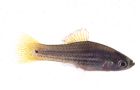
 I don't think it's a cross, just a wild type. They can be MUCH more colorful.
 .
. )
)