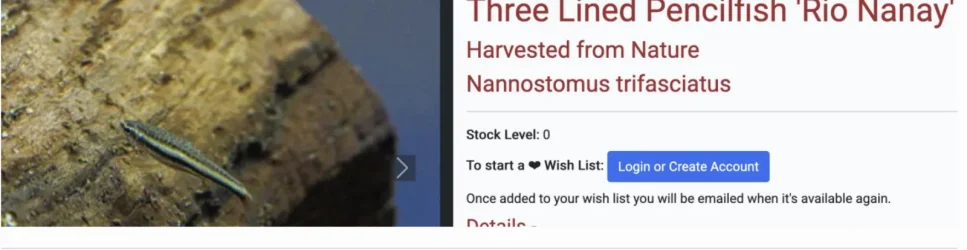
Another 'new' Nannostomus

Are there any 'circles' of people exchanging info on pencils the way there are with Aphyosemion?
Sadly, no. This is the liveliest venue for Nannostomus conversation I've experienced, forum-wise. TomC of Norway and I have a periodic back-and-forth, especially when something new emerges. And when Stan Weitzman was alive, we had a wonderful and cherished dialogue that started with letter-writing. Remember letter-writing?

I have Asian bred beckfordi here, and so far, the aggression levels have been fairly mild. I'll keep a close eye on them as they grow.

This is good to hear. Perhaps a different source with a less compromised gene pool than earlier imports.

Wouldn't it be great if we could have access to these interesting fish in a much easier fashion?>>
I meant to comment on this in your earlier post. Those of us who live south of the Provinces have had a bit easier time securing Nannostomus. The WetSpot--and its prior incarnation, The Cichlid Exchange--have been bringing in all sorts of Nannostomus for over 40 years. It is not uncommon for 7 or more species to be available at one time, many at reasonable prices, the latter including N. marginatus (numerous populations), N. minimus, N. trifasciatus, N. marylinae, N. eques, N. unifascistus, N. anduzei, N. beckfordi (wild and farm bred) and N. harrisoni. They carry the high price-tag species too--N. espei, N. rubrocaudatus, N. morthenthaleri and the various new 'red things.' Jeff at Aquatic Clarity , who has been around since the early 2000s, also is fond of Nannostomus and has several offerings on pretty much every list. I know this doesn't help you out but it does and did make for a different experience for some of us.

The fish still haven't developed full finnage yet for me to see if they are really different and if what we saw in the sunlit nets is what we'll see in aquariums. But the subtle differences are big.
For all of the focus on the diversity in the Nannsotomus species groups--N. trifasciatus, N. marginatus and N. beckfordi--I'm especially fascinated by a rarely seen species that you pretty much will only find as by-catch. N. digrammus is virtually never brought in under its own name, but sharp eyes will find it in a tank of Cardinals and especially among Green Neons. It's a lovely, friendly thing. Small and its two stripes are rich maroon instead of the usual black. The males have a species-defining especially large anal fin described as 'rag-like.' But here's the part that brings Gery's words to life. There are other populations that lack an adipose fin, and others where there is the slightest hint of a third stripe, and still others where the two stripes are decidedly less maroon and near-black. Yet all have males with the hallmark rag-like anal fin.


I was loosely discussing a trip to pencilfish lands with a friend who is heading back that way next year. The obstacle to me is first that this would be camping and really roughing it and I'm feeling old, and second, that I'm not really into South American fish. Now I'm guzzling coffee and thinking about pencilfish diversity...
TomC invited me to join him on a collecting trip to Nannostomus-land. As I said to him, "if it doesn't involve room service and air-conditioning, you've got the wrong guy.'

N. digrammus:
n. digrammus.webp
 
Last edited:
Yeah, I like camping out, but as I age, the recovery time from a rough day trying to get around in the water, the heat, etc gets longer. In 10 days of Benin, with ample drinking water so I never felt thirst, I lost 8 pounds. I'm not far off the ideal weight for my size and age already - it's not as if I rid myself of a lot of excess.

5 star hotels? I appreciated the struggling AC in our one star, 2 exploding Musk Space X rockets and 3 falling meteor Cotonou hotel. Even a bug rich roof with rattling AC beats a tent at night. I come from a cool northern climate, and as I get older, it's harder and harder to adjust to heat and humidity.

I've looked at the US sellers a lot. I know it would be very impolite to invade and seize 2 or 3 aquarium shops in the hopes no one would notice. I have in the past scooted across the border and received boxes sent to poste restante set ups, but in these times, I can't do that anymore. Such is life - I can still get good fish to amuse myself with!
 
Here are purported N. limatus and N. nitidus listed by vendors. They are not what they claim to be. I usually write to these vendors and provide the correction. In all but one case, I was ignored. The one exception was a vendor claiming to have N. nitidus that was actually N. beckfordi. They corrected it.

But as for these:

This is being sold as N. limatus. It is N. beckfordi

sold as limatus.webp


This is being sold as N.nitidus. It is in fact. N. beckfordi.
sodl as nitidus.webp


This too is being sold as N. nitidus. It is one of the new undescribed 'red things.' Meanwhile, if this is the fish they send you, you're getting a steal! They normally go for 5-7 times as much as the listed $11.
sold as nitidus.webp


And in a related example, this fish is being sold as N. trifasciatus. It is in fact N. marilynae.
marylinae.webp
 
Here are purported N. limatus and N. nitidus listed by vendors. They are not what they claim to be. I usually write to these vendors and provide the correction. In all but one case, I was ignored. The one exception was a vendor claiming to have N. nitidus that was actually N. beckfordi. They corrected it.

But as for these:

This is being sold as N. limatus. It is N. beckfordi

View attachment 381391

This is being sold as N.nitidus. It is in fact. N. beckfordi.
View attachment 381392

This too is being sold as N. nitidus. It is one of the new undescribed 'red things.' Meanwhile, if this is the fish they send you, you're getting a steal! They normally go for 5-7 times as much as the listed $11.
View attachment 381393

And in a related example, this fish is being sold as N. trifasciatus. It is in fact N. marilynae.
View attachment 381394
Fascinating. For each example of misidentification could you explain the morphological features that led you to the correct identity of the Nannostomus sp? A teaching moment.
 
Fascinating. For each example of misidentification could you explain the morphological features that led you to the correct identity of the Nannostomus sp? A teaching moment.
THis is fascinating. I know it's almost asking for a note form article, but for the few people really interested by the pencilfish group (even if some of us may only get to have a reading interest) you are a learned resource. If you get the time and can give us an overview, I'd appreciate it.
 
Here are purported N. limatus and N. nitidus listed by vendors. They are not what they claim to be. I usually write to these vendors and provide the correction. In all but one case, I was ignored. The one exception was a vendor claiming to have N. nitidus that was actually N. beckfordi. They corrected it.


This is being sold as N.nitidus. It is in fact. N. beckfordi.


This too is being sold as N. nitidus. It is one of the new undescribed 'red things.' Meanwhile, if this is the fish they send you, you're getting a steal! They normally go for 5-7 times as much as the listed $11.
They probably sell them whatever the exporter/shipper calls them BUT making that kind of mistake on one of the red species is pretty bizzare.

Personally i think when a store refuses to correct the name you should call out the store so folks know to avoid it.
-
Btw i've emailed several stores selling on ebay when i was looking for winemilleri they typically show a picture of albios or dicrozoster both much more common. So i email them and say that the picture is albios and they respond with "if you buy our fish don't worry you will get the right species"; and i respond can you show me a picture of the fish you are selling as winmilleri and they respond it is on ebay. Sigh.
 
Fascinating. For each example of misidentification could you explain the morphological features that led you to the correct identity of the Nannostomus sp? A teaching moment.
Sure. First some Nannostomus basics to predicate the conversation. When we speak of stripes in Nannostomus, the PRIMARY stripe is the main band traveling the length of the fish from snout , through the eye, to tail. For some Nannsotomus that is the only stripe they have. If there is a second stripe it is dorsal (north) to it, it is the SECONDARY stripe and is usually weaker/thinner than the primary. Many Nannostomus have these two stripes. If there is another stripe, it is call the TERTIARY stripe and it is ventral (south) to the Primary stripe and is often very weakly expressed. When Nannostomus are in condition and happy, secondary and tertiary stripes often recede and the primary stripe intensifies.

Another feature relevant to this conversation is the adipose fin. For many Nannostomus species it is always present. For others it is always absent. For two species known so far it can be either present or absent depending on individuals and population. They are N. eques and N. trifasciatus. I mentioned in another post that N. digrammus which has heretofore been known to always have an adipose fin, now has a population without it. I suspect the splitters will have something to say about this phenomenon.

So, for the species at hand. N. beckfordi only has a primary stripe, never has an adipose fin, and the males always have white tipped ventrals.

N. limatus has a weakly expressed secondary stripe reduced to a row of dots, a weakly expressed tertiary stripe, never has an adipose fin, and males do not have white tipped ventrals.

So in the first example I gave in my previous post, that fish is clearly N. beckfordi.

Example 1: N. beckfordi, not N. limatus. Compare to next pic...

n. beckfordi.webp


N. limatus
Screenshot 2026-05-13 at 4.17.08 PM.webp


N. nitidus also has a weakly expressed secondary stripe reduced to a row of dots but never has a tertiary stripe. Nor do males have white tips to the ventrals. Adipose fin always present. So in the second example I provide in that post, it is clearly not N. nitidus but is rather N. beckfordi.

Example 2: N. beckfordi, not N. nitidus. Compare to next pic...
no nitidus.webp


N. nitidus
Screenshot 2026-05-13 at 4.20.08 PM.webp


In the third example, "The red thing" being sold as N. nitidus is just, as @anewbie put it, bizarre. "The red thing" is , like all of the N. marginatus group, a stubby pencil, not elongated like N. nitidus and so many other Nannostomus and the color pattern is unique and entirely different from N. nitidus. Furthermore, the red things, like all the marginatus groups members, never have an adipose fin and N. nitidus always does.

Example 3: Obviously a 'red thing' and not N. nitidus--see next pic....
red thing.webp

The real N. nitidus
Screenshot 2026-05-13 at 4.20.08 PM.webp


As for the 4th example, N. marilynae being sold as N. trifasciatus-- the color patterns are entirely different. While both have three stripes, N. marilynae's are toned brown while N. trifasciatus stripes are jet black. Also, the latter has brilliant red adornments on its fins and body which are absent in N. marilynae replaced by a small, subtle blotch of orange on the caudal base only. And something the picture doesn't indicate, N. marilynae is much smaller and less robust. . Dan should know better, not least because I wrote him THREE times about it.

Not N. trifasciatus but rather N. marilynae. compare to next pic...
n. marilynae.webp


N. trifasciatus
n. trifasciatus.webp


To quote Voltaire: Any questions?
 

Attachments

  • n. marilynae.webp
    n. marilynae.webp
    48.5 KB · Views: 52
Some dealers are sloppy. A few months ago we had a thread where I was supposed to be receiving the red 'not nitidus' fish at a reasonable price. The same photo seems to have been used.

I confess was sort of hoping to pull a fast one on a lazy dealer, but when he got the order from the shop I was dealing with, he suddenly didn't have the fish anymore. I think it may have become a pencilfish stock photo.

Thank you for posting that.
 
Sure. First some Nannostomus basics to predicate the conversation. When we speak of stripes in Nannostomus, the PRIMARY stripe is the main band traveling the length of the fish from snout , through the eye, to tail. For some Nannsotomus that is the only stripe they have. If there is a second stripe it is dorsal (north) to it, it is the SECONDARY stripe and is usually weaker/thinner than the primary. Many Nannostomus have these two stripes. If there is another stripe, it is call the TERTIARY stripe and it is ventral (south) to the Primary stripe and is often very weakly expressed. When Nannostomus are in condition and happy, secondary and tertiary stripes often recede and the primary stripe intensifies.

Another feature relevant to this conversation is the adipose fin. For many Nannostomus species it is always present. For others it is always absent. For two species known so far it can be either present or absent depending on individuals and population. They are N. eques and N. trifasciatus. I mentioned in another post that N. digrammus which has heretofore been known to always have an adipose fin, now has a population without it. I suspect the splitters will have something to say about this phenomenon.

So, for the species at hand. N. beckfordi only has a primary stripe, never has an adipose fin, and the males always have white tipped ventrals.

N. limatus has a weakly expressed secondary stripe reduced to a row of dots, a weakly expressed tertiary stripe, never has an adipose fin, and males do not have white tipped ventrals.

So in the first example I gave in my previous post, that fish is clearly N. beckfordi.

Example 1: N. beckfordi, not N. limatus. Compare to next pic...

View attachment 381407

N. limatus
View attachment 381414


N. nitidus also has a weakly expressed secondary stripe reduced to a row of dots but never has a tertiary stripe. Nor do males have white tips to the ventrals. Adipose fin always present. So in the second example I provide in that post, it is clearly not N. nitidus but is rather N. beckfordi.

Example 2: N. beckfordi, not N. nitidus. Compare to next pic...
View attachment 381408

N. nitidus
View attachment 381415


In the third example, "The red thing" being sold as N. nitidus is just, as @anewbie put it, bizarre. "The red thing" is , like all of the N. marginatus group, a stubby pencil, not elongated like N. nitidus and so many other Nannostomus and the color pattern is unique and entirely different from N. nitidus. Furthermore, the red things, like all the marginatus groups members, never have an adipose fin and N. nitidus always does.

Example 3: Obviously a 'red thing' and not N. nitidus--see next pic....
View attachment 381409
The real N. nitidus
View attachment 381410

As for the 4th example, N. marilynae being sold as N. trifasciatus-- the color patterns are entirely different. While both have three stripes, N. marilynae's are toned brown while N. trifasciatus stripes are jet black. Also, the latter has brilliant red adornments on its fins and body which are absent in N. marilynae replaced by a small, subtle blotch of orange on the caudal base only. And something the picture doesn't indicate, N. marilynae is much smaller and less robust. . Dan should know better, not least because I wrote him THREE times about it.

Not N. trifasciatus but rather N. marilynae. compare to next pic...
View attachment 381412

N. trifasciatus
View attachment 381413

To quote Voltaire: Any questions?
Thank you. That was clearly expressed and illuminating.
 
In the early portion of this thread, @anewbie mentioned that WetSpot had N. limatus on their list. I forgot to check it out. Just did. The fish in the photo are not in color making a determination difficult. There's no adipose fin so that eliminates N. nitidus and I'm not sure I see a very faded secondary dotted stripe dorsal to the primary, and the shadow of a tertiary stripe below the primary, which would suggest it is indeed N. limatus. BUT, I also think I see white tips on the male's ventrals which would negate that possibility and make them faded N. beckfordi. Or perhaps the white tips are just a photographic highlight. I'd need to see a better photo. Or in a case such as this, and assuming I was ordering other fish as well to mitigate the shipping charge, I might buy six. In the worst case scenario they would be wild caught N. beckfordi and you could do worse.

wetspot 'limatus'.webp
 
Wow you guys ! I’m reading this thread and am flabbergasted by the intensity of the passion for these fish . They must really be something .
 
So here are some of my n's in a single aquarium (65 which is 48x16x18):
r0.webp


Not sure what this one is - from your description well not limitaus - i think it was sold as a very very small Nannostomus rubrocaudatus but it lacks the 2nd stripe. Hum. and there is this one:
r4.webp

-- then these are just margys with either a mortenthal or rubrocaudatus in the mix probably morthenthal from the white belly (bottom fish) and i guess the top one is a clueless unknown. If it were a rubrocaudatus it would have a black strip near the top. Maybe a female ruby ?
r1.webp
 
Top photo: N. beckfordi male.
2nd Photo: N. beckfordi female
Bottom photo, top to bottom:
N. beckfordi male
2 N. marginatus--looks like a pair, male above
N. mortenthaleri--appears to be female. If when the dorsal is erect and there's a prominent white blotch on the leading edge, it's a male.

All lovely!
You are truly a maven. A question. I now have 17 wc Brazilian N. marginatus. How do I distinguish males vs females?
 
You are truly a maven. A question. I now have 17 wc Brazilian N. marginatus. How do I distinguish males vs females?
Most Nannostomus species exhibit gender dimorphism via the anal fin through shape and/or color. N. marginatus is certainly one of them. The anal fin of males is slightly larger and elongated and always more colorful, especially regarding the presence of that lovely liquid gold color which is far more prominent in males and far less so in females. In some populations that shade is absent in females altogether. In addition, N. marginatus males are generally more colorful all around. Again, this varies depending on population and there are MANY populations/variants.

PS. I'm not convinced your N. marginatus are Brazilian. You got them from Jeff, yes? I do believe that's what his supplier told him. But I think your fish are Colombian or Peruvian. The Brazilian marginatus tend to be more subdued color-wise, especially those from the Rio Negro. If you like, check out TomC's page on N. (cf) marginatus and all the geographical variants to see if yours match any of the photos there.
 
Last edited:

Most reactions

Back
Top