What's new

A Good Way To Lower Your Ph And/or Soften Tyour Water For A Long Time?

Joined
Jun 7, 2011
Messages
322
Reaction score
1
Points
16
Location
Right now... in front of my computer
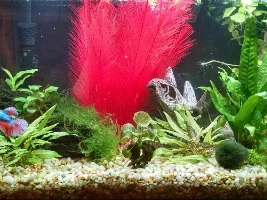
Hey all! I have got a 55 gallon fish tank that is starting to be loaded with fish. I have always had problems with the water in this area because it is always high in ph alkanity and very hard. My fish are all from the amazon who like soft slightly acidic water. Is there any way to lower my ph and/or soften my water for a long period of time.
 
Hard to say, really. Some people use Reverse Osmosis systems to get soft water, but I don't know if that would effect pH.

I'm sure that if your fish are bred in your area or if you've had them a long time, they'll be used to the hard water and high pH, and it would be more harmful to change that than it would be beneficial.
 
Peat moss works well i use it in my Apisto set-up's. You can get peat ball's that you can put it in your tank or in an external filter/sump :good:
 
Hard water contains lots of mineral so it's likely to buffer any thing that you add to acidify your water. You can certainly try, but don't expect to lower your pH by much with peat etc.

The only way is to use RO water as suggested above. This would give you pure water with no minerals, at pH7.0. Then you can add peat etc to acidify your water. Not the cheapest way to go about things with a 55G tank.

A stable pH is more important than "correct" pH. Alternatively match your fish to your water, ie no south american fishes...

Adrian (pH 7.8 in my area)
 
so should I just keep my Ph the same or buy a RO machine. My first fish from my 10 gallon have survived and they are the only types of fish I will be keeping other than upside down catfishes. I have heard because RO machines get rid of minerals in the water it is bad for the fish so what do you think I should do.
 
Pure RO is not used. One can either mix it with their tap or if using 100% RO, they add back a commercial mix of minerals etc.

I use it to drop TDS to simulate rainy season for plecos. I also have other goodies such as catappa leaf, alder cones and driftwood when I need to get soft water and low pH.

However, it is always best to be able to work with one's tap rather than to be fiddling with adjusting parameters. it is not so easy to get and keep right :)
 
I keep mostly soft water fish and have for some time now. My pH had been 7.4 for many years but in the opast few years that has dropped to 7-7.1. My hardness also dropped from 6dg to 4.5 +/-. My fish have all done pretty well over that span. As long as you are not breeding stuff, most fish are pretty adaptable within reason. TDS (hardness) is much more of an issue than pH.

If your fish appear healthy, have good appetite, grow normally and are not harming each other, why would you assume your parameters are not acceptable for them? Changing ones water params and then holding them at that level can be a lot of work and an invitation to disiater if things go wrong. Plus it is more work.
 
TDS (hardness) is much more of an issue than pH.

I hope you won't mind if I point out that hardness and TDS are not the same thing. Hardness is (mostly) magnesium and calcium ion concentration but TDS is just as it says, the total dissolved solids, or the total amount of ions in solution, which is why it's measured with a conductivity meter. I do agree that TDS is the greater issue though. :good:
 
TDS (hardness) is much more of an issue than pH.

I hope you won't mind if I point out that hardness and TDS are not the same thing. Hardness is (mostly) magnesium and calcium ion concentration but TDS is just as it says, the total dissolved solids, or the total amount of ions in solution, which is why it's measured with a conductivity meter. I do agree that TDS is the greater issue though. :good:

So, is there a way to measure hardness?
 
So, is there a way to measure hardness?

Yes. You can buy a hardness test called a GH test, standing for general hardness, from the same place you get your other tests from or, as always, from eBay. Just don't confuse it with the other hardness test we have in the hobby - carbonate hardness - or KH, although some kits, like the API one comes with both in one pack.
 
Prime- you are somewhat correct form a technical point of view. But there are actually different "types" of hardness.

The total hardness is usually regarded as consisting of two components: general hardness (GH) and carbonate hardness (KH). General hardness is caused by divalent metal ions, primarily calcium and magnesium. Carbonate hardness is due to carbonate/bicarbonate ions, and represents the main 'buffering capacity' of the water, i.e. its ability to resist pH changes.

Carbonate hardness is sometimes referred to as 'temporary' hardness, because it can be removed by boiling, which precipitates the carbonates. The remaining hardness contributed by other salts of calcium and magnesium is then referred to as permanent hardness, or non-carbonate hardness.

Note that normal table salt (sodium chloride), does not increase hardness. Although it will increase the overall mineral content of the water (and its 'ionic strength'), it is not a hardening salt, like the salts of calcium and magnesium, so will not be measured by a normal GH kit.
From http://www.thetropicaltank.co.uk/hardness.htm

This is why treating a fw tank with salt one is told to add the salt in several doses over time. This is even more important when using Epsom salts as it does contribute to and is measured by a GH kit.

I am more concerned with TDS in regards to osmoregulation than I am with the more narrow measures. I am also more concerned with TDS than GH when it comes to triggering seasonal spawners. Moreover, using the typical test kits for GH and KH there is a lot less acuracy. These kits measure in degrees of hardness and each degree represents about a 17.7 ppm difference. If the test is slightly off and gives a reading +/- one degree, it can be an issue. Plus these test kits can go bad over time, so we really don't know how accurate they may be. I have calibration fluids for my TDS meter.

Finally, I said:
TDS (hardness) is much more of an issue than pH.

I did not say GH or general hardness. But to have been more accurate I should have said "total hardness".
 

Most reactions

Back
Top