Your opinion on my next pair of fish

gwand

Fish Gatherer
Tank of the Month 🏆
Fish of the Month 🌟
2x Pet of the Month!
Joined
Dec 31, 2022
Messages
2,779
Reaction score
5,460
Location
Baltimore, MD
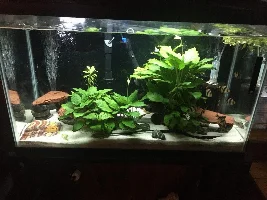
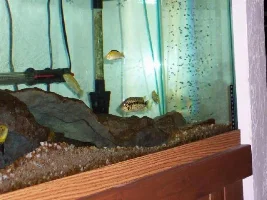
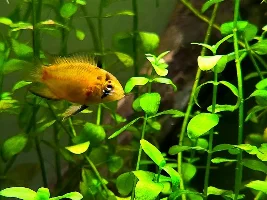
This Friday I am selling 15 Apistogramma cacatuoides. The 20 gallon long tank will no longer have cockatoos, only 12 n. backfordi. I have another tank to keep breeding cockatoos. I would like to add a pair of fish come spring. Here are some of my potential choices. I have never kept any of them nor have I seen them live. I have been reading up on all of them. I will only choose one pair to join the beckfordi. Your opinions will help me with my choice. Please include comments on behavior and appearance.

Nannacara anomala
Ivanacara bimaculata
Laetacara dorsigera
Laetacara araguaiae

Thanks
 
I'm gonna throw a wrench into your plans.
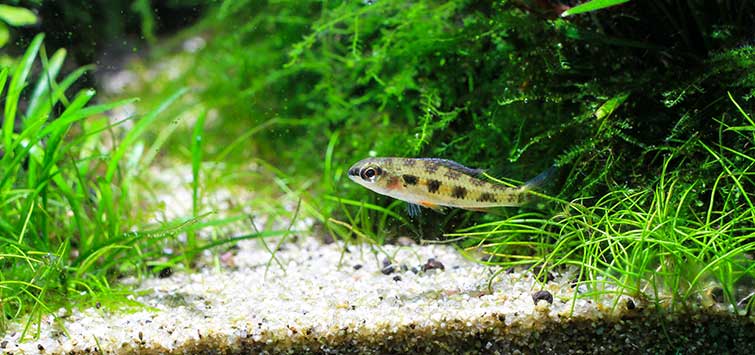
Dicrossus. Several species to choose from. D. maculatus, D. filamentosus, D. foirni, D. gladicauda, D. warzeli.
All are small, 1-3 inches, can be kept in groups, like blackwater conditions and you're already an expert in that.
These fishes are woefully underrepresented in the hobby.
 
I'm gonna throw a wrench into your plans.
Dicrossus. Several species to choose from. D. maculatus, D. filamentosus, D. foirni, D. gladicauda, D. warzeli.
All are small, 1-3 inches, can be kept in groups, like blackwater conditions and you're already an expert in that.
These fishes are woefully underrepresented in the hobby.
Thanks. I will go read up.
 
Hmm, I never kept any of those, but I do like most laetacara. Dorsigera are fairly common & very pretty, I haven't seen the other 1. Might be a better resale bet?
 
D. maculatus is probably the nicest of the bunch but they really aren't temperature compatible with the pencil fishes - they are closer to rams. 80 is probably a good compromise - also they do best in blackwater and they are not small - a 40b would be a better option. I have a couple in a 180 with my discus - they are real beauties but lean on the delicate side though tank raised specimen might be more adaptable (they are technically clear water which is 0 kh but higher mineral content - maybe 1 gh or ec 50ish). filamentosus are simliar (different shape tail):


They are really pretty fishes but also can be quite vicious esp when competing for females. One of these days i'll setup a dedicated 40b for some - two of the males in the 180 are doing well but their breeding dress is truely a sight to behold.
--
wc Laetacara dorsigera are awesome and inexpensive
-
i've not had much success with cz tank raised nannacara (most common); but if you can find a hobby bred pair they are also awesome - they come in several different forms from deep blue to green. By far the smartest fish i've ever owned. Really clever devil was amazing to watch him deal with new situations and work out solutions.
-
Ivanacara bimaculata - these guys are incredibly passive - true community fish - will require blackwater like conditions to breed successfully - also even though they have not been around long it seems the frys being produced didn't get properly trained by their parents. Again if you can find some locally hobby bred one where the frys were raised with the parents would be a plus.
--
I believe all these fishes are pair forming 'cept the dicrossus but you really only want 1m 1f in a 40b given their size and aggression level.
 
That is helpful. Thanks.
 
I’ve always had a soft spot for Laetacara araguaiae. They're very nondescript when young, but soon grow into spectacular, pastel colored adults.
Nannacara anomala are a bit feistier, and a brooding female will sometimes kill her mate if the tank is too small. I keep mine in groups of 6 +,
the aggression dispersed among the larger numbers. I’ve even managed to raise a good number of fry with this method
 
I’ve always had a soft spot for Laetacara araguaiae. They're very nondescript when young, but soon grow into spectacular, pastel colored adults.
Nannacara anomala are a bit feistier, and a brooding female will sometimes kill her mate if the tank is too small. I keep mine in groups of 6 +,
the aggression dispersed among the larger numbers. I’ve even managed to raise a good number of fry with this method
I've had laetacara araguaiae - my last group died out a few months ago - they breed easy enough but i'm sort of opposite having that soft spot for wc dors; just be aware that dors come in different colour based on catch location while araguaiae have some slight variation but seem more uniform. Domestic dors are frequently sold as cuvies so if you really want cuvies get a picture and id the species first.
 
I've kept the Laetacara, and frankly, don't like the Genus. It's a minority opinion, for certain, but I find them... lumpy.

I love Dicrossus. I've kept 2 of them long term (maculatus and filamentosus) without being able to breed them. At one point, filamentosus was a cheap, easily found Cichlid, but it's now much rarer. It's one of the prettiest Cichlids.

Ivanacara? Haven't kept that species from the Genus, just adoketa.

Nannacara anomala are a great sidestep from cacatuoides. They are more forgiving about water chemistry, but similar socially. I like @Mr Limpet 's idea of six. I never tried that, but they can be aggressive when breeding, and in a large enough tank, they might be easier. Or, you could end up needing spaces for them. I had them in groups when I grew out fry, and they were great then. They are smart as @anewbie noted. They can also be rough on corys. I wouldn't combine the two. But even if I love my corys, it's one of the only SA Cichlids I occasionally think of getting again.

One thought - I believe beckfordi and anomala occur together in Suriname. They certainly come from the same region. So you would be on your way to a biotope tank there.

It's rarer and pricier, but Nannacara taenia is one I used to keep and breed. It's not as pretty as anomala, but it's a nice fish.

They can be hard to key out and unpredictable, but Guianacara are very cool. I've kept them in three instances - one was calm and great in the community, and two showed high levels of aggression. All dig and have great broodcare. But when I had them, they were new in the hobby, and I'm not sure I could give species names on what I kept. They were creatures of beauty, but hard to get info on that early.

There are also bobos from the same region - the dumbest Cichlid I've ever kept, but one that was genial and pleasant - Cleithracara maronii, the keyhole. Maybe my pair was atypical, but they had a whacked in the back of the head with a paddle approach to life. You couldn't help but like them though.

 
FWIW I have 4 L. dorsigera in my 36 gal. bowfront. It's 30"x12" (15" at the bow) so about the same as your 20 long just taller. They are very peaceful. They are housed with some Hyphessobrycon megalopterus and Aphyocharax rathbuni. It's a nice peaceful tank. Hopefully in a few months a pair will form amd breed.
 
I'm a huge Laetacara fan and have kept, enjoyed and bred L. curviceps, two different color forms of L. dorsigera, and L. araguaiae. Currently have young adult L. curviceps that I raised from inchlings whose colors are now blooming.
 
I'm a huge Laetacara fan and have kept, enjoyed and bred L. curviceps, two different color forms of L. dorsigera, and L. araguaiae. Currently have young adult L. curviceps that I raised from inchlings whose colors are now blooming.
Thanks. Which Laetecara do you like the best in regards to color?
 
Thanks. Which Laetecara do you like the best in regards to color?
That question reminds me of Leonard Bernstein's brilliant response when asked which of the four Brahms symphonies was his favorite. He replied, "The one I heard last."

As for Laetacara...they each have their charms. L. curviceps is probably the most subtle but truly lovely when all the blue sparkle is present. A red-breasted L. dorsigera (there are black-breasted and blue forms also) in full color can be head-turning. And as @Mr Limpet stated. L.araguaiae in full bloom is a mighty pretty sight. Take a look at some photos and see what speaks to you. But caution, many of the offerings on line are misidentified. Once you decide which one you want and think you've found a source, we can confirm for you if it's the right species.
 
If I were to keep them, I think L. curviceps had a bad rap it hasn't come out from under yet. They used to be the main one available, and people decided they were 'common'. That happens a lot.

Oftentimes a fish is common because it's a great fish and many people realize that.

But a nice little blue curviceps is a fine looking fish.
 
When I had schoolers the way I kept them schooling was to have a few bigger vegetarian fish which they would perceive as a potential threat bu were actually not. I found SAEs were good for this in my tanks.
 

Most reactions

Back
Top