
Why is this brain-dead idea for saving water one for failure ?

anewbie

Fish Gatherer
Tank of the Month 🏆
Fish of the Month 🌟
Joined
May 30, 2021
Messages
2,520
Reaction score
2,875
Location
usa
So as a few of you might have come to realize I have a *lot* of blackwater aquarium which means i use a *lot* of water. I'd like to get my water usage down to 20% waste or less (typical ro system is 1:1 or worse).

After some thinking i came up with this idea which I know is brain dead but someone can please tell me what i am missing.

c1 - container with ro water
c2 - water from aquarium tanks and/or tap water mixed

Code:
ro unit -> c1 -> fish tank -> drain -> c2 -> sentiment filter 1 & 2 -> ro unit

Now after the unit has been primed if c2 < 10% full put in tap water else do not
ro unit -> waste line -> tds controller -> valve [tds > 150 drain < 150 -> c2]

So in a nut shell the water you take from the black water aquarium go through sentiment filters 1 and 2 and into c2 - the ro unit is fed from c2 - if c2 is low add dechlorinated tap water.

Why I think this works - if tds from blackwater aquarium is approx 15 (we call it 30 for this discussion) when you run it through the ro unit it should double to 30 then 60 then 120 then down the drain.
That means you should get around 80% usable water instead of 50% usable water.
These two little gadgets might help:
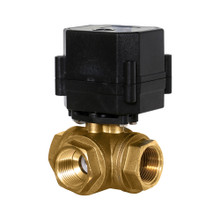

(there are others more and less expensive - i know hanna is a good company not sure about the random valve i found on the internet).
----
So there must be something really stupid i'm not considering that makes this entire idea hogwash but i'm missing it.
 
Das spart vielleicht Wasser, aber dafür machst du dir die RO Anlage kaputt...
Ich hab hier ein Verhältnis von 1:3 und dafür aber seit Jahren die gleiche Osmoseanlage.
nein nein Die TDS-Steuerlogik sollte verhindern, dass hartes Wasser die Umkehrosmosemembran beschädigt.
 
That might save water, but you'll ruin your reverse osmosis system...
I have a 1:3 ratio here, and I've been using the same reverse osmosis system for years.
 
When I was looking at replacing my RO system I did see some that had 2 membranes and claimed to work on a similar principle, i.e. some of the waste water mixed with tap pre-filtered tap water and sent back through the second membrane.
I tried to DIY this and failed. Not because the idea didn't work. I added to my existing unit which used a tank and the additional filter I added had a different valve mechanism and and I could not shut it off when the tank was full - so everything went through the overflow to waste.
At that point I gave up and went for the tankless system which also gives me about 1:3 waste. Waste was a consideration but my main goal was to increase throughput, and that did not give me enough. If you're concerned about bacteria that may be a more practical route.

FWIW (in case you are new to RO) don't neglect to change the pre-filters. I was shocked at how much visible muck came out of them after 6 months from only mechanical filtration. So much so that I will never drink tap water again. Your water supply may be different but that was my experience and our water does comply with all the EU limits. I assume for cost reasons the supplier only does what they are forced to - and my tap water is almost at the 50ppm nitrate limit, which is the main reason I started using RO.
 
When I was looking at replacing my RO system I did see some that had 2 membranes and claimed to work on a similar principle, i.e. some of the waste water mixed with tap pre-filtered tap water and sent back through the second membrane.
I tried to DIY this and failed. Not because the idea didn't work. I added to my existing unit which used a tank and the additional filter I added had a different valve mechanism and and I could not shut it off when the tank was full - so everything went through the overflow to waste.
At that point I gave up and went for the tankless system which also gives me about 1:3 waste. Waste was a consideration but my main goal wat to increase throughput, and that did not give me enough. If you're concerned about bacteria that may be a more practical route.

FWIW (in case you are new to RO) don't neglect to change the pre-filters. I was shocked at how much visible muck came out of them after 6 months from only mechanical filtration. So much so that I will never drink tap water again. Your water supply may be different but that was my experience and our water does comply with all the EU limits. I assume for cost reasons the supplier only does what they are forced to - and my tap water is almost at the 50ppm nitrate limit, which is the main reason I started using RO.
---
I change the prefilter once a month; i use close to 10,000 gallons a month (5 good 5 bad); if i can recycle the very soft water (and that is the key aspect of the system is the input starts very soft); then i could save 8,000 gallons a month. Of course i dont' want to spend both arms and a leg doing it but the above design isn't that expensive IF it works. If i have to throw in a uv system thta of course can get expensive since uv bulbs of sufficient strength (i need around 50 watt) have to be replaced at least once a year. I'm not worry about a few 100 watts of power since that can be handle via the solar grid.
 
That did occur to me and I realised I could get a better solution but could end up spending a lot along the way. Is chlorination an option for C2? The prefilter should deal with that.
 
That did occur to me and I realised I could get a better solution but could end up spending a lot along the way. Is chlorination an option for C2? The prefilter should deal with that.
I thought about dripping in tap water into c2 (small dose of chlorine); and then putting carbon between c2 and the ro unit to remove it but wouldn't the uv unit be just as effective ?
 
My advice would be a rosin filter. Zero wastewater and with your already soft water it should last very long. I even used it directly in the aquarium.
 
My advice would be a rosin filter. Zero wastewater and with your already soft water it should last very long. I even used it directly in the aquarium.
The water is only soft because i'm recycling water from balckwater aquariums.
 
In your case, the goal is to recycle your water with as little wastewater as possible.

The mixed-bed resin reduces the water hardness to 0% if you want. You can reuse all the water, and since your water already contains few salts, it's an economical method and far less complicated than what you're planning.

Theoretically, organic contaminants would still need to be oxidized, but in practice, I haven't noticed any negative effects when using resin in the filter chamber. However, I do have heavily planted aquariums.
 

Most reactions

Back
Top