Why does my tank get dirty overnight?

I would stop the blue light altogether for a few weeks just to see whether or not it makes a difference.

Gravel vacs are excellent, I dont typically use one however because my tank is heavily planted and I dont want to risk breaking or disturbing roots. Thankfully I have a well balanced system at the moment, the fish poo and mulm breaks down into the gravel and feeds my plants while I do my big water changes every week.

I appreciate finding the water changes difficult especially with a disability, I can relate some. I siphon water out my living room window onto the lawn with a hose...to fill the tank up again, I run the kitchen tap at the right temperature into a bucket with a pond pump sitting in it, which pumps the clean water back to the tank through another long hose. No more lifting and carrying heavy buckets

Edited to add:
In your case, vacuuming out whatever gunk you can with every water change will benefit your situation...just incase my own lack of vacuuming suggested you didn't have to
 
Last edited:
By "gravel cleaner" do mean the 8 inch hard plastic larger tube on the end of 6ft of tubing? Or the powered kind that seem gimmicky to me too? I use the 1st kind all the time, I actually have 2 with different size hard plastic & tubing diameters depending on tank size & depth. Even with plants I stick the hard plastic part into the substrate ~1/2 inch deep without harming roots. With your gravel more "stuff" can get trapped between the stones.

A couple of your plants look either artificial or not aquatic (the large pointy leaved 1 with yellow leaf veins & the silver & green 1). Do you use fertilizer for your sword? I'm lazy & use root tabs ferts mostly every 3-4+ months shoved deep into the substrate.

It's great you feed zucchini! BN plecos & CAEs (yes, Chinese algae eaters, sorry) like to graze most of the time. But like others have said, you don't have to feed every day or even foods for each type of fish. They often have similar ingredients & your bottom feeders will eat any that others miss. I agree with everyone that said to try feeding less & less often.

Many of us do larger water changes more often. I can't lift as heavy of buckets as I once did, so I do a couple more.
 
I suggest you vacuum the tank to get the substrate clean. You do not need to suck on the end of the hose from a gravel vac to get it going. But first, put the end of the vacuum hose into a bucket. What you vacuum out will drain into it. Then submerge the tube in the tank with the open end tilled upward a bit so the tube fils with water.

When it is filled, raise the front end of the tube out of the water which will start the water in the tube draining into the bucket. Immediately submerge the whole tube in the water so it fills before it can drain out totally. You can then hold it vertically and begin to pass it over the surface of the substrate to suck up the gunk. You cen push the end of the tube a below the top of the substrtate a bit, but there is no need to push it deeper.

I still think that once you get the sybstrate cleaned off, that you skip feeding for one or even two days. This will definitely show you if the cause of the problem is over feeding as the junk will not reappear on the substrate, If it too much food causing the problem, sreduce how much you feed.

My personal experience has been that all fish are basically pigs when it comes to food. Fish do not care who is the intended target for each typy of food one feeds, they will generally try to eat anything even if it is not for them.

Most bottom feeders will eat after lights out and rarely eat things not on the bottom. So if you can gfedd slow sinking food for the mmid water feeders, the bottom feeders won't get to it. Then just before, or soon after lights out, you can add the food for the bottom feeders.

Flake us usually best for surface feeders. You can avoid it being sucked into a filter by turning the filter of for a few minutes which will prevent that. They you can turn it back on after they have eaten.

Also, it is not true that a sponge filter wont move water. They are not big water movers but they still suck in water and then push it towards the surface. I have been breeding plecos for man years and I often have only air poered foam filters in their tanks.

Also, if you use a heater it also moved water since heat rises. So an optimal placement of a heater is to place it horicontally lower down in a tank. This will cause it to move the most water upward from the bottom of the tank where the coolest water is. Horicantally placing it means the entire length og the heating element is moveing water upwaerds. Placed vertially it basically make a cmall colum of heateswater rising. Horizontal placement meahs the entire bottom half of the heater where the element is will beraising water in more of a sheet than a narrow column.

Many of us have tnk lights ona timer which tunrs them on and off automatically. Somethin like those below is inexpensive and riliable.
1782703276576.webp
1782703331400.webp
 
It's a curiosity, but not to you. You're in the middle of it!

The closest I can come is a thick clumpy algae that got into a couple of my tanks. Where from, I don't know. I thought it was black beard when it appeared, but rapidly learned it isn't. It's slimier and denser. It doesn't smell like Cyano. If I lift it out, it has structure and holds together, though pieces easily shred off. Is that familiar?

I've largely eliminated it by aggressive manual removal, although I've wondered if it just used whatever it thrives from up and what I've been doing has done nothing. It did grow quickly over several days, but wasn't as catastrophically fast as what you see. It's been annoying me for about a year and half now.

This isn't of a whole lot of use to you, but maybe what you see is something related to it. A super version, or a similar thing that loves something in your water so moves faster. The next weird algae like growth that shows up in my tanks will never be the first, at this point. I've had more than one thing appear, annoy and vanish like it came. This one grew in all light , but I too adjusted out blue light, and eliminated the overnight blue function even though I liked it. I think that had an effect.

It also grows in all levels of current.

I've wondered if it likes a nutrient imbalance, as it grew best where I had lots of Rotala indica. That's a quick grower that uses up nutrients. I still see the "algae" (??) in 2 tanks where it once ran wild, and I keep meaning to pick up liquid ferts to see if that will eliminate it. I think whatever I have here grows in scarcity, not in a usual algae overload.

I don't have answers, but if this sounds familiar and you're getting it at a level I'm not, we have similar questions.
 
I suggest you vacuum the tank to get the substrate clean. You do not need to suck on the end of the hose from a gravel vac to get it going. But first, put the end of the vacuum hose into a bucket. What you vacuum out will drain into it. Then submerge the tube in the tank with the open end tilled upward a bit so the tube fils with water.

When it is filled, raise the front end of the tube out of the water which will start the water in the tube draining into the bucket. Immediately submerge the whole tube in the water so it fills before it can drain out totally. You can then hold it vertically and begin to pass it over the surface of the substrate to suck up the gunk. You cen push the end of the tube a below the top of the substrtate a bit, but there is no need to push it deeper.
Orrrrr.... you can use one that has a hand pump attached like I do 😁 no sucking or hose wizardry
 
I would stop the blue light altogether for a few weeks just to see whether or not it makes a difference.

Gravel vacs are excellent, I dont typically use one however because my tank is heavily planted and I dont want to risk breaking or disturbing roots. Thankfully I have a well balanced system at the moment, the fish poo and mulm breaks down into the gravel and feeds my plants while I do my big water changes every week.

I appreciate finding the water changes difficult especially with a disability, I can relate some. I siphon water out my living room window onto the lawn with a hose...to fill the tank up again, I run the kitchen tap at the right temperature into a bucket with a pond pump sitting in it, which pumps the clean water back to the tank through another long hose. No more lifting and carrying heavy buckets

Edited to add:
In your case, vacuuming out whatever gunk you can with every water change will benefit your situation...just incase my own lack of vacuuming suggested you didn't have to
Yeah, I wish I could get the python to Work cause that would solve the issue, but it just won’t attached to my faucet as sounds like a good situation you have I’m hoping I can figure it out cause I don’t wanna have to give up having my tanks. Using the bucket with a siphon this might work does I do have a couple of those pumps? Never thought about using them for that but good suggestion thank you.
 
Since my family is understanding, I was able to change the aerator part on my bathroom faucet in one of my houses to one that would support a python knock off. I drained via gravity to the toilet, and filled via the tap. I found it you run the tap emptying system on the python, it wastes too much water even if it's faster. Plus my sink was shallow.

It cost next to nothing to do with a standard hardware piece for a garden hose.
 
Python offers a series of adapters to allow one to connect to most faucets. They also have a "Universial Asapter" for faucets which do not accept any of their standard screw in adapters.

I do not use the Python system for vacuuming/emptying/refillings. However, the Python system is compatible with the standard garden jpse connections. I use hoses and punps which also use the same size connections. When I was doing events as a vendor these adapters were lofe savers and I havd all of them.

I could connect to almost any water source in a hotel and make it connect to my 100 feet of hose and I could fill my tanks that way. I could also emty them using my pumps which are mostly adapted to accepr a carden hose connection. My portable RO/DI set-up came with me to events and most of the time I could batch more RO/Di water in my room. I found that mixing that 50/50 with hotel tap water was the best solution for the fish I bred and sold.

Do a Google search for Python adapters and you will see there are a number of these. Years back I got them all and they have served me well. If you need one for a specific sink then you can save a lot of money buying just that one. I am lucky at home as I habe a utility sing I had installed in my fish space and when I bought the sink facets set I needed at Home depot I made sure to vuy an adapter which would allow the faucter to accept garden hose connections.

I used plastic connectors to make the sind have the option to have the water come out of a hose permanently connected or to shut that sideoff and have the water flow into the sink. After many years I just splurged abd bout the below Satinless Steel dual output. I should have done this years ago. I will not use metal hose end etc, for rank water. I cut the metal ends off the hoses I use and replace them with palstic/nylon connectors. The only metal I want to use relative to aquariums is Stainless Steel.

619skYMS9UL._AC_SX679_.jpg

https://www.amazon.com/dp/B0DSJLB2WM?tag=fishforums-20

Current price today is $17.99 a 10% discount.
 
Running a tap into a bucket with a pond pump is much less wasteful
 
Just inputting my 2 cents worth here, from the first three photos that you posted, it looks like a diatom type of algae that's happening here.

Diatoms usually occur in newly set up tanks with silica sand substrate though but can also be caused by other factors such as low light / not enough light, excess organic accumulation of decaying fish waste or debris or even just by a simple water imbalance somewhere.

Think that vacuuming/cleaning the gravel/substrate and tank decor will help and with the advice given by earlier comments about higher or more often water changes will help, if you can.

And stick with the same filter and try to ensure that the water flow throughout the tank is fairly even as dead spots or low flow areas anywhere in the tank can be a factor in getting algae build up.

No simple or one single answer really, just have to persist in your water changes, vacuum substrate and even getting a few more plants may help in the competition for nutrients in the water column can starve out the algae, a timer as suggested for lighting timing will help greatly, not just for your plants but for the livestock also.

Will take a while before these diatom algae, if that is what it is, will fade away and disappear eventually, diatoms btw is usually harmless and will not harm your livestock, just a eyesore really......and frustrating!
 
My tap water is high in silicates so I now use a silicate remover in my filter. This put a stop to a decades long issue I'd had with diatomic biofilm, and I've now been free of it for 8 months.
Weirdly, as soon as the diatoms disappeared I had an explosion of tiny Ramshorn snails, though I'd never seen any previously, and nothing new had been added to the tank for many months.
I started removing hundreds of them manually for several weeks, but gave up when it seemed to be having no effect on numbers. Then, for no obvious reason they all but disappeared and now I rarely see one.
It perhaps shows that our tanks are constantly evolving, and sometimes it needs an intervention to fix something, and sometimes it's better to just live with an issue and see if it works itself out.
 
Thanks for all your suggestions I have taken and given them tried a few of them and I have somehow I think got it under control. I did water changes And I’m also picking my little snails out of there little by little but they are disappearing. I found out that my Gouramis are eating them also. With the filter not being a problem anymore and I got a new filter for the little tank things seem to be going along pretty well right now so I’m going to hope and pray that all your suggestions helped me and that everything will work out after I’m through eating dinner I’ll post a new picture.
 
That's great you were able to find a way to a better tank health. It's often a matter of trial & error for each tank. There is no 1 way that works every time for every tank even if they're similar to our tanks.

I'd love to see your new pics. & hear what you've tried. We all learn from new experiences, even us oldtimers ;)
 
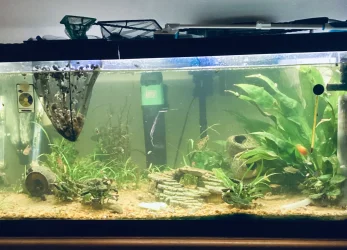
IMG_0770.webpWell, here’s the picture. It’s not what I want it to be yet but it’s at least closer you can see all of the snails that I caught in the net on the left side of the tank and there’s of course more to get but I got a lot of of them out of there that helped first of all I also did a couple water changes and I’m now using springwater in my tank instead of municipal water that seems to have made a big difference I am leaving the blue light off more and I’m going to get me a couple of snail eaters like a couple of loaches I think. The polisher that I have ran for about 12 hours and it helped to clear up a lot also I’m still having trouble with my tank filter. I don’t know why it keeps plugging up. It seems like it’s still dealing with The sludge that was in there I think I’m gonna take the head off and clean it out real good tomorrow but otherwise the white sludge that was collecting in the tank and on all the plants seems to be under control. Thanks for all your help.
 

Most reactions

Back
Top