Can municipal water cause a tank to be dirty compared to using RO water?

Crafty Nana

New Member
Joined
Mar 30, 2026
Messages
25
Reaction score
6
Points
3
Location
US
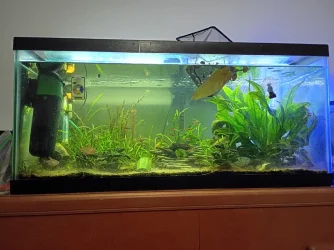
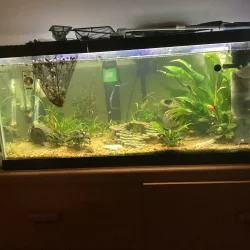
Some of you may recall my thread on why my tank gets dirty. I have been using spring water in my tank instead of the municipal water for a while now. I’ve attached a picture of the tank using the Springwater and it has been staying cleaner than what it did with the municipal water. Our municipal water tastes terrible and it has a lot of chlorine in it which I did treat prior to using for my fish and I also used tapwater conditioner by API to condition the water before I put it in the fish tanks. My question is the tank staying cleaner because of the water or is it just the fact that I may be paying more attention to it.

I have an RO system that we put in about 15 years ago and has not been used. It’s just been sitting there because my husband used it for hydroponics and then he stopped doing the hydroponics so we didn’t invest in the filters to make it clean again. It’s been sitting there for probably about 10 years and has not been used. Is it worth my investment to get this RO system up and running or is it staying clean because I’m paying attention to it? If you recall in my post before it got dirty overnight when I did clean it and I believe that it was due to the water, but I may be way off base here and I’m hoping somebody can help me with this if it is due to the RO water or spring water and not using the municipal water, do you think that this old system would be worth using again or should I invest in a new system and if I should invest in a new system? Is there a brand that you would recommend?

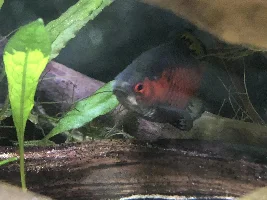
The picture on the left is the older picture with the faucet water and the one on the right is the one I’ve been using spring water in. The one on the left was overloaded with nails that you can see in the net we collected a lot of them and I’m not sure how many more we’re gonna collect and I also have new babies hatching which I’ve got to get out of there before they get big, but my major question is the water is RO water better for the fish tank the municipal water?
 

Attachments

  • IMG_0769.webp
    IMG_0769.webp
    190.2 KB · Views: 21
  • IMG_20260810_170701611_HDR.webp
    IMG_20260810_170701611_HDR.webp
    285 KB · Views: 21
Well water companies do put additives in water for various reasons but i can't answer if they would cause your water to be 'cloudy'.

as for the question "is RO water better for fish tank then municipal water" is a bit complicated:

If you mean straight RO vs tap then it depends on mineral content of your tap water and what the species of fish you are keeping require.

If you mean RO water with additives you add to meet the requirement of the species of fish you keep then likely it is better since you know what is and is not in the water.
 
I would change out the pre-filters and membrane on your R/O unit and put it back in service if for no other reason than good drinking water and coffee . I’ve had an R/O unit for several years now and I wouldn’t be without one now .
I think you’re onto something with your suspicions about municipal water . Yes , municipal water is very clean and clear but some municipalities use some drastic chemicals and processes to get it that way . Then it’s run through pipes that might be rusty or whatever and then we aquarists dose it with a chemical to neutralize the chlorine and / or chloramine .
Don’t assume that spring water is good . It can come from tainted sources too but judging by your pictures I think you have good spring water .
You can mix R/O water with tap to get the water you want but then you’re using the tap water that you are suspicious of OR you can use straight R/O and mix in commercially available reconstituting salts . That’s what marine aquarium hobbyists do and so do some Rift Lake cichlid keepers .
 
we have a high nitrate content in the ground water around here, most likely from heavy agricultural pollution, I know many of the city water systems do nothing to remove those nitrates… there may be other things in your ground water they are not removing as well… I have 2 RO systems one commercial size for my aquariums ( I have several ) and one for our drinking water and ice cubes in the house…
 
The words are too vague to give an answer. I have had many different municipal water sources. Here, it's always been clean, but in one of the places I lived, the old pipes in the house could be a problem with rust and scale in them, The municipal water was fine when that was resolved.
Water is never one thing, and municipalities all have different sources. I have excellent soft tap, but up the road, the tapwater is hard and I'd need RO if I lived 10 minutes away.

The most popular brand of spring water here would be bad for my tanks. A less popular brand from a different source would be okay.

One friend's well is great. Another's is barely drinkable. It depends on the aquifer.

I know a lot of hobbyists in the midwestern US have bad water, so it's altogether possible. I remember the older thread and it was a head scratcher. If it's the municipal tap, it's worth checking out for your health as well.

What's odd is I have a five gallon I use to quarantine plants I find when kayaking. I grabbed a bunch from a swampy area affected by agriculture last week and threw them in unrinsed, and the water became very cloudy. I was kicking myself for being lazy and the next day was going to dump the tank out. Only the next day, the water was crystal clear. That's far from what was building up in your tank.
 
My question is the tank staying cleaner because of the water or is it just the fact that I may be paying more attention to it.
When you say you are paying more attention, do you mean you have changed the tank maintenance? If you are changing more water, changing it more frequently, feeding less or even have fewer fish, then the pollution will have reduced.
 
1st off, this picture is an advertisement, but in reality, do we want any of this in our tanks… I’ve noticed a big improvement over all, after switching to RO water as the base, for all but my really hard water tanks…
IMG_9822.webp


add to this list, medication residues and tons of other pollutants that are not removed by most water treatment facilities, not to mention the chlorine / chlorides added by the treatment facilities…
 
This is part of where our environments matter. I'm eccentric enough that when I planned a move for retirement, looking at the water quality from the tap in detail was part of my deliberations. This city draws from 2 sources, and I would not have agreed to go after a house in the area served by one of them. I would have need RO in too large quantities for it to be reasonable.

There are strong enviromental regulations in place for our water, and I support them 100%. You can't take a boat out or go fishing in the lakes that provide our water - even kayaks are prohibited. There are no houses or farms on the banks.

Not everyone has that, and I'd be a terrible advice giver if I assumed people in other countries, regions or societies approached things the same way. I'm not being holier than thou - we have an oil refinery, a paper mill, and other industries that pollute the sea and leave the freshwater alone. The river I kayaked on yesterday had heavy algae growth, probably from farm ferts and cattle wastes too close to the banks.

I wonder if one day, we'll be like the reef hobby and generally have to use RO with minerals added back in?
 
If you fill a glass with your tap water and it is clear, then it is unlikely the source of cloudy water. This is mostly caused by dissolved solids in the water and these are usually organic in nature. But clear water does not mean it has nothing undesirable for fish in it.

I have a private well and the water is excellent and almost anything I get will spawn in it as long as they like softish water. I also had an RO/DI unit I used for years for Altum angels because my tap was not great for them.

Also, other bacteria can cause water to be clouded if they reproduce rapidly. They use the same things out cycllng bacteria do and it is common in a new tank to have a bacterial bloom which makes the water cloudy. This usually clears up on its own but before it does we normally have to do a bunch of water changes.

Also, in the states there are limits to the level of nitrate in municipal water.
The U.S. Environmental Protection Agency sets the legal maximum contaminant level (MCL) for nitrate in public drinking water at 10 mg/L (or 10 parts per million) measured as nitrate-nitrogen.
p.s.- Where I live are most of the reservoirs that supply water to NYC. We can fish in these but we cannot use motor boats nor swim in this water.

When the nitrogen complex is measured it can be done usinge two different scales. One it the Total Ion scale and is the most common one used in our test kits. It measures the Nitrogen plus the other components involved. Ammonia is NH3 which means it is one nitrogen and three hydrogen. Nitrate in NO2 which is one nitrogen and two oxygen while nitrate is NO3.

Science is mostly concerned with the Nitrogen and uses the nitrogen scale which only counts the Ns. The way to tell the difference is that, when the nitrogen scale is used there will be a -n at the end of the chemical formula. In this case 1 ppm of Ammonia = 1 ppm of Nitrite = 1 ppm of Nitrate.

One can convert between the two scales just like we can convert C to F or miles to kilometers.

Nitrogen scale = Total Ion Scale
1 ppm of NH3-n = 1.21589 ppm of NH3 (Ammonia)
1 ppm of NH4-n = 1.28786 ppm of NH4 (Ammonium)
1 ppm of NO2-n = 3.28443 ppm of NO2 (Nitrite)
1 ppm of NO3-n = 4.42664 ppm of NO3 (Nitrate)

Most of the ammonia in water turns to ammonium. So when we want to know the number for Total Ammonia (the sum of NH3 + NH4) I generally use 1.28 for the Total Ion scale value for 1 ppm Total Ammonia-n.

What this means is that that the 10 ppm of NO3-n the government allows in tap water would give us a reading using the Total Ion scale used on an API nitrate test of 44.266 ppm.

This also means on the API kit that 1 ppm of ammonia can only produce a maximum of 3.2844/1.280 = 2.566 ppm of nitrite, and 4.42664/3.28443 = 1.347 x 2.556 = 3.443 ppm of nitrate. I say maximum for a few reasons. First is because ammonia can evaporate. But plants will interfere with this as they do not make nitrite or nitrate when they use ammonium. And, even with no plants, other things can use ammonia, nitrite and nitrate. This includes algae and other bacteria etc.

If one is a really nerd it is possible to recalculate the actual maximums by using a conversion calculator which will give us a breakdown of the actual, amount of NH3 and NH4 in any total ammonia reading. This will require we also know the pH and temperature of the water tested. You can find such a calculator here https://www.hamzasreef.com/Contents/Calculators/FreeAmmonia.php

The is likely more information than most of us need beyond knowing how to convert between the two scales. But I am a bit of a nerd, so I provide more info than most keepers need. It is better that one has access to it and doesn'3t use it than it is to need it but not know it.
 

Most reactions

Back
Top