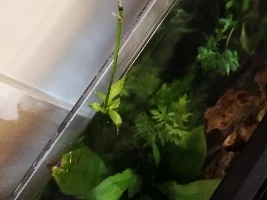
why all the "wilted" fish???

What GH do you keep your mollies/ paradise fish/ sail fins in? Are they in mixed communities?
 
Mollies are in a hard well water tank, the paradise fish are in a soft RO water tank, not together...
 
Here in Europe, it is not permitted to send fish (vertebrates) via normal parcel services. There are a few certified overnight express parcel services that guarantee that fish picked up in the late afternoon will arrive the next day and that the parcels will not be thrown around or left in cold rooms or lorries for long periods of time.
Unfortunately, this service is now only available to retailers; it is no longer possible to send fish from private individuals.
Mollies are in a hard well water tank
My dealer recommends keeping mollies in water with a little salt. Especially those with sail fins. They would even thrive in marine habitats. In large fish farms, they are usually kept and bred using salt and often antibiotics, just like guppies. It is really difficult to adapt them to normal aquarium conditions.
 
I've never been one to add salt to a fresh water aquarium, but am aware of their ability to thrive in salty conditions... but, I thought, they had the "ability", not the desire... I used to raise molly's, in the dark ages ( before the internet ), I did so in a very salty brackish water, as I was looking for live feeders ( babies ) that would survive in a salt water tank, long enough to get eaten by my larger variety sea horses... they had babies, although not large groups of them... I was using black molly's at the time, as they were more visible to the sea horses...

I suppose I could at "some" salt to the breeder tank, to see if that helps, with the sail fins, at worst case, I can just not replace it during water changes...

I do have a pair ( not currently mating ) super red plecos in there, and would be concerned about the salt, with the plecos, that are in that tank, to help keep the large glass sides clean ( the tank is a 45 gallon tall, that is 36 inches wide, and 24 inches tall ) sorry, I'm not particularly good at metric conversions...
 
Last edited:
This ist what Tropic Water says on their stocklist
P. latipinna
"Giant mollies, as broad-mouthed livebearers are also known, can be recognised by their large, broad dorsal fin, which is almost reminiscent of the dorsal fin of sailfin livebearers. These fish grow significantly larger than the
pointed-mouthed livebearers (Poecilia sphenops) listed below, which is where the colloquial name "giant molly" comes from. The addition of salt has proven to be beneficial, especially for the pure black fish."

Next section, P. sphenops:
"Small, hardy Molly with short dorsal fins that definitely do NOT need salt in the water! To be precise, they are pointed-mouthed livebearers, but nobody calls them that..."

And P. velifera:
"As beautiful as sailfin mollies are – males always impress with their upright dorsal fins when displaying – they only survive long-term with salt, or in brackish or even sea water!"


I think sometimes it's hard to tell which species where used to breed all the fancy Mollie types.
 
velifera, are mostly what I've been trying to start in that tank, my desire was for a wild looking fish, as large as I could breed...
 
Molly's are so messed up in the hobby...

here are 2 pictures from different sellers of what each is calling latipinna...

1770484158350.jpeg


IMG_9012.jpeg
 
was digging for my old thread on my desire to breed wild type sail fins, since this thread kind of turned there, but buried too deep...
I found this, on line

Poecilia velifera Care Page - Back to Poecilia velifera Page
MsSpacer.gif
MsSpacer.gif
MsSpacer.gif

Common Name- Giant Sailfin Molly
Water Conditions- pH around 8, clean water, multiple daily feedings, Vegetable flake based diet
Behavior- Large, well behaved community fish. Very distinctive, best in larger species only tank.
Breeding- 10-50 large fry born after 30 day gestation
Size- 3-5 inches, males will get up to 5.5 inches in the aquarium.
- Also see the care and maintenance page for the P. velifera HERE.


This will be a slightly longer care page, because this is a very special fish. For many years this was a
fish I wanted to keep, and I knew it as THE iconic livebearer, it would be just the type of fish I should
carry at Select Aquatics. Though not endangered in the wild, they are very rare in the hobby, and becoming...

sorry too long to copy and paste... balance here..

 
When I was a child, my aunt had some sailfins in a small aquarium together with other livebearers. It was about 100 litres in size... I found them so fascinating.

For a long time, they were part of the standard range in pet shops in Germany. I'm glad that has changed; I haven't seen any in a shop for years. They do have special needs.

I wish I had space for a brackish water aquarium large enough for a group of these beauties.
 
The day will come ... a big tank, rock scape, incredibly intense green algae and stunning sailfins!

 
so, AI says Ancistrus plecos should easily be able to handle 1-2 tablespoons of salt per gallon... so 1 table spoon per gallon, is about 1.5 lbs. for this tank... I have another shipment of sail fins coming to try again ( my well water is very alkaline, with a ph, over 8.0 usually )... so if I continue to have problems getting them to come around, I could add a pound and a half of salt, before I try another, to see if that helps...

I'm suspicious of general recommendations like I posted above, as that doesn't say what the base water was, before adding salt... logic would dictate that adding the salt would be done to neutral 7.0 water... if my well water has a ph of 8.4 ( the reading I last tested. quite a while ago , and the reason for a large RO system ), I'm guessing that would greatly reduce the amount of salt I'd want to add... in theory, as far as I know, they should love my well water, which I've been using straight, since I began this attempt...

 
I'm suspicious of general recommendations like I posted above, as that doesn't say what the base water was, before adding salt... logic would dictate that adding the salt would be done to neutral 7.0 water...
Me too. My understanding is that they need minerals like calcium and magnesium (250GH) rather than sodium. You didn’t answer how hard your water is in their tank. The sodium is used as a substitute to harden soft water but rift lake minerals would be better.
Either way, your soft water plecos won’t be happy in there long term.
 
My dealer recommends keeping mollies in water with a little salt. Especially those with sail fins. They would even thrive in marine habitats. In large fish farms, they are usually kept and bred using salt and often antibiotics, just like guppies. It is really difficult to adapt them to normal aquarium conditions.
I have gone fishing and caught various molly species, and this is the area where a little of the biodiversity research I natter on about is very valuable.
Within US Poeilia latipinna, there are local populations adapted to pure freshwater, and others adapted to brackish. It's not certain if the saltier water ones can adapt to the same habitats freshwater fish of the same species thrive in. We see great variation in needs between the wild molly species in southern North America into northern South America and the Carribbean, as different habitats create different needs. You can't say "molly" and be sure you are talking about the same fish as your friend is.
Here's the molly group. not counting the many hybrids the hobby has made.
Does it look like all these species could have the same needs and same adaptations?
Mollienesia Lesueur 1821

Poecilia (Mollienesia) boesemani
Poecilia (Mollienesia) butleri
Poecilia (Mollienesia) catemaconis
Poecilia (Mollienesia) chica
Poecilia (Mollienesia) formosa
Poecilia (Mollienesia) gillii
Poecilia (Mollienesia) hondurensis
Poecilia (Mollienesia) koperi
Poecilia (Mollienesia) kykesis
Poecilia (Mollienesia) latipinna
Poecilia (Mollienesia) latipunctata
Poecilia (Mollienesia) limantouri
Poecilia (Mollienesia) marcellinoi
Poecilia (Mollienesia) maylandi
Poecilia (Mollienesia) mechthildae
Poecilia (Mollienesia) mexicana
Poecilia (Mollienesia) nelsoni
Poecilia (Mollienesia) orri
Poecilia (Mollienesia) petenensis
Poecilia (Mollienesia) rositae
Poecilia (Mollienesia) salvatoris
Poecilia (Mollienesia) sphenops
Poecilia (Mollienesia) sulphuraria
Poecilia (Mollienesia) teresae
Poecilia (Mollienesia) thermalis
Poecilia (Mollienesia) vandepolli
Poecilia (Mollienesia) velifera
Poecilia (Mollienesia) wandae

You'd be surprised how many fish have gone into the soup for making the hobby ones - latipinna, and velifera from the saltier side, mexicana, lots of sphenops, butleri from the hard freshwater world. Even if we just look at the ones in the trade, saying 'mollies like salt' is like saying "bird eat seeds".
I've kept 11 of those species, and forget 'varieties' or 'types' - they can be pretty distinctive in how you keep them. It's actually not an easy fish to keep. Like goldfish, they are productive and cheap, and the hobby runs its hybrids as disposable fish. Not many hobbyists manage to keep them for their full lifespans, or grow out their babies to good sizes.
 
THIS HOBBY IS DOOMED... despite the improvements in shipping speeds and temperature regulation in the last 50 years, the fish are not the same as were sold before... and seem to have gotten worse very recently... perhaps do to hormonal breeding, or another "newer farming practice"

I think I can add panda garra to the list as well... my 1st order, years ago, the fish were amazing... I've since then ordered them 3 times, from multiple sellers with no survivors... seems like either the fish get popular, and poor practices give bad fish, or maybe just current farming practices are producing fish that will not survive??? if that is the case, the hobby is doomed, as we pollute the waters many wild fish are caught from ( and wild caught fish are not "sustainable" ) and ecologically unpopular, and "sustainable" sources are not producing actual sustainable fish...
 
Last edited:

Most reactions

Back
Top