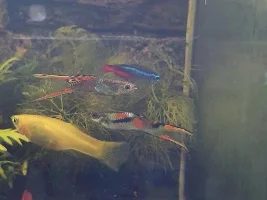
There are a couple of possibilities.
You know I've always mentioned shipping season when we discuss. The stress of winter shipping when so much can go wrong can't be discounted.
Fancy mollies (ie, hybrid bred in the hobby) are very prone to Mycobacteriosis, and that makes a fish hunch and hollow out. The fish most affected by tb from my observations are rainbowfish and hardwater livebearers. The disease is pretty well everywhere on many farms, even respected ones. Add the stress of shipping to the life of a fish fighting that slow chronic killer, and the disease wins.
But other bacterial diseases will also gain the upper hand.
I think we're looking at something new. The diseases are old, the species are old, but how we get the fish isn't.The system for getting fish until recently was they were shipped from either the wild, or a farm. Upon arrival, people like me would sort out the shipping losses, anywhere from none to all, but often around 20%. Then, after a few days once they'd stabilized and there were no more 'deads' for a few days, they would be shipped to the retailer. Losses upon arrival there were unavoidable, and everyone in the supply chain knew the cause was shipping.
Stage one: anywhere from 24 hours to 72 hours crowded in bags.
I often bought my wild caught fish out of the bag, without even 'tanking' them at stage one. I took them straight home after a water change, and almost all of them rebounded and did fine. Their bagmates who stayed in the warehouse also did great. But shipping to the next source killed a lot of the latter. The pros expected it it, knew it, regretted it and factored it into their prices.
Stage two: anywhere from 12 hours to 24 hours crowded in bags, unless the airline screwed up.
Then, the aquarist would buy them. They'd be bagged and carried home carefully, and if the store was good, they were generally fine. They might have picked up treatable Ich in the store tanks. If they were hunched or folded, no one sensible bought them. Sight unseen though?
Now, over the past 15 or so years, another shipping marathon is added. I sometimes get to the major city where the wholesalers I know are, and I get my fish. They arrive alive and prosper, after a ten hour car ride in controlled conditions (a styro that doesn't get thrown around, crushed, boiled or chilled). If I get those fish shipped from the exact same places, by friends who choose carefully for me, and who pack very professionally, I'll still face serious losses. 50% on some species beats 100%. You can pack and ship like the greatest seller ever, but that box is about to be rushed through a system that only thinks of quick, and often fails at that. The workers in parcel shipping don't have time for TLC. That's inefficiency and gets them fired.
I sometimes buy from a young retailer who ships overnight. It generally takes about 30 hours for me to get the fish, via UPS. He insists on six fish per bag, which isn't good for things like corys. His prices are excellent, so I bite the bullet. If I want 8, I buy 12. If I bought between October and late April (I don't although it kills me to see what he has in the prime time for importing wild fish) I would consider myself lucky if I got a 50% survival rate. We're in the north and the climate is treacherous. If I wanted to have all year availability I would either move to a huge city or move to Europe.
I've never bought single fish. If I want winter arrivals - my daughters live in a good sized city 4 hours from here, and I buy fish from a good retailer when I visit them. I time it so I get my fish on the way back, to minimize in the bag transit time. If I can't control the transit conditions of fish from late Fall to late Spring, I expect them to arrive injured. It's harsh sounding, but it's built in to where we live.