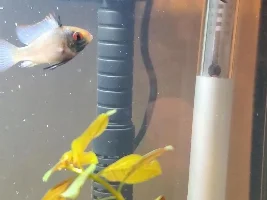
You should pay more attention to what GaryE just posted. Ignoring the size issues the fish you want are definitely from different water parameters. Also, they have different dietary needs.
Neolamprologus brichardi is a small cichlid endemic to Lake Tanganyika. It lives along the rocky shoreline, mostly between 5 and 25 m deep (Konings, 1993). It gathers in large groups that can look like
shoals, but most adults in them live as breeding pairs. It hovers up to a metre above the rocks to feed on
plankton
Temperature 23–26°C pH 8.0–9.0 Hardness 9–19dGH
https://www.seriouslyfish.com/species/neolamprologus-brichardi
Cribroheros rostratus is native to Central America, specifically the Atlantic slope of Nicaragua and Costa Rica. A floodplain fish found between 0 and 200 m elevation. Inhabits lakes and rivers of low to high current velocity. A soil-eating omnivore with a strong carnivorous tendency; it sifts and digs through sand and substrate to feed on aquatic insects, detritus, and sediments. The generic name
Cribroheros derives from the Latin word for a sieve, reflecting this sifting behavior.
Temperature range of 73–93°F ( 23°C - 34°C) and a pH of 7.0–8.2 General Hardness (GH). Aim for 8–20 dGH
https://www.fishbase.se/summary/Cribroheros-rostratus.html
Heros efasciatus is widespread throughout the
Amazon main channel and rio
Solimoes and also recorded from the rio
Xingu. Slow moving rivers, tributaries and floodplain lakes. It's most abundant in deeper, calm waters with a lot of submerged tree roots and branches.
Omnivorous and unfussy. Feed good quality dried foods, along with meatier fare such as bloodworm, chopped earthworms and prawns. Some vegetable matter should also feature in the diet. Shelled frozen peas, blanched spinach and dried
spirulina-based foods are all recommended.
Temp 22.2–28.9°C pH 5.5–7.0 Hardness 1–8dGH
https://www.seriouslyfish.com/species/heros-efasciatus
Most wild
Tetras live in the Neotropical rivers, streams, and blackwater or clearwater systems of
South America, particularly throughout the
Amazon Basin (spanning countries like Brazil,
Peru, Colombia,
Venezuela, and
Bolivia). The vast majority of wild tetras live in the Neotropical rivers, streams, and blackwater or clearwater systems of
South America, particularly throughout the
Amazon Basin (spanning countries like Brazil,
Peru, Colombia,
Venezuela, and
Bolivia).
The
Tetras tend to live in softer and somewhat acid pH waters. Because most tetras (like neon tetras) are small fish, choose finely crushed flakes or micro-sized granules they can easily swallow. They are an omnivorous fish.
Mixing the fish you are looking at in the same tank will not be good for half of the 4 species. Depending, on your tank parameters and how you feed, you may even manage to kill half of the 4 species.