Which Corys Do You Have?

But cory isn't easy to spell. All over the web, I now see one corydora, two corydoras. So the hobby isn't even able to manage that.

I'll be the old editor and just spell corydoras with a small c. It's a Latin word that has become English. But Aspidoras has the same number of letters and is no harder. Hoplisoma is shorter!
You've got me on Scleromystax though.
 
There's precedence for this in the hobby. Most famously, we still call them 'tetras' long after Tetragonopterus, from which it was derived, was no longer the relevant genus.
There is an answer - 2 wrongs make a right !

Tetra and cory for life.
 
This doesn't apply people here, but have you noticed some scientific names are cool only when newer scientific names are introduced? Most of the 'new' cory groups are resurrections - old names that the fish were taken out of when Corydoras was expanded. Now the old names are back, but 'corydoras' has become an English word.
Most of our Rasboras aren't rasboras, either.

Our tetras aren't tetras. Most plecos aren't plecos. Once we start using a name, it just gets adopted.

 
Most of our Rasboras aren't rasboras, either.

Our tetras aren't tetras. Most plecos aren't plecos. Once we start using a name, it just gets adopted.
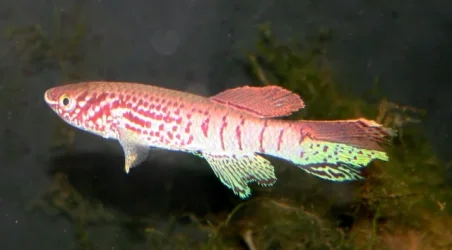
True. I can think of only one 'common' name derived from a former genus name that didn't endure. Several of us are old enough to recall when killies were commonly referred to as 'panchax' after a long-defunct genus of the same name. There were even books about them using that name. But the moniker seems to have faded away some time in the 1970s or '80s, though it has endured as part of some individual common names, i.e. "Striped Panchax" = A. lineatus.

panchax.png
 
Last edited:
A Blue Gularis Panchax . How interesting ! I had a big male Blue Gularis once that my best friend gave me after its mate died . That was then and still is now the coolest Killie I’ve ever seen . I’ve even heard stories of them growing 6 to 8 inches outdoors . They seem to be very easy for some to breed and nearly impossible for others . I’d like to take a crack at them someday . I’d definitely pick the Fundulopanchax sjoestedti Blue Gularis over Discus as my own personal shot at attempting the difficult . You ever tried them Gary ?
 
A Blue Gularis Panchax . How interesting ! I had a big male Blue Gularis once that my best friend gave me after its mate died . That was then and still is now the coolest Killie I’ve ever seen . I’ve even heard stories of them growing 6 to 8 inches outdoors . They seem to be very easy for some to breed and nearly impossible for others . I’d like to take a crack at them someday . I’d definitely pick the Fundulopanchax sjoestedti Blue Gularis over Discus as my own personal shot at attempting the difficult . You ever tried them Gary ?


I have several times. I once saw an importation of the the hard to spell sjoestedti that had to be 6-7 inches long. At that size, I didn't buy them. There were about 100 on the first day, but even in a huge tank, it was murder central for about 3 days. The same shipment had beautiful deltaense, almost the same size and even nastier.

I bred one of the dwarf (ish) blue gularis strains. Some people think they're easy but I don't do well with them. They are beautiful, but I lack whatever specific skill is needed for them. I have friends that produce them like guppies.

I have some old mags with the Panchax name. The American name, killifish, took over. I love the fact my Heterandria formosa livebearers are called "least killifish". I used to camp at an upstate NY place called "Fish Kill", with the "kill" in the name being old Dutch for stream.
 
I kept them for years. When I used my usual colony method for killies I wound up with nearly all males. When I bred them in pairs, the gender ratio improved greatly. It was one of the few species that my local aquarium shop--now long gone--eagerly bought from me. Even a bag full of just males. They do turn heads. No wonder it's the poster-fish for AKA and other clubs.

I too have seen huge Blue Gularis. There was a guy in AKA--I believe he lived in SF-- who sent enormous F. sjoestedti and F. deltaense to the convention for auction every year for years in the '80s and '90s. And the biggest ones I ever saw were surprisingly in a local chain we used to have in the northeast, Petland. They were in bad shape but they were BIG.
 
The problem with them arriving big was they were old. I bought wilds at about 3 inches a couple of times, and got one of them breeding.
 

Attachments

  • sjo 008 (640x354).jpg
    sjo 008 (640x354).jpg
    148.4 KB · Views: 20
This doesn't apply people here, but have you noticed some scientific names are cool only when newer scientific names are introduced? Most of the 'new' cory groups are resurrections - old names that the fish were taken out of when Corydoras was expanded. Now the old names are back, but 'corydoras' has become an English word.
Most of our Rasboras aren't rasboras, either.

Our tetras aren't tetras. Most plecos aren't plecos. Once we start using a name, it just gets adopted.
Going back some years I met Jack Watley in passing , went to his Miami fish store and back then it was packed as he had for sale plecos you do not often see for sale being the simpleton which I am I bought common clown plecos ( Panaqolus maccusm } they thrived for years in a backyard buried home depot type 125 gallon pvc '' pond '' .
 

Most reactions

Back
Top