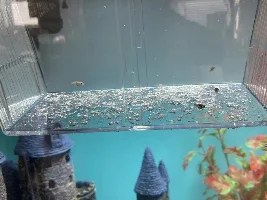
watching baby fish grow up…

Magnum Man58 173

Fish Maniac
Tank of the Month 🏆
Fish of the Month 🌟
Joined
Jun 21, 2023
Messages
7,751
Reaction score
7,037
Points
113
Location
Southern MN
I have a few species of fish that I don’t have in their “forever” homes, they require growing out before they can be placed with bigger, more mature fish…one of them are a group of 7 spot tail algae eaters ( Crossocheilus reticulatus ) these all came in at the same size, as babies, and in the month ( s ) they have been here there is getting to be pretty big size differences between them, I believe they are monomorphic ( where it’s difficult to sex them ) I’m wondering if that size difference is just the individual fish, or if a person can make a basic sexual decision, by the size / growth rate when it comes time to break up the band???
 
Last edited:
From the little bit I googled on them when I first heard of them I seem to remember they can be difficult to sex. Not really sure that google can really be relied on all the time though.
 
It's really imprecise with my fish. Size? It depends on who's bigger, male or female. On who gets to the food. Whose genetics are for fast growth. Whose are for certain temperatures, which we can easily mess up. I recently saw an article on a species whose rates of growth depend on daily lighting length.

If I told you the number of times I got a fish to breed but it was the one I thought was male that laid the eggs... it's happened a lot with species that aren't sexually dimorphic. There are indications, but the more experience I gain the less I trust them.

I have raised thousands of fish - having fish breeding as your hobby will do that. I love watching them grow, but with many fish, I have to stop at the idea that they know who's who, and wait to see what happens.
 
It's hard to sex fish properly when they are monomorphic, for sure...
It's really imprecise with my fish. Size? It depends on who's bigger, male or female. On who gets to the food. Whose genetics are for fast growth. Whose are for certain temperatures, which we can easily mess up. I recently saw an article on a species whose rates of growth depend on daily lighting length.
I totally agree...
 

Most reactions

Back
Top