Undergravel filtration and Cory group fish

GaryE

Moderator
Staff member
Global Moderator ⚒️
Fish of the Month 🌟
Joined
Oct 14, 2011
Messages
9,190
Reaction score
15,886
Location
Eastern Canada
I've built a few undergravel filters over the past few months, in my quest to see what works from past aquarium keeping techniques. So far, they've been great.

I understand the logic of saying that since a bottom dweller like a Cory is in contact with the substrate, and since the substrate is filter media, there could be a problem. I'm not seeing such a problem though, as I do proper maintenance to pick up mulm as you should with those filters. But the filters in question are all under a year old.

I also understand my own tendency to see what I want to see. So what direct experience can people bring to the question of UG filters and Cory catfish? Are they really problematic, or is that the usual fishlore, with no basis?
 
it would seem the main problem would be a cross over between acceptable substrates that would work for under gravel, and the Cory's

are you using sand??? I would guess that a screen, coarse foam, or green scrubber kind of media could be used on top of the under gravel filter plates, to keep the sand out of the filter plate, assuming the layer of sand would be thin ( maybe one inch or less )

Have you tried reverse flow??? I had a tank I ran reverse flow 30 years ago, and I think it would have worked great, if used in combination with a proper sized mechanical filter, like a hang on back, to remove the solids, as they don't settle into the substrate

I have cory's in my South American Tetra tank, that has a full under gravel... I use a finer, rounded edges river gravel as a substrate in that tank.. it's been running that way, with cory's in that tank for several years
 
Last edited:
I cheat, since I prefer two filters per tank. About two/thirds of the substrate is a fine gravel, too coarse for sifting but not by much. The other third has no piping under it and is siftable sand. What I'm curious about is whether the filtration substrate is unhealthy for Corys, or if that's simply something that is said but not experienced.

I had healthy Corys in tanks like this 30 years ago when I never worried about it, but the sample was small. and hearing from people who are on the forum and have done this might be helpful.
 
Some may disagree and I don't have much experience with corys. Still, in the long past, I have had them.

Many will say that they absolutely NEED a sand substrate bit I don't agree. I think the biggest issue with gravel is that most that is packaged have sharp edges which can, and likely will, cause damage to the barbels. However I believe that smaller, polished, river pebbles are fine as there are no sharp edges. Smaller river pebbles are also not small enough to sift through the UG filter plates yet still small enough for a Cory to move around and sift.
 
Everything you hear about corydoras requiring a sand substrate is nonsense. Corydoras are found in environments with sand, gravel or mud, or a combination thereof, in real world environments. In most of the Amazon videos I've seen, whatever the substrate might be, it is often completely buried beneath leaf litter. While I have no direct personal evidence, I have also read at least one report testing the hypothesis that sharp edged gravel damages cory barbels that found no evidence to that effect.

Lastly, I have personally kept corydoras over a period of years using fine grade (3-4 mm) natural quartz gravel over UGFs and have seen no evidence of disease or physical damage whatsoever. I suspect the problem reported with gravel is due to the use of pea gravel, which traps food that can't be reached and therefore rots.
 
The sand versus gravel issue will never be resolved. I go with the idea that the Corydoras group are sifters. They sift fine particulate matter. That's anatomical.
We can't have tank bottoms of mulm and mud mixed with sand or fine gravel, so that substrate is out. It may be natural, but our aquariums aren't. So as usual, hobbyists apply 'hacks'. Corys can feed without sifting, as can other eartheating fish like Geophagus.
Sand is found in many of their habitats, and in parts of their habitats, and it's a sensible addition IF you want to see natural behaviour (sifting). If you don't care, then the fish will live well and long over gravel. Over pebbles, I have seen problems with trapped food, but people will argue for that being fine.
MY concern here wasn't texture, but trapping. The goal of the old UG system was to turn the whole substrate into filter media, a clever goal I think we ditched too soon due partly to marketing. With the right fish, it was an effective system. I'm glad to see @plebian 's post address that side of things, especially because it said what I wanted to hear!
I'll keep following this one in case of other experiences. We usually say 'other opinions', but this is experience based, not opinion.
Corys move down, and up rivers, streams and brooks. The substrate and where the food is will vary. When I was a fish fascinated kid, I thought tropical streams would be different from the ones I explored locally. The plants, microscopic life, temperatures and fish are, but if you travel down a couple of kilometres of most undamaged streams where you live, you get a picture of the substrates.
I often read UGs harmed bottom dwellers, and because they trap debris, exposed them to high bacterial loads. I also know UGs were the advanced filter of choice in the balanced aquarium myth years, when water changing was seen as messing up the system, a la father fish. I'm thinking that with current maintenance regimes of changing at least 25% per week, and using gravel vacs (a relic of the UG period of the hobby), these old filters should be very good. But I don't want to harm my corys.

The bags of gravel I used were labelled as sand. They're not inclined to pack, but aren't siftable for a little cory. They got thrown around a lot when I had big Geophagus. I think sometimes when we debate sand vs gravel we can be talking about the same thing. But when we talk about filtration substrates vs fish health, then we're debating something different.
 
so, I haven't had very good luck with Cory's over the years, and reading through the threads about them , it seems "everyone" has problems with their Cory's... this makes me wonder if there is an under lying problem with farm raised Cory's??? I suspect there are only a few, with as many as are in the hobby , that are wild caught any more... and even wild caught fish can be getting exposed to unnatural things with deforestation climate change, and man moving into their areas, and farming...

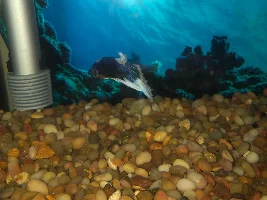
the best luck I've had with Cory's are the few I have left, long term from a small shoal I started with, in my South American Tetra tank, on the river gravel I linked above, and in a tank, with full under gravel filter plates with power heads on the lift tubes... these have been in that tank between 2 and 3 years...

the 2 tanks I actually set up for Cory's, on sand, have not sustained Cory's long term... ( so, is that the fault of the Cory's, or the tank I set up with sand for them??? ) the ones I have thriving are active, fat, and happy in my South American Tetra tank, on finer smooth gravel, with and under gravel filter... your results may vary...

both those sterbai are in this picture, on the substrate described above...
IMG_8594.jpeg
 
Last edited:
Enter the Sandman....

Okay, I prefer sand with Corys. I also think a key to success is large groups, something I usually can't afford. I keep them in fives or sixes, and hope they 'll breed. If I can get young from them, then the group can expand.
I make them central to the tank. They have no competitors in their niche. Never Cichlids, certainly never loaches. I'm starting to see them as good candidates for single species tanks.
I've begun to keep them with killies, as well as small tetras. I can do that with the Corys that like the lower temperature range. I research every individual species to see where that stands.
I have one farm raised member of the group, some paleatum, and another mixed group of raised from eggs and bought from store panda. All my others come from a supplier who orders direct from South America. I have concolor, brevirostre, atropersonatum, melini, grantii, arcuatum, napoensis, loretoensis and sodalis, and all except the sodalis and brevirostre are quite young. I don't expect breeding for some time yet. Maybe next Spring.

The Cory group takes patience and attention. They aren't the easiest fish. The water has to be be well maintained, diet has to be considered and their niche has to be respected. They're social animals.

I suspect the problem we have with them is between our ears. We often buy the dumb idea they're a clean up crew. We aren't a clean up crew for airborne birds, and they don't clean up for waterborne fishes.

We also go with one size fits all for temperature.

Osteogaster aenea, our old friend the bronze Cory is a fish caught up in the defining what a species is debates scientifically, but which has a huge range. It has a temperature spread from 17c to 26. It seems to like around 20, but we keep it at 26 in tanks and pathogens and dangerous bacteria like that temp more than the fish do.

Hoplisoma paleatum, the salt and pepper Cory in some regions is the other most common Cory, and its natural range is 18 to 23 degrees.

Meanwhile, the popular Hoplisoma sterbai likes 26 to 30 degrees. It doesn't do well cooler.

A lot of Corys get labelled as 'tropical fish' and thrown into poor situations by lazy fishkeepers. I love sterbai and used to keep them, but I keep them no more. They have needs I don't want to meet.

Research into other fish groups has shown them to have temperature dependent digestive systems. Their digestive enzymes become very sluggish and they grow and survive poorly at extremes. It's not clear if this is true for Corys - no one has done that research to my knowledge. But that means it's not proven untrue either. It might prove very useful info, though in the way of fishkeepers, a lot of us will ignore it.

Over the years, I've bred few Corys, and that's part of their appeal. They're a challenge in different ways than I'm used to. I'm in the midst of a storm blowing in from the sea, with lots of roaring noises and rain hammering the windows, so after this I'm running out to do some cool water water changes to see if I can get some eggs.


Corys are popular, and the word "Corydoras" is now English, not just Latin. I've seen a number of aqurists recently decide there was such a thing as a corydora. Two of them are corydoras. The word ends with an 's', whether you have 1 or 100, but the fact we're making it follow English grammatical rules shows we've taken their name to heart.
 
one of the tanks I set up for cory's was a cooler water tank, ( 72 degrees F. ) and I had a dozen or more Osteogaster aenea ( long fin, so I assume farm raised ) they were in a 55 gallon sand bottom tank... there were a few plecos, but no cichlids... they have all since died out... I personally think just by the nature of the fish, that maybe Cory's don't farm raise well??? since they are bottom feeders, and may be exposed to different bacteria, in Asian fish farms, than they were exposed to in their native environment...
 
We had Corydoras in the shop and I had them at home over a 20 year period. The fish in the shop were on gravel that wasn't smooth but didn't cut you if you dragged it over your hand. We have sponge filters and trickle filters in the shops.

My Corydoras at home were kept on the same sort of gravel we had in the shop but I used undergravel filters in most of my tanks because it was easier. I had one big air pump and it provided air to undergravel filters, air operated sponge filters, and airstones bubbling away in buckets or tanks to mix and or circulate water.

A lot of my tanks had half the base covered with an undergravel filter and the other half didn't have the filter plates. In some of these tanks I had a partition that kept the gravel on the filter plate and I had sand, finer gravel or only a thin layer of gravel in the sections without the filter plates.

I also tried plastic containers with sand and had those in the tank with gravel, and the Corydoras and a number of bottom dwelling cichlids (Apistogramma sp) would spend quite a bit of time in them either grazing, sifting or just resting on the sand.

I did a tank with a reverse flow undergravel filter with a Fluval 303 external power filter. I used an Aquaclear 800 powerhead to pump water down an uplift tube and under the filter plates. The tank was a 4x2x2ft and had Corydoras and Botia lohachata in. The Botias loved it and spent half their time under the plates and the other half on the gravel feeding. The sediment/ gunk built up in the gravel and it needed gravel cleaning occasionally, not as often as normal flow undergravel filters but it still needed it. The power filter also needed cleaning regularly.

-------------------

Diseases from being on the substrate
From a disease perspective, I never saw Corydoras or any other bottom dwelling fish catch anything that might have originated specifically from the substrate. The fish do catch diseases but they were free floating pathogens found in the water column. There was no evidence the substrate (unless it wasn't cleaned regularly) had any impact on their overall physical health. When tanks had dirty substrate from lack of gravel cleaning, then we had disease outbreaks. The first thing we did when we had a disease outbreak was wipe the inside of the glass down, gravel clean the substrate and do a massive water change. This diluted the disease organisms and gave us a clean starting point to treat the fish (fewer pathogens to infect the fish and fewer pathogens needing to be killed in the tank).

Bottom dwelling fishes like Corydoras have been sliding around on the mud, sand and gravel bottom of creeks and rivers for hundreds of thousands of years, if not longer. They have developed an immune system and physical features to help compensate for whatever might be lurking on the bottom. That hasn't changed because we started keeping them in aquariums. They evolved to live on substrate and are quite good at it.

The biggest health issues with Corydoras (and all other fishes) in aquariums is poor water quality (ammonia, nitrite, nitrate) and dirty tanks. Over time aquariums develop a biofilm on the glass and other surfaces in the water, including the filter media. These can harbour beneficial bacteria to help convert ammonia into nitrite and then nitrate, or they can harbour harmful pathogens that kill our fish. Most beneficial filter bacteria prefer dark places so the biofilm on the glass and ornaments in the aquarium are usually home to harmful pathogens. Keep these things clean and keep the filter media clean via regular filter maintenance, and keep the substrate clean, and your fish usually do well.

One thing I have noticed on Corydoras that are kept on gravel instead of sand is their barbels don't grow as long. Since their barbels are sensitive and used to find food, we can assume if the barbels are being damaged even to a small degree by being on gravel, then the fish isn't going to do as well compared to if it lived on sand.

-------------------

Sand on the bottom of Creeks & Rivers
I have spent a lot of time walking up and down rivers and creeks in the southern half of WA. They are all the same. Most of them (99%) of all waterways I have been in, have had a sand base. There might be 2 feet of mud and leaves on top of that, and there might be a few boulders spread around, but the vast majority of waterways have sand over most if not all of their base.

The exceptions to this are where boulders (smooth river rocks) have been washed down stream and these can cause gravel to collect around them. You regularly find various grades of courser gravel and small rocks at the base of bigger rocks. You also get rocks in rivers where the water is cutting through a rocky cliff and then you have a rock base with gravel and various sizes of rocks in. If you move downstream from these rocky cliffs you end up with sand again.

There are some rivers around the world that have rocks and gravel but these are few and far between and usually occur in areas with recent geographical land masses or in areas where landslides occur. The gravel and rocks end up in the water during heavy rainfall, which causes land to slip and causes the rocks to end up in the river.

Even the Great Rift Lakes in Africa, which are renown for having lots of limestone and sandstone rocks in, have a sand base over most of the lake. They have solid rock under the sand but they have a lot of sand over the base. There are lots of rocks around the edges of these lakes but 30-40 meters out from shore and it is sand.

The reason most rivers and creeks have a sand base is because sand wears / washes away easier than big rocks. Rivers naturally change their course over time and they can straighten up, or more often start to meander and become S shaped (this is the norm). The sand gets washed away while the heavier stones stay put. The easier it is for the water to move the soil, the easier it is to cut a new path through the land.

In a perfect world we would use sand on the base of our tanks for bottom dwelling fishes that come from sandy areas, and have smooth rocks on the base for fishes that come from water with rocks.
 
Long fins are a mutation manipulated by line breeders on farms. For about 2-3 years when they were new, you couldn't get natural forms around here.

They've been farmed since the 1940s, so I don't think that's the issue. But when I buy them from my favourite source, he ships them single packed. Expensive ones from South America can also arrive single packed. The affordable ones people like me buy come in crowded bags across great distances. The atropersonatum and loretoensis I received this week were the fish that scared me in the shipment, as the seller packs them like any other fish. I was pleased to see no red gills or signs of distress when they got here. But if I lose fish in the next 2 weeks at the start of quarantine, it'll be the Corys.

I think shipping is our nemesis, and as shipping costs have risen, the amount of water they're in has dropped.

@Colin_T - I appreciate that long response, which I read carefully. I was hoping for an experience based response like that, and I got some. TFF members are a great resource.
 
My very first tank, a 45 gal., had an undergravel filter as well as an Emperor 400 hang on. Over filtered for sure. But I had the right size geavler and the proper 3 inch depths over the plate. O also had a few corys which included a small group of pandas. After a couple of months I converted it into a reverse flow using a powerhead. The tank was on a metal stand which only supported the frame so it was possible to look up from below and see through the bottom glass. Having read that UGFs could get a build of of junk under the plate, I decided to take a look.

To my surprise when I did I discovered there were several baby swordtails and panda corys swimming around under the plate. That was the end of my using a UGF. I rescued them and did not return the plate etc. to the tank, instead I added an Aquaclear 200 (now called a 50). Ao, the corys must have been doing OK with the UGF/RUGF while I had it.

For at least the firsy 10 years I did tanks and probably a bit longer, I did only gravel or bare bottom. I had my zebras plecos in a bare bottom tank and they spawned prolifically for a number of years.

The nitrifying bacteria are photophobic and once they crate the bio-film in which they live they can get some protection for light. But they will not do well on tank glass exposed to bith a tank light and exteriotr light especially of it is sunlight. They will colonize where things are favorable to them.

Next, I do not agree with this. It is not a universal statement.
Long fins are a mutation manipulated by line breeders on farms.

Have a look at the pictures on Planetcatfish of Hopisoma sp. (Cw111). You will see that the males get a rather long dorsal fin as adults. Below is one of the pics from there.
https://www.planetcatfish.com/common/species.php?species_id=6569

1761945378742.jpeg


These are wild fish. I have a group of 10 which I accepted as partial payment for plecos I sold. The corys were imported buy my buyer. I have been growing mine out in the hopes they might spawn. When I got them they were about 3/4 of an inch.

And then there are the Xiphophorus montezumae aka Montezuma swordtail. I kept several strains of this species in my earlier years in the hobby. Here is a pic of one of my males.
i-9sf7jdS.jpg
 
Last edited:
To my surprise when I did I discovered there were several baby swordtails and panda corys swimming around under the plate. That was the end of my using a UGF. I rescued them and did not return the plate etc. to the tank, instead I added an Aquaclear 200 (now called a 50). Ao, the corys must have been doing OK with the UGF/RUGF while I had it.
The above brings up a situation with my soon to be new tank build. I will be replacing a 20 gallon cube with a 21 gallon high. I've been waiting for being able to get fresh water scud cultures which just haven't been locally available this year. This could actually be a good thing as I'll be using UG filtration involving a couple of small power heads on 2 risers and another 2 air driven. Since I'll be using medium sized river pebbles as the substrate the scuds could easily establish colonies under the filter plates. It dawned on me that the power heads could pull scuds into the impellers which could disable their function. Since the scuds are so small they could possibly just pass through the impellers but seems to me that they could be an issue.
 
Enter the Sandman....

Okay, I prefer sand with Corys. I also think a key to success is large groups, something I usually can't afford. I keep them in fives or sixes, and hope they 'll breed. If I can get young from them, then the group can expand.
I make them central to the tank. They have no competitors in their niche. Never Cichlids, certainly never loaches. I'm starting to see them as good candidates for single species tanks.
I've begun to keep them with killies, as well as small tetras. I can do that with the Corys that like the lower temperature range. I research every individual species to see where that stands.
I have one farm raised member of the group, some paleatum, and another mixed group of raised from eggs and bought from store panda. All my others come from a supplier who orders direct from South America. I have concolor, brevirostre, atropersonatum, melini, grantii, arcuatum, napoensis, loretoensis and sodalis, and all except the sodalis and brevirostre are quite young. I don't expect breeding for some time yet. Maybe next Spring.

The Cory group takes patience and attention. They aren't the easiest fish. The water has to be be well maintained, diet has to be considered and their niche has to be respected. They're social animals.

I suspect the problem we have with them is between our ears. We often buy the dumb idea they're a clean up crew. We aren't a clean up crew for airborne birds, and they don't clean up for waterborne fishes.

We also go with one size fits all for temperature.

Osteogaster aenea, our old friend the bronze Cory is a fish caught up in the defining what a species is debates scientifically, but which has a huge range. It has a temperature spread from 17c to 26. It seems to like around 20, but we keep it at 26 in tanks and pathogens and dangerous bacteria like that temp more than the fish do.

Hoplisoma paleatum, the salt and pepper Cory in some regions is the other most common Cory, and its natural range is 18 to 23 degrees.

Meanwhile, the popular Hoplisoma sterbai likes 26 to 30 degrees. It doesn't do well cooler.

A lot of Corys get labelled as 'tropical fish' and thrown into poor situations by lazy fishkeepers. I love sterbai and used to keep them, but I keep them no more. They have needs I don't want to meet.

Research into other fish groups has shown them to have temperature dependent digestive systems. Their digestive enzymes become very sluggish and they grow and survive poorly at extremes. It's not clear if this is true for Corys - no one has done that research to my knowledge. But that means it's not proven untrue either. It might prove very useful info, though in the way of fishkeepers, a lot of us will ignore it.

Over the years, I've bred few Corys, and that's part of their appeal. They're a challenge in different ways than I'm used to. I'm in the midst of a storm blowing in from the sea, with lots of roaring noises and rain hammering the windows, so after this I'm running out to do some cool water water changes to see if I can get some eggs.


Corys are popular, and the word "Corydoras" is now English, not just Latin. I've seen a number of aqurists recently decide there was such a thing as a corydora. Two of them are corydoras. The word ends with an 's', whether you have 1 or 100, but the fact we're making it follow English grammatical rules shows we've taken their name to heart.
This wasn't your specific point, but I feel one of the big mistakes in the hobby is how people love the variety of fish, but don't consider feeding habits and competition at feeding time. That's just one aspect of many, of a species only tank that is worth it's weight in gold. An example being, so many people mix cichlids with Reed fish or Bichirs. I can't stand it. Respect to others if they are convinced this can work. I've plenty of experience with Reed and Bircher only tanks and also mixing them with cichlids. The speed at which some fish get the food is just too fast.
 

Most reactions

Back
Top