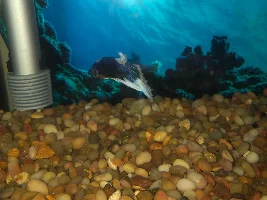
Three Spinned Sticklebacks

Bazouteast

New Member
Joined
Jul 11, 2012
Messages
45
Reaction score
25
Location
GB
Does anyone have detailed knowledge of keeping this species in an indoor coldwater aquarium? I'm looking to keep a small group, perhaps with a view to breeding. Need advice on lighting, filtration, substrate, feeding and what debris to put into the tank to facilitate nest-building.
Thanks in advance.
 
They look like a fun fish to keep and breed. I don't know much about them apart from what I've seen online and on Springwatch. (Spineless Si)

From what I've seen. A single male in a tank is a good idea since they are feisty little guys (females added for breeding). Substrate-wise, fine sand and lots of debris/mulm. Moss could be a good idea too.

This video is a small insight into the species. I noticed it looks like they have sponge filters in the stickleback tanks.


I'm interested to see if any other members have kept them too.
One of my LFS used to sell them out of a 6ft tank kept outside all year. Missed opportunity on my part ;)
 
Thank you for responding. Yes, I well remember the trials of poor old Spineless Si on Springwatch, and the repeated destruction of his nests. I think fish don’t get a fair slice of the Springwatch action, especially as it takes place in the middle of the spawning season. Its difficult to film, but there are ways. The Avon Roach Project for example has spawning boards, which are easily filmed, and tonight Springwatch had a presenter and a cameraman sitting in the rain in a back garden for over 6 hours. We need more fish on Springwatch!

Thanks for the video link. There is some good info in there. Advice on substrate and filters, for starters. Like you, I'm keen to hear from other people on this.
Thanks again. Much appreciated.
Baz.

 
IMG_1556.jpeg
IMG_1555.jpeg
 
Nice book you got there, @Back in the fold !
Exotic Aquarium Fishes by Dr. William T. Innes has information on everything . I refer to it constantly . A book which belongs on the shelf of every aquarist . I’ve always liked his last sentence in the Stickleback description . It conjures up an image in my mind of him that I like .
 
I wish I could add more. They are known locally as picks, and a Finnish kid I grew up with used to sneer at my guppies because he kept only sticklebacks. It's a neat fish I always planned to try and never got around to. Every local baitshop sold them cheaply, by the dozen, and every time I fished for natives there was a chance they'd be the catch. Good luck with them!
 
Thanks all for the feedback, and to Back in the fold, for sending the Innes extract. I really didn't think of looking there - I have a beautifully bound 1947 edition, which is exactly per your posting! Thanks for waking me up!
 
Sticklebacks have always been a fish I would love to have . I had a book in grade school that had a lengthy article with pictures about them and they fascinated me and still do . Alas , I have never encountered them . A pretty fish with a very interesting spawning method .
 
What surprised me was Sticklebacks sometimes move into the sea, and can survive perfectly well in brackish water. I know people who keep and breed them in a garden pond, so they obviously don't NEED to go to sea, but I wonder if they are perhaps naturally migratory?
 
What surprised me was Sticklebacks sometimes move into the sea, and can survive perfectly well in brackish water. I know people who keep and breed them in a garden pond, so they obviously don't NEED to go to sea, but I wonder if they are perhaps naturally migratory?
See the Stickleback entry in Innes's book posted above. Yes. They inhabit 'brackish and freshwater coastal waters' on both the Atlantic and Pacific coasts.
 
That's quite exciting. If I manage to raise some Sticklebacks, I'll need to take a drive to the Thames Estuary to release them. Pretty cool! When I asked AI about Stickleback migration, this was the response -

Yes, three-spined sticklebacks (Gasterosteus aculeatus) can be migratory — but it depends on the population.
There are two main types:

  1. Anadromous (migratory) sticklebacks:
    These populations live in the sea but migrate to freshwater to breed, much like salmon. They're commonly found in coastal regions and estuaries.
  2. Resident (non-migratory) sticklebacks:
    These live entirely in freshwater or entirely in marine environments, depending on where they evolved. Freshwater resident populations, like those from isolated ponds or lakes, do not migrate.
Key differences:
  • Anadromous sticklebacks tend to be larger, more streamlined, and heavily armored.
  • Freshwater residents are often smaller and have reduced armor due to different selective pressures (like lower predation in isolated habitats).
If your sticklebacks are captive-bred from a freshwater pond, they are almost certainly non-migratory.
 
Today I received 7 x 1" three-spined sticklebacks (Gasterosteus aculeatus). I know they are carnivors, but does anyone have experience of feeding small sticklebacks? I'm thinking brine shrinp and white worms, and maybe chopped bloodworm. I think Daphnia and Mozzy larvae might be too large.
 
Nice to see you got them! Interested to see their behaviour and what environment you make for them :)

as for food Microfuana and brineshrip is my best guess
 
Last edited:

Most reactions

Back
Top