Still Has Worms..

mbsqw1d

Fish Aficionado
Tank of the Month 🏆
Joined
Jul 28, 2009
Messages
3,083
Reaction score
3,076
Points
113
Location
UK
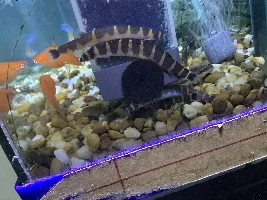
Hey, Wilder helped me alot last time I posted with this. I can actually see 2 small red threads (worms) protruding from one of my Bolivian Ram's anus.. again! I have a sand substrate and so once I treated the first time (with levimisole) and did the clean-up (to try and remove worms and eggs from the bottom) it was hard to say if I actually sucked up any worms or not.. theyre kinda hard to see. Would you guys be suprised that my Ram is still alive since being infected with these worms from day one? (Had him about 3-4 months now)

The worms have only just become visible again since the last treatment.. however his poo has never improved from the stringy/inconsistent stuff. I feed cooked/shelled peas every so often. I added a few new live plants recently.. could the worms arrive on these??
 
I would redose the levaimsole.
Did you retreat for camallanous worms last time.

Also once you treat with levaimsole you are meant to back up with a bacterial med afterwards.

I suppose they could come into a tank with live plants. That's why its best to steralise them.
 
yeh i decided they were Callamanus and treated with Levimisole. But Levimisole works by making the worms 'unconcious' - and doesnt acyually kill them. Thats why thoroughly cleaning up after treatment is important. But with sand I'm finding that difficult. I reckon my option is going to be setting up a hospital tank and hope that only the Rams are carrying the worms. I have only used Melafix (well.. melafake) afterwords.. although its not exactly an anti-bacterial med. Whats the general/common anti bacterial used in aquariums?
 
The only other option really is to remove the sand so you can get to the worms.

Medicated food.
Or maracyn plus, or maracyn one and two.

Get you some info.


Camallanus


Symptoms:

When the fish is stationary, deep red worms can be seen protruding from the anal pore. They are only visible when the fish is still because the worms retreat into the intestine at the fish�s slightest movement. Other signs may include an inflamed and enlarged anus. In severe infestations, the fish may become emaciated and spinal curvature may also occur.


Cause:

The parasitic worms Camallanus Cotti and Camallanus lacustris. These small, livebearing parasitic worms attach to the intestinal walls and rectum with pinchers. The worm�s grip is so tight that any attempts to remove it forcibly will rip away tissue from the intestinal wall. The worm�s pinching causes ischemia (reduced blood flow) to that part of the intestine. In time, the tissue to that part of the intestine will die, at which time the worm will migrate to another part of the intestine. This causes perforations throughout the intestine, which allows other pathogens to gain entry. If the fish is not treated, either the parasite or bacterial will kill the fish. Camallanus infestations occur most often in livebearing fish such as Guppies and Mollies, though infection is possible in all fish. Camallanus infestations are contagious. All fish, including those not yet showing visible symptoms, as well as the aquarium, should be treated.


Treatment:

Treat with Internal Parasite Guard, Pipzine, Disco-Worm, Trichlorfon or Fluke-Tabs as well as a medicated food to prevent a bacterial infection.
 
ok.. if Callamanus worms ALWAYS retreat when the fish moves.. then they dont have them. :blink:
 
ok.. if Callamanus worms ALWAYS retreat when the fish moves.. then they dont have them. :blink:

I thought my ram had callamanus worms when I first got him. I fed him blood worms the day before. Thats when he showed the little red "worms" protruding from his anus. Wilder gave me the exact same piece of information. And after reading that they retreat when the fish moves, I figured that my ram didnt have them. So, just to be safe, I popped a few of those garlic soft gel pills, and soaked his food in them, as it is supposed to weaken parasites. I did this for about a week. Then I went back to feeding him regular flake food.

I still believe to this day that it was the shape of the blood worms that made it look like he had callamanus. After this, I started to crush up his blood worms (they were freeze-dried) and mix them with his flake food. I never saw the "worms again."
 
ok.. if Callamanus worms ALWAYS retreat when the fish moves.. then they dont have them. :blink:

I thought my ram had callamanus worms when I first got him. I fed him blood worms the day before. Thats when he showed the little red "worms" protruding from his anus. Wilder gave me the exact same piece of information. And after reading that they retreat when the fish moves, I figured that my ram didnt have them. So, just to be safe, I popped a few of those garlic soft gel pills, and soaked his food in them, as it is supposed to weaken parasites. I did this for about a week. Then I went back to feeding him regular flake food.

I still believe to this day that it was the shape of the blood worms that made it look like he had callamanus. After this, I started to crush up his blood worms (they were freeze-dried) and mix them with his flake food. I never saw the "worms again."

brilliant! thanks betta boy. Gonna give some good old garlic a go for a while! I think Callamanus are probably quite nasty and my fish should be dead by now. I too feed frozen blood worm on occasion. Im starting to think theyre not Callamanus... I hope! -yeah, gonna try some garlic. thanks again
 

Most reactions

Back
Top