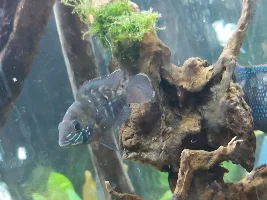
Red dot on young and baby lampeyes

confused_aquarist

Fish Fanatic
Joined
Oct 2, 2024
Messages
122
Reaction score
11
Location
Tokyo
I almost feel ashamed because I've had so many diseases going on in my fish tanks, but I'm still curious to know what's the issue.

Lately I've seen red dots on (in??) lampeye fry and younger juveniles and I'm mystified as to what they are.
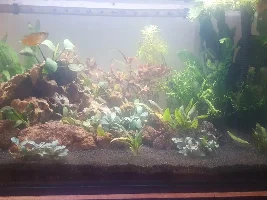
They are in a 90L tank, it has 5 adults and 18 fry, and usually each fry with the disease has only 1 dot, pin-sized.
Sometimes its under the skin, sometimes it's on the skin either sitting on it or protruding out, sometimes it's on the gill area, sometimes it's inside the brain (and when it's inside the brain, they have fast respiration rate).
I've had maybe 8 or 9 of the fry affected with it.
Only 1/8 from my initial batch had it. Most out of the 10 fry from the 2nd batch has had it.
(The fry are transparent, so it's very easy to observe them but I feel that the dots could also be in the adults just that I can't see them.)
I am growing the fry in 2L breeder boxes connected to the main tank. The dots also appear after I transfer the fry to the main tank.
Usually, the dot goes away within a week. I haven't lost any fish to it yet.

The main tank has no ammonia, a good amount of water flow and a lot of filtration. Plants are growing fine and there is no algae.
It seems to be related to biofilms, because when I wipe away the biofilms the red dots seem to go away faster.

Edit: Also I don't know if this info would be helpful but the recovery is always gradual, happening slowly within 2 or 3 days. So it probably couldn't be one sudden rupture or 1 worm, for example. It looks more like a capillary rupture more than anything else. I haven't seen any of them flash even when the dot is outside.
 
Last edited:
The first question, from curiosity, is what species of lampeye? There are dozens.

That's a weird observation I have never read before. Lucky you, you're seeing something distinctive... I would guess a parasite that also resides in biofilm - something similar in lifestyle to Epistylis, but that's a guess.
 
pictures and video of the fish?
It appears again, here is the video.
[https://jumpshare.com/s/KAwIxmNbMDBrXlCQEQbh]

Because the video quality is very poor, I have to describe: there is a red dot after the swim bladder, this time it’s internal and same size as the eye. It has no influence on breathing, behavior, etc.

The container looks dirty but actually it’s very clean, only it has a lot of scar due to old age. The Norman lampeye is 2 month old
 
Last edited:
The first question, from curiosity, is what species of lampeye? There are dozens.

That's a weird observation I have never read before. Lucky you, you're seeing something distinctive... I would guess a parasite that also resides in biofilm - something similar in lifestyle to Epistylis, but that's a guess.
This is Norman’s lampeye. Actually at first I thought it’s a worm or parasite, but mostly it’s internal. When it disappears it gradually fades away, almost turns pink. I asked AI and it suggests it may be septicemia. I also think the bleeding looks like in human the Ebola virus, but I have not seen more than 1 appear on the same fish. I wonder if it can be the lampeye iridovirus or fish tb tubercle somehow turns red?? When the dot appeared externally I cannot take the sample of skin because the fry was too small, and once it was in the brain and the head was swollen very big. Then it shrank again in a week. This is from wild-collected parents
 
I can't see the video, all I get when i click the link is a stupid google site for
Safe Browsing site status, whatever that means. But no video just google being ducks.
 
I can't see the video, all I get when i click the link is a stupid google site for
Safe Browsing site status, whatever that means. But no video just google being ducks.
Actually, it seems if you click on the link it just directs you to a different site.
It worked when I copy and pasted the URL to the address bar.

It's such horrible quality anyway, but you could see a dot right behind the swimbladder. It seems like a blister more than anything else except it's under the skin, at least certainly not external.
 
It could be a blood spot or a parasitic worm. The blood spots are like a blood blister we get. The parasitic worms can appear as red, brown or black spots anywhere on the body. If it's the worm they don't normally do anything and just live there until they die. Blood spots can clear up or stay, but they don't normally cause problems. If you notice the red spots are increasing in number, then it's time to worry.
 
It could be a blood spot or a parasitic worm. The blood spots are like a blood blister we get. The parasitic worms can appear as red, brown or black spots anywhere on the body. If it's the worm they don't normally do anything and just live there until they die. Blood spots can clear up or stay, but they don't normally cause problems. If you notice the red spots are increasing in number, then it's time to worry.
Okay. It’s just that when so many fry suddenly get affected with the same thing, at the worst 3-4 fry in the same container, only in the fry of this species in this tank, it would make you think that there were some reasons behind the blister. (Which I may never know)
I almost feel sorry for them for not being able to track down the reason, I thought it was the biofilm so I cleaned the filter and wiped glass and now there’s almost no biofilm for 2 weeks and the dot still appears again. I think it helped a little, probably the biofilm overwhelms their immune system. At least it doesn’t seem to recur in the same fry or I would think the same susceptible individual would get it over and over again, it’s not that but they all seem to get it.

I’d be surprised if this were a parasitic worm though; an eye-sized ball literally appeared overnight when there was nothing there before. I didn’t think these could be transmitted without a bird host.
 
The parasitic worm eggs are get washed into waterways and ingested by the fish. The worms don't normally live in fish and get lost in the fish's body and that's where they end up living (usually in the muscle tissue somewhere). The worm eggs usually come from livestock (sheep, goats, pigs). If you are using chlorinated tapwater that has been treated to remove the chlorine/ chloramine, then it's unlikely to be worms. If you use river or creek water then it could be worms.

Bloodspots shouldn't occur in all the fry and usually only appear randomly in 1 or 2 fish. They are quite uncommon but can occur. If you are handling the fry, you could be damaging them and causing the spots through physical damage. If you aren't handling the fry or eggs, then it's unlikely (not impossible but very unlikely) to be bloodspots.

If you can get some clear pictures it should help us try to work out what is going on. If you make videos, upload them to YouTube, then copy & paste the link here. If you use a mobile phone to film the fish, hold the phone in landscape mode.

Actual pictures can be uploaded directly to the forum. Check pictures and video on your computer to make sure they clearly show the issue, then upload them here.

Do the fry lose the red spots and are any of them dying?
 
The parasitic worm eggs are get washed into waterways and ingested by the fish. The worms don't normally live in fish and get lost in the

I am sorry, I have tried to take better pictures and video, but because my phone is very poor quality I cannot film a video that is higher quality than the previous one. I have drawn a picture for the spot, it's looks better than the video. I have attached it, and I have replicated the shape, color, and size of the spot exactly. The big circle is the swim bladder and it shows in relative to the swim bladder where the spot is. The spot is not deeply embedded and appear to be directly under the skin, but not external.

I use dechlorinated tap water, also the spot has appeared in 9 or 10 fry out of 18. None of the fry died and they all recovered in around 3 days, then the spot completely disappears after a week.

Update on this individual: the spot is fading away.
Update on the individual with brain swell: Even though the brain swell recovered many weeks ago, its head remained slightly bigger than normal. Today it develops pop-eye. I have isolated this fry and treated with kanamycin, feeding 10-20 bbs a day (it's only ~1 month old). It's isolated in a non-aerated 1L container. Is there anything else that I can do to help relieve the pressure build up? ex. Adding salt, etc.
Poor thing! It has appetite, but its breathing is very heavy and weak..
 

Attachments

  • スクリーンショット 2025-09-24 14.25.31.png
    スクリーンショット 2025-09-24 14.25.31.png
    178 KB · Views: 48
Last edited:
The location of the red mark could relate to poop and the fish are getting some pigment in the area, which causes the colour to disappear after a week.

I don't know anything about the fish with the swollen head. Is that from another thread or did I miss it in this thread?

If a baby fish is sick and has trouble breathing then euthanise it.
 
The location of the red mark could relate to poop and the fish are getting some pigment in the area, which causes the colour to disappear after a week.

I don't know anything about the fish with the swollen head. Is that from another thread or did I miss it in this thread?

If a baby fish is sick and has trouble breathing then euthanise it.
Ah, but there are also other locations of the spot like in the picture. When it was found in the brain its head was swollen. I think it's the same disease. (But, the color is indeed the same as poop.)
Because I think the fry may be saved, I want to see if it can be treatable by antibiotic. The disease may not be completely eradicated and can come back later so I want to establish the treatment.

The fry with swollen head is in the same thread. What I'm also sort of wondering is if this is what's commonly seen during tubercle formation in fish TB. I know that mycobacteria infect immune cells and they gather to one spot to form a wall. I don't know if there's blood vessel rupture or dilation to help increase immune cell recruitment to that one spot, or if red blood cells also infiltrate there. The pop-eye or brain symptom would certainly be consistent with a tubercle being there.
 

Attachments

  •  2025-09-24 16.40.03.png
    2025-09-24 16.40.03.png
    191.6 KB · Views: 38
  •  2025-09-24 16.41.37.png
    2025-09-24 16.41.37.png
    193.3 KB · Views: 45
  • 2025-09-24 16.42.00.png
    2025-09-24 16.42.00.png
    192.7 KB · Views: 44
  • 2025-09-24 16.46.25.png
    2025-09-24 16.46.25.png
    188.3 KB · Views: 44
Last edited:
It's unlikely to be TB in baby fish. The Mycobacteria take a long time (3 months or more) to grow big enough to form a granuloma and they aren't red in colour, they tend to be more cream coloured but can take on a similar colour to the surrounding area. If it was Mycobacteria, it wouldn't disappear and the red spot would still be there months after it first appeared.

Infections in the brain can be from bacteria, protozoans or viruses, most commonly protozoan.

There might be a predator in the aquarium. Something like an argulus (fish louse), or a predatory aquatic insect that is attacking the fish and leaving a red blood spot type of sore.
Are there many plants in the tank? If yes, the insect pest could be hiding in there.
 
It's unlikely to be TB in baby fish. The Mycobacteria take a long time (3 months or more) to grow big enough to form a granuloma and
I see. That is actually what I thought, they are too young to be so ill from fish TB. But, I don't think it's a coincidence for multiple disease to appear one by one, I think it's the same disease.

I will try to dissect the fish if it cannot be rescued (though I am not a fan), maybe it can be protozoan or microsporidia.
I have no plant in the tank, it's a breeder box, the plants in the main tank are all tissue culture.
 

Most reactions

Back
Top